Tag Archives: Year 12 Specialist Mathematics

Simple Harmonic Motion Question

An object in simple harmonic motion passes through the central point x=0x=0 at time t=0t=0 and every second thereafter.

Find an equation for the motion ifv(0)=−4.v(0)=-4.

Because the particle passes through the central point x=0x=0 when t=0t=0, it is natural to use a sine function:x=Asin⁡(ωt).x=A\sin(\omega t).

The particle passes through the central point every second.

However, passing through the centre occurs twice during each complete cycle — once moving in one direction and once moving in the other.

Therefore, the time from one central crossing to the next is half a period:T2=1.\frac{T}{2}=1.

Hence,T=2 seconds.T=2\text{ seconds}.

For simple harmonic motion,ω=2πT.\omega=\frac{2\pi}{T}.

Since T=2T=2,ω=2π2=π.\omega=\frac{2\pi}{2}=\pi.

Our equation is thereforex=Asin⁡(πt).x=A\sin(\pi t).

We still need to determine AA.

For simple harmonic motion,

v^2=k^2(A^2-x^2)

When t-0, x=0 and v=-4

16=\pi^2(A^2-0)

A=\frac{4}{\pi}

Hence,

x(t)=\frac{4}{\pi}sin(\pi t)

Leave a Comment

Filed under Rectilinear Motion, Simple Harmonic Motion, Trigonometry, Year 12 Specialist Mathematics

Partial Fractions

Integration Using Partial Fraction Decomposition

Partial fraction decomposition is the process of taking a rational function and decomposing it into simpler rational expressions which are easier to integrate.

We only use partial fractions if the rational function is proper. If

f(x)=\frac{p(x)}{q(x)}

then the degree of p(x) must be less than the degree of q(x).

Types of Partial Fraction Decompositions

FactorTerm in Partial Fraction
ax+b\frac{A}{ax+b}
(ax+b)^n

    \[ \frac{A_1}{ax+b} + \frac{A_2}{(ax+b)^2} +\cdots+ \frac{A_n}{(ax+b)^n}\]

Irreducible quadratic
ax^2+bx+c

    \[ \frac{Ax+B}{ax^2+bx+c} \]

Example

    \[ \int \frac{3x+5}{x^2-x-2}\,dx \]

Find

Factorise the denominator:

    \[ x^2-x-2=(x-2)(x+1) \]

Write

    \[ \frac{3x+5}{(x-2)(x+1)} = \frac{A}{x-2} + \frac{B}{x+1} \]

Multiplying through by

(x-2)(x+1):

    \[ 3x+5=A(x+1)+B(x-2) \]

Let x=-1:

    \[ 2=-3B \]

    \[ B=-\frac23 \]

Let x=2:

    \[ 11=3A \]

    \[ A=\frac{11}{3} \]

Hence

    \[ \frac{3x+5}{x^2-x-2} = \frac{11}{3(x-2)} - \frac{2}{3(x+1)} \]

Integrating:

    \[ \int\frac{3x+5}{x^2-x-2}\,dx = \int \left( \frac{11}{3(x-2)} - \frac{2}{3(x+1)} \right) dx \]

    \[ = \frac{11}{3}\ln|x-2| -\frac23\ln|x+1| +C \]

Example

Find

    \[ \int\frac{3x+2}{(x-1)^2}\,dx \]

Write

    \[ \frac{3x+2}{(x-1)^2} = \frac{A_1}{x-1} + \frac{A_2}{(x-1)^2} \]

Multiplying through by (x-1)^2:

    \[ 3x+2=A_1(x-1)+A_2 \]

Let x=1:

    \[ 5=A_2 \]

Let x=0:

    \[ 2=-A_1+5 \]

    \[ A_1=3 \]

Therefore

    \[ \int\frac{3x+2}{(x-1)^2}\,dx = \int \left( \frac3{x-1} + \frac5{(x-1)^2} \right) dx \]

    \[ = 3\ln|x-1| -\frac5{x-1} +C \]

Example

Find

    \[ \int \frac{2x-5} {(x-1)(x^2+1)} \,dx \]

Write

    \[ \frac{2x-5} {(x-1)(x^2+1)} = \frac{A}{x-1} + \frac{Bx+C}{x^2+1} \]

Multiplying through:

    \[ 2x-5 = A(x^2+1) + (Bx+C)(x-1) \]

Let x=1:

    \[ -3=2A \]

    \[ A=-\frac32 \]

Let x=0:

    \[ -5=-\frac32-C \]

    \[ C=\frac72 \]

Let x=-1:

    \[ -7=-3+\left(-B+\frac72\right)(-2) \]

    \[ -4=2B-7 \]

    \[ B=\frac32 \]

Hence

    \[ \int \frac{2x-5} {(x-1)(x^2+1)} \,dx = \frac12 \int \left( -\frac3{x-1} + \frac{3x}{x^2+1} + \frac7{x^2+1} \right) dx \]

    \[ = \frac12 \left( -3\ln|x-1| +\frac32\ln(x^2+1) +7\arctan(x) \right) +C \]

    \[ = -\frac32\ln|x-1| +\frac34\ln(x^2+1) +\frac72\arctan(x) +C \]

Leave a Comment

Filed under Algebra, Integration, Polynomials, Year 12 Specialist Mathematics

Logistic Growth Worked Example

A brumby is a free-roaming wild horse found in large number in parts of Australia. The culling of brumbies was banned in the year 2000. At this time the estimated population of brumbies in
Kosciuszko National Park was 1600. Scientists have modelled the population, P(t), of brumbies in
Kosciuszko National Park t years since the ban, by

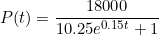
    \begin{equation*}P(t)=\frac{18000}{10.25e^{0.15t}+1}\end{equation}

(a) Use the model to determine how long it will take the brumbies to increase to a number that is triple the number when the ban came into effect.

(b) From this model, determine the estimated long run number of brumbies in Kosciuszko National Park.

It can be shown that the growth rate of the population of brumbies can be expressed as

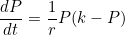
    \begin{equation*}\frac{dP}{dt}=\frac{1}{r}P(k-P)\end{equation}

(c) Determine the values of the constants r and k.

(d) Determine the greatest growth rate for the population of brumbies.

ATAR 2024 Specialist Mathematics Question 13

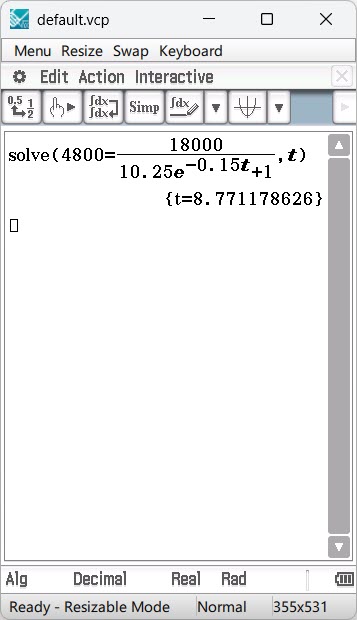
(a) 1600\times 3=4800
4800=\frac{18000}{10.25e^{0.15t}+1}
t=8.8 years.

(b) \lim_{\limits_{t \to \infty}\frac{18000}{10.25e^{0.15t}+1}=18000

(c)k is the carrying capacity (long run number of Brumbies), therefore k=18000.
Remember,

    \begin{equation*}\frac{dP}{dt}=rP(k-P)\Longleftrightarrow P=\frac{KP_0}{(k-P_0)e^{-rkt}+P_0}\end{equation}

We have \frac{1}{r} instead of r.

Therefore,

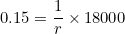
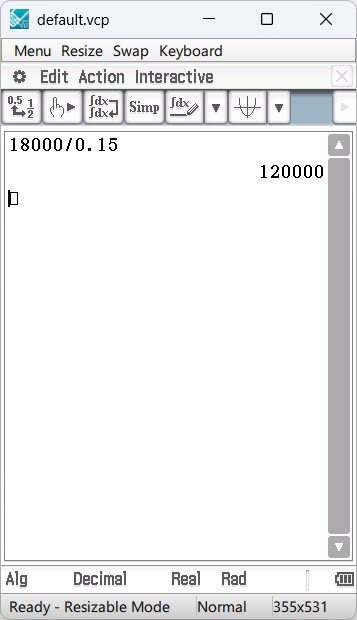
    \begin{equation*}0.15=\frac{1}{r}\times 18000\end{equation}

r=120000

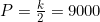
(d) The greatest growth rate occurs when P=\frac{k}{2}=9000

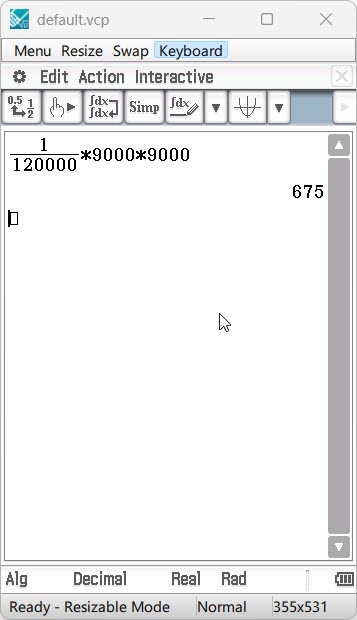
    \begin{equation*}\frac{dP}{dt}=\frac{1}{r}P(k-P)\end{equation}

    \begin{equation*}\frac{dP}{dt}=\frac{1}{120000}(9000)(9000)\end{equation}

The greatest growth rate is 675 Brumbies per year.

1 Comment

Filed under Differential Equations, Logistic Growth, Year 12 Specialist Mathematics

Integrating by Trigonometric Substitution

Integrating by using a trigonometric substitution can be quite trick for some students.

For example, this question from OCR 4726 June 2009 Question 6

Trig Substitution Notes

PDF version of the above solution

Leave a Comment

Filed under Integration, Trigonometric Substitution