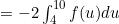
Ellipses appear in both complex loci and vector calculus.

We are going to use calculus (integration) to derive the formula for the area of an ellipse. The equation of an ellipse is
$$ \frac{x^2}{a^2}+\frac{y^2}{b^2}=1. $$Our aim is to find the area under the upper half of the ellipse and then double the result to obtain the total area.
Rearrange the equation to make \(y\) the subject.
$$ \frac{y^2}{b^2}=1-\frac{x^2}{a^2} $$ $$ y^2=b^2\left(1-\frac{x^2}{a^2}\right) $$ $$ y=\pm b\sqrt{1-\frac{x^2}{a^2}}. $$We only need to consider the positive branch.
$$ y=b\sqrt{1-\frac{x^2}{a^2}}. $$The area of the upper half of the ellipse is
$$ A=\int_0^a b\sqrt{1-\frac{x^2}{a^2}}\,dx. $$Let
$$ x=a\sin\theta. $$Then
$$ dx=a\cos\theta\,d\theta. $$When \(x=0\), \(\theta=0\), and when \(x=a\), \(\theta=\frac{\pi}{2}\).
The integral becomes
$$ A =ab\int_0^{\pi/2}\cos^2\theta\,d\theta. $$Remember the trigonometric identity
$$ \cos^2\theta=\frac{1+\cos(2\theta)}{2}. $$Hence,
$$ A =\frac{ab}{2}\int_0^{\pi/2}\left(1+\cos(2\theta)\right)\,d\theta. $$ $$ =\frac{ab}{2}\left[\theta+\frac{1}{2}\sin(2\theta)\right]_0^{\pi/2} $$ $$ =\frac{ab}{2}\left(\frac{\pi}{2}\right) $$ $$ =\frac{\pi ab}{4}. $$This is the area of one quarter of the ellipse. Therefore, the total area of the ellipse is
$$ 4\times\frac{\pi ab}{4}=\boxed{\pi ab}. $$


 is
is



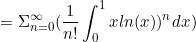
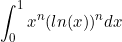
 then
then  and
and  where
where 
 and when







 or
or  the differentiation column is zero except for
  ,
, ![\int_0^1 x^n(ln(x))^n dx=\frac{e^{(n+1)u}}{(n+1)^{n+1}}}]_{-\infty}^0](https://www.racquelsanderson.com/wp-content/ql-cache/quicklatex.com-386585ef2bf24a7da966b3d35fc4ad72_l3.png "Rendered by QuickLaTeX.com")
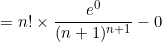

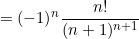



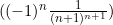



 is continuous everywhere and that
  , find: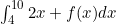
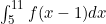
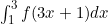
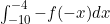

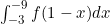
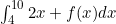

![(x^2]_4^{10} + (-10)](https://www.racquelsanderson.com/wp-content/ql-cache/quicklatex.com-7bea7635f96fcfb2748ee44e7a6a45b3_l3.png "Rendered by QuickLaTeX.com")


 and when


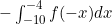


 and when
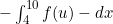


 and when


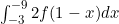

 and when