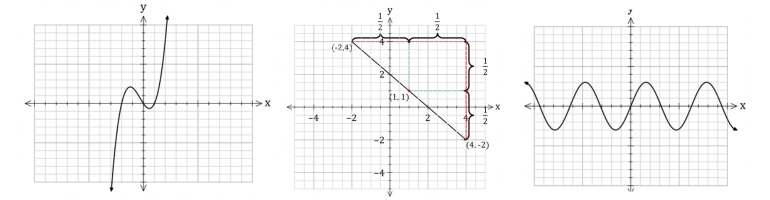
Ellipses appear in both complex loci and vector calculus.

We are going to use calculus (integration) to derive the formula for the area of an ellipse. The equation of an ellipse is
$$ \frac{x^2}{a^2}+\frac{y^2}{b^2}=1. $$Our aim is to find the area under the upper half of the ellipse and then double the result to obtain the total area.
Rearrange the equation to make \(y\) the subject.
$$ \frac{y^2}{b^2}=1-\frac{x^2}{a^2} $$ $$ y^2=b^2\left(1-\frac{x^2}{a^2}\right) $$ $$ y=\pm b\sqrt{1-\frac{x^2}{a^2}}. $$We only need to consider the positive branch.
$$ y=b\sqrt{1-\frac{x^2}{a^2}}. $$The area of the upper half of the ellipse is
$$ A=\int_0^a b\sqrt{1-\frac{x^2}{a^2}}\,dx. $$Let
$$ x=a\sin\theta. $$Then
$$ dx=a\cos\theta\,d\theta. $$When \(x=0\), \(\theta=0\), and when \(x=a\), \(\theta=\frac{\pi}{2}\).
The integral becomes
$$ A =ab\int_0^{\pi/2}\cos^2\theta\,d\theta. $$Remember the trigonometric identity
$$ \cos^2\theta=\frac{1+\cos(2\theta)}{2}. $$Hence,
$$ A =\frac{ab}{2}\int_0^{\pi/2}\left(1+\cos(2\theta)\right)\,d\theta. $$ $$ =\frac{ab}{2}\left[\theta+\frac{1}{2}\sin(2\theta)\right]_0^{\pi/2} $$ $$ =\frac{ab}{2}\left(\frac{\pi}{2}\right) $$ $$ =\frac{\pi ab}{4}. $$This is the area of one quarter of the ellipse. Therefore, the total area of the ellipse is
$$ 4\times\frac{\pi ab}{4}=\boxed{\pi ab}. $$
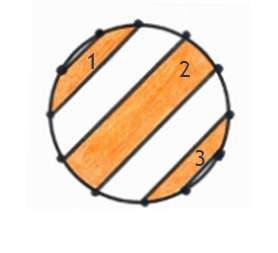
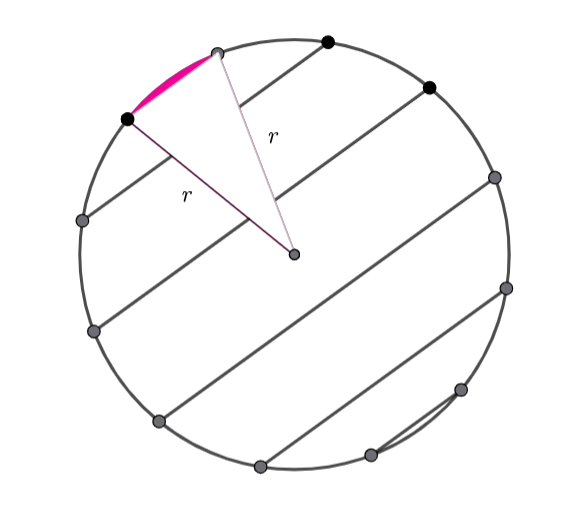
 and
and  have the same area.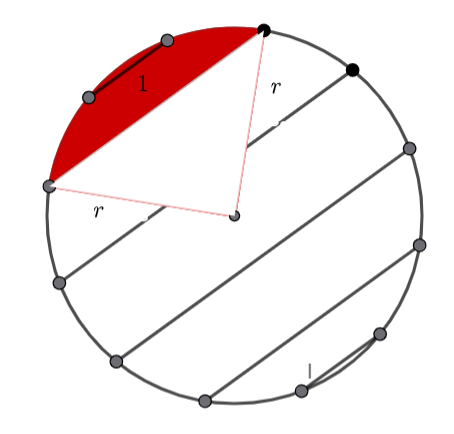

 where the angle measurement is in radians.


 equation
  .
.
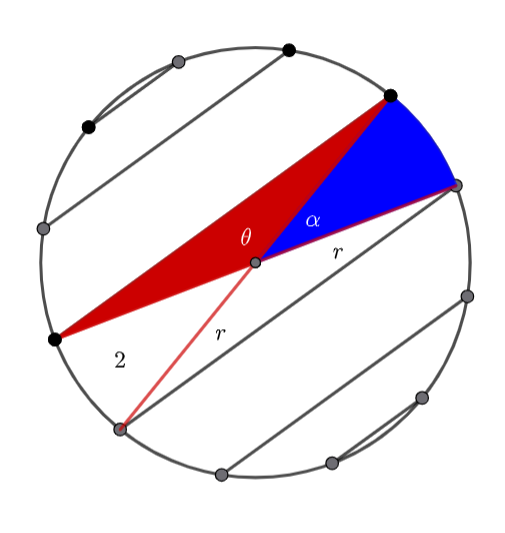





 and
and  subtract the sector
  .
.



 where
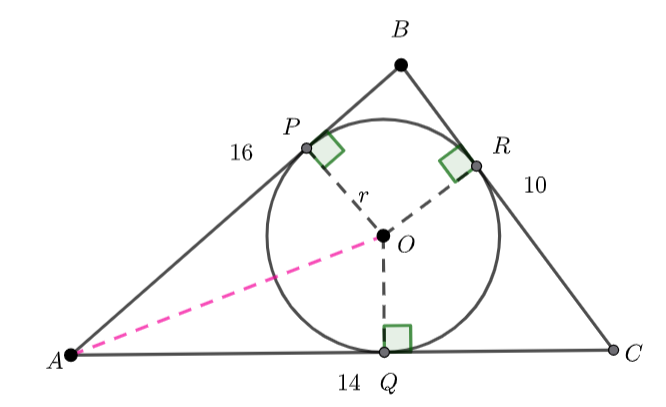
where  is the radius of the inscribed circle.
 and
and 
 , and
, and  – tangents to a circle are congruent.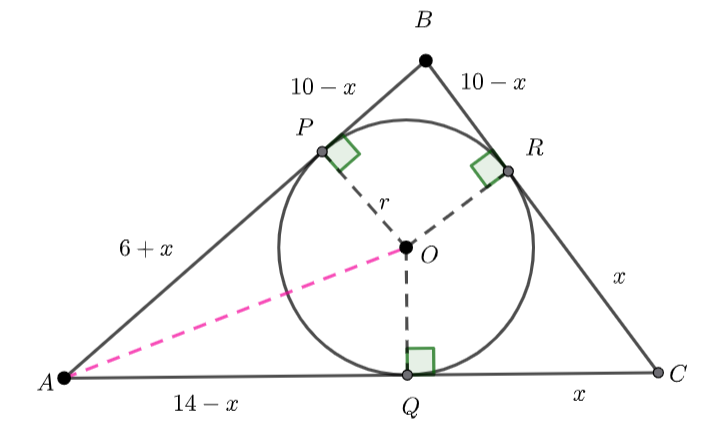




 Area
Area 
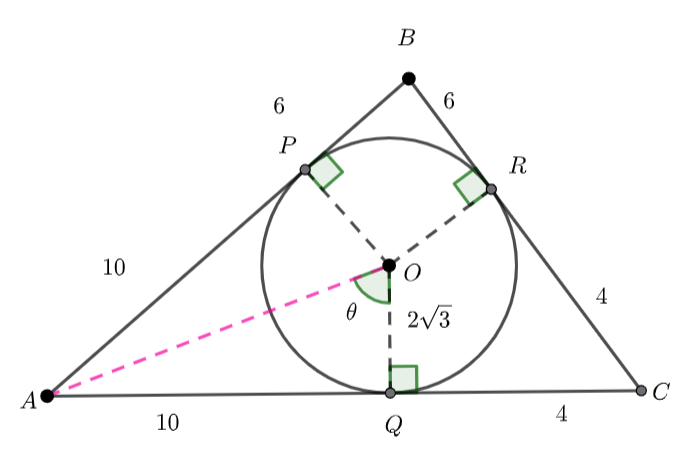
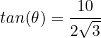





 is the semi-perimeter,
  and
and  are tangents to the circle. And the radii are perpendicular to the tangents.
 and
and  .
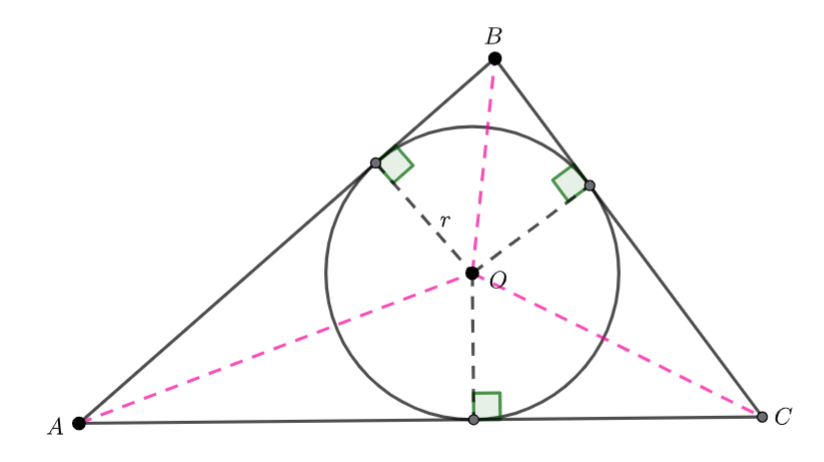
.
 and
and  .
.





 .
.


 anti-clockwise.



 – the area of
 because the diagonal of a square bisects the angle.
 is a right angle as it’s on a straight line with the vertex of a square.
 and
and  , hence



 . The larger bed has twice the perimeter of the smaller and the larger side of the smaller bed is equal to the smaller side of the larger bed. If the two beds are not similar, and if all edges are a whole number of metres, what is the length, in metres, of the longer side of the larger bed?







 and
and  )
)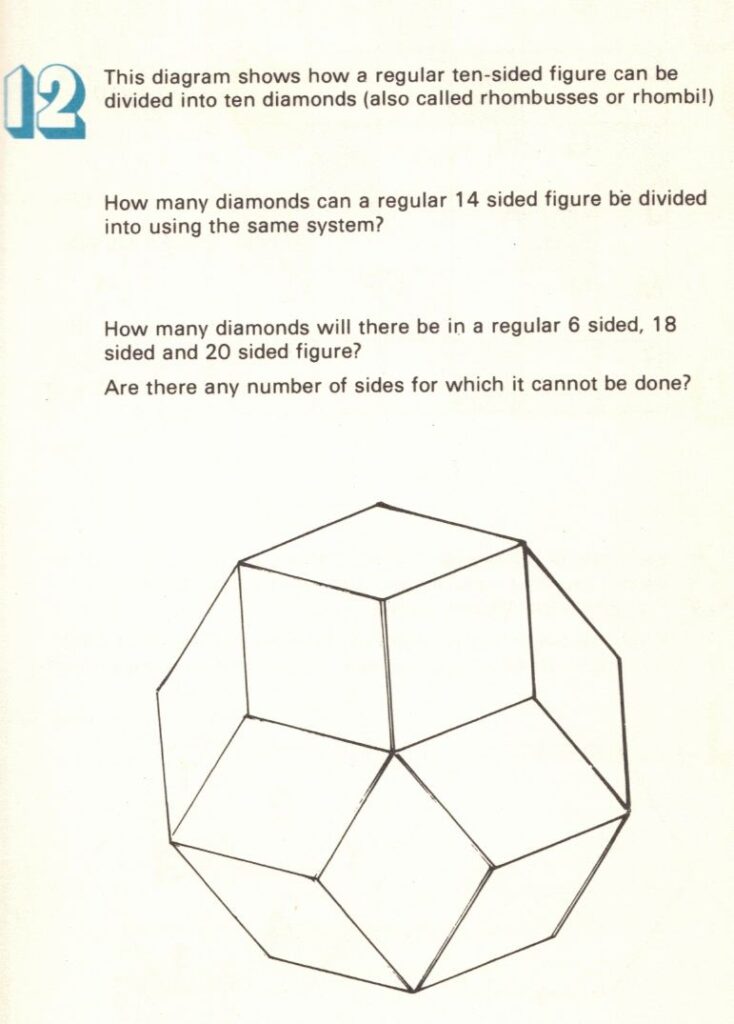
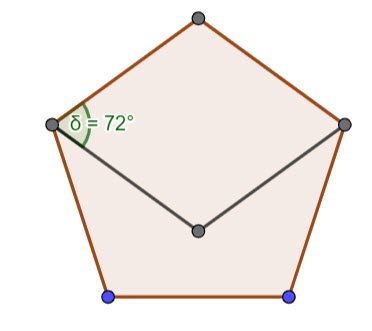
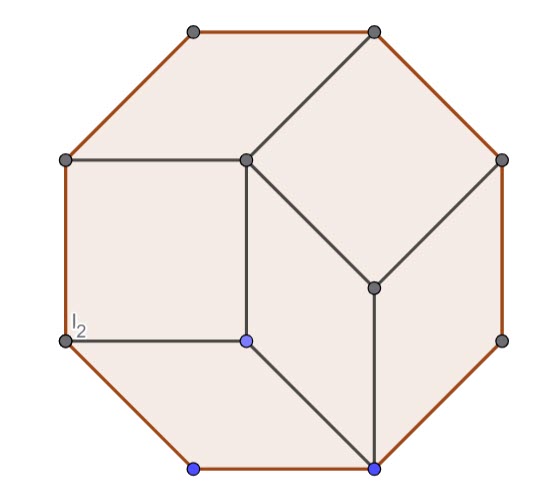
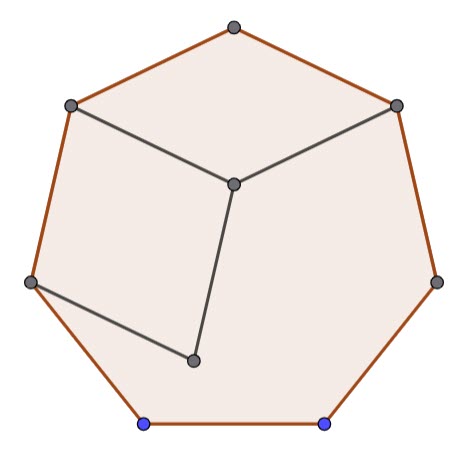
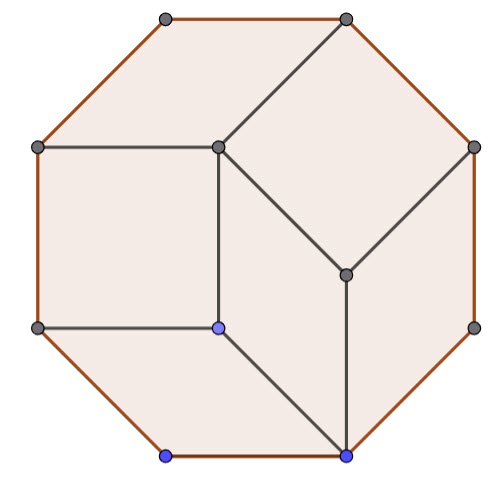

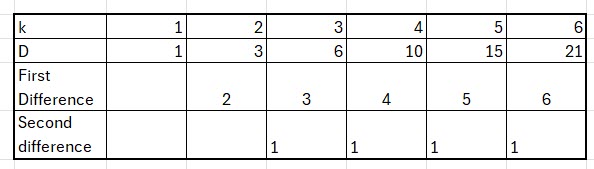
 the number of diamonds is
  , and for
  it’s
it’s  .
. in terms of
  and then combine the two equations.




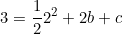


 into equation
 , therefore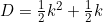





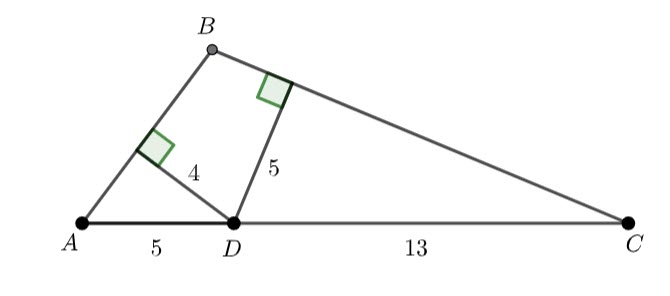

 and
and 
 is a cyclic quadrilateral and
  is the diameter. I am not sure if this is useful, but it is good to notice.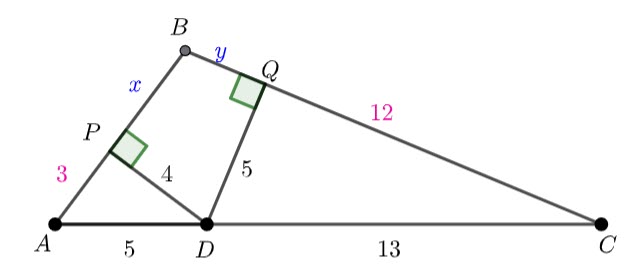





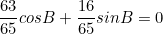



 then
then