The particle  is moving with velocity
 metres per second from its initial point with position vector
 metres. The particle
 is moving with velocity
 metres per second, where
 is a constant. At
 seconds, where
 , particle passes through the point with position vector
 metres, where
 is a constant.
Both particles start their motion at the same time, the paths of the particles are perpendicular, and the paths of the particles intersect at point  .
(a) Determine the position vector of .
The paths of particles P and Q are perpendicular, so the dot product of their velocity vectors is zero:



The position vectors are
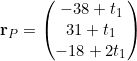
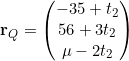
Solve simultaneously:


Equation 1 subtract equation 2:


Substitute  into equation 1:


Hence, the position vector of A is

(b) Determine the value of and the value of so that the particles and will collide
The  -component of A is 10, therefore



For the two particles to collide,

Particle Q is at the point  at time , and it is at point
 11 seconds later. Both particles start at the same time, hence

Both particles arrive at A at 14 seconds.
Particle  is moving with constant velocity
 so that its path is perpendicular to both paths of particles and .
(c) Determine the speed of particle , correct to 0.001 metres per second
As  is perpendicular to and , the vector must be parallel to
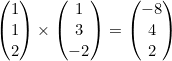
Using the given -component of ,


Therefore,
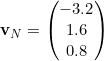
and the speed of particle is

