Category Archives: Simultaneous Equations

3D Vector Motion Question

The particle P is moving with velocity v_{P}=(1,1,2)  metres per second from its initial point with position vector (-38, 31, -18) metres. The particle Q is moving with velocity v_{Q}=(1,\lambda,-2) metres per second, where \lambda is a constant. At T seconds, where T>0, particle Q passes through the point with position vector (-35,56,\mu) metres, where \mu is a constant.

Both particles start their motion at the same time, the paths of the particles are perpendicular, and the paths of the particles intersect at point A.

(a)   Determine the position vector of A.

The paths of particles P and Q are perpendicular, so the dot product of their velocity vectors is zero:

(1,1,2)\cdot(1,\lambda,-2)=0

1+\lambda-4=0

\lambda=3

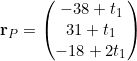
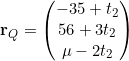
The position vectors are

\mathbf{r}_P=\begin{pmatrix}-38+t_1\\31+t_1\\-18+2t_1\end{pmatrix}


\qquad\mathbf{r}_Q=\begin{pmatrix}-35+t_2\\56+3t_2\\\mu-2t_2\end{pmatrix}

Solve simultaneously:

-38+t_1=-35+t_2

31+t_1=56+3t_2

Equation 1 subtract equation 2:

-69=-91-2t_2

t_2=11

Substitute t_2=11 into equation 1:

-38+t_1=-35+11

t_1=14

Hence, the position vector of A is

\begin{pmatrix}-24\\45\\10\end{pmatrix}

(b) Determine the value of \mu and the value of T so that the particles P and Q will collide

The \mathbf{j}-component of A is 10, therefore

\mu-2t_2=10

t_2=11

\mu=10+2(11)

\mu=32

For the two particles to collide,

t_1=t_2

Particle Q is at the point (-35,56,32) at time T, and it is at point (-24,45,10) 11 seconds later. Both particles start at the same time, hence

T=3

Both particles arrive at A at 14 seconds.

Particle N is moving with constant velocity \mathbf{v}_N) so that its path is perpendicular to both paths of particles P and Q.

(c) Determine the speed of particle N, correct to 0.001 metres per second

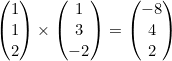
As \mathbf{v}_N is perpendicular to P and Q, the vector must be parallel to

\begin{pmatrix}1\\1\\2\end{pmatrix} \times \begin{pmatrix}1\\3\\-2\end{pmatrix}=\begin{pmatrix}-8\\4\\2\end{pmatrix}

Using the given \mathbf{j}-component of \mathbf{v}_N,

0.8=k\times2

k=0.4

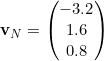
Therefore,

\mathbf{v}_N=\begin{pmatrix}-3.2\\1.6\\0.8\end{pmatrix}

and the speed of particle N is

\sqrt{(-3.2)^2+(1.6)^2+(0.8)^2}

\frac{2\sqrt{101}}{5}\approx 4.02\text{ metres per second}.

Leave a Comment

Filed under Algebra, Cross Product, Simultaneous Equations, Vectors, Year 12 Specialist Mathematics

Simultaneous Equation (or is it?)

Solve simultaneously

X+Y+Z=10
XYZ=30
XY+YZ+XZ=31

We could attempt to solve this simultaneously, but I think the algebra would be tricky.

The three equations are related to the roots of a cubic polynomial.

If the general equation of the polynomial is ax^3+bx^2+cx+d, then we know

The sum of the roots

\alpha+\beta+\gamma=\frac{-b}{a}

The product of the roots

\alpha\beta\gamma=\frac{-d}{a}

and

\alpha\beta+\alpha\gamma+\beta\gamma=\frac{c}{a}

So from our three equations we have

(1)   \begin{equation*}X+Y+Z=10=\frac{-b}{a}\end{equation*}

(2)   \begin{equation*}XYZ=30=\frac{-d}{a}\end{equation*}

(3)   \begin{equation*}XY+YZ+XZ=31=\frac{c}{a}\end{equation*}

Let a=1, then b=-10, c=31, and d=-30

Our cubic is t^3-10t^2+31t-30 and we can try to solve it.

The roots will be factors of -30, so \pm 1, \pm 2, \pm 3, \pm 5, \pm 6, \pm 10, \pm 15, \pm 30

Try t=2

    \begin{equation*}(2)^3-10(2)^2+31(2)-30=0\end{equation}

Hence t=2 is a root.

Use synthetic division to find the quadratic factor

21-1031-30
2-1630
1-8150

The quadratic factor is x^2-8x+15, which factorises to (x-3)(x-5)

Hence the solutions are X=2, Y=3, and Z=5

We could assume the solutions are natural numbers, then we can look at factors of 30.

Factors of ThirtyX+Y+ZXY+YZ+XZ
1, 1, 301+1+30=321+30+30=61
1, 2, 151+2+15=182+15+30=47
1, 5, 61+5+6=125+6+30=41
2, 3, 52+3+5=106+10+15=31

Hence the solutions are X=2, Y=3, and Z=5

But with this approach we might not be able to find the solutions.

Leave a Comment

Filed under Algebra, Cubics, Factorising, Polynomials, Quadratic, Simultaneous Equations, Solving, Sum and Product of Roots

Age Question (Year 8 equation solving)

Eight years ago my father was three times as old as I shall be in five years time. When I was born he was 41 years old. How old am I now?

I always find these age questions a bit weird – a bit of a riddle, and contrived (just so we can solve some equations)

Let x be my age now, and y be my fathers age now.

(1)   \begin{equation*}y=x+41\end{equation*}

Because my father was 41 when I was born.

(2)   \begin{equation*}y-8=3(x+5)\end{equation*}

y-8 for 8 years ago, and 3(x+5) for three times my age in 5 years.

Solve the equations simultaneously. Substitute y=x+41 into equation 2

    \begin{equation*}x+41-8=3(x+5)\end{equation}

    \begin{equation*}x-33=3x+15\end{equation}

    \begin{equation*}18=2x\end{equation}

    \begin{equation*}x=9\end{equation}

Hence my current age is 9.

Leave a Comment

Filed under Algebra, Simultaneous Equations, Solving Equations, Year 8 Mathematics