I finally put together some notes (with the help of Copilot) on percent.
Category Archives: Arithmetic
Completing the Square

Completing the square is useful to
- sketch parabolas.
- solve quadratics.
- factorising quadratics
- finding the centre and radius version of the equation of a circle.
When completing the square we take advantage of perfect squares. For example, 
 and
and 
Example 1
Put  into completed square form.
What perfect square has an  term?
term?

We don’t want  , we want
  , so subtract


What about a non-monic quadratic? For example,

Factorise the 

And continue as before
![2[(x+3)^2-9+\frac{11}{2}]=2[(x+3)^2-\frac{18}{2}+\frac{11}{2}]=2[(x+3)^2-\frac{7}{2}]=2(x+3)^2-7](https://www.racquelsanderson.com/wp-content/ql-cache/quicklatex.com-75a4ad924f4dac2900b0825b3dbc5eb1_l3.png "Rendered by QuickLaTeX.com")
Example 2

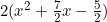
![2[(x+\frac{7}{4})^2-(\frac{7}{4})^2-\frac{5}{2}]](https://www.racquelsanderson.com/wp-content/ql-cache/quicklatex.com-86decb178d67f6e763e3418b68dd4609_l3.png "Rendered by QuickLaTeX.com")
![2[(x+\frac{7}{4})^2-\frac{49}{16}-\frac{40}{16}]](https://www.racquelsanderson.com/wp-content/ql-cache/quicklatex.com-46cc98a61881eb23836f41e52a308e56_l3.png "Rendered by QuickLaTeX.com")
![2[(x+\frac{7}{4})^2-\frac{89}{16}]](https://www.racquelsanderson.com/wp-content/ql-cache/quicklatex.com-9c430d81a00ab51437da9037c1141aac_l3.png "Rendered by QuickLaTeX.com")

Converting base 10 numbers to base 2
Converting integers to base 2 is reasonably easy.
For example, what is 82 in base 2?
Think about powers of 2
 |  |
 |  (‘ones’) (‘ones’) |
| (‘tens’) |
|  (‘hundreds) (‘hundreds) |
 |  (‘thousands’) (‘thousands’) |
Make  the sum of powers of .

We follow the same approach for real numbers
| |
 |  |
 |  |
 |  |
| (‘ones’) |
| (‘tens’) |
| (‘hundreds) |
| (‘thousands’) |
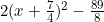
Convert  to base
 the first number is 1
 the second number is 1
 the third number is 0
 the fourth number is 0
 the fifth number is 0
 the sixth number is 1 and we have finished

What about something like  ?
?
The non-decimal part 
 first number is zero
 second number is 1
 third number is 1
 fourth number is 1
 fifth number is 0
 sixth number is 0
We are back to where we started, so 
Filed under Arithmetic, Decimals, Fractions, Number Bases
Divisibility Rule for 11
I was working on a question and involved 11 and I wondered what the divisibility rule was?
So then I had a bit of a think about it.
Let  be a number divisible by
  . The
. The 


Now  which is congruent to because
  , which is a multiple of 11.
Thus

Odd powers will be negative and even positive.
So if we start at one end of the number and add every second digit (i.e. first digit plus third digit plus fifth digit etc.) and then subtract the other digits (i.e. second digit, fourth digit, six digit, etc.), if that equals zero then the number is divisible by 11.
For example, is  divisible by ?

Hence is divisible by
Filed under Algebra, Arithmetic, Divisibility, Index Laws, Interesting Mathematics, Number Bases
Synthetic Division (for factorising and/or solving polynomials)
I use synthetic division to factorise polynomials with a degree greater than 2. For example, 
It works best with monic polynomials but can be adapted to non-monic ones (see example below).
The only problem is that you need to find a root to start.
Try the factors of  i.e.
i.e. 

Hence,  is a root and
  is a factor of the polynomial.
Set up as follows

Bring the first number down

Multiply by the root and place under the second co-efficient

Add down

Repeat the process


The numbers at the bottom  are the coefficients of the polynomial factor.
We now know  .
.
We can factorise the quadratic in the usual way.

Hence  .
.
Let’s try a non-monic example
Factorise 
I know is a root. Otherwise I would try the factors of 30.
Use synthetic division

Because this was non-monic we need to divide our new co-efficients  by 6 (the co-efficient of the
  term)
term)

We now need to go again. I know that  is a root and
  is a factor.

Our quadratic factor is  , which is
  .
.
The quadratic factor doesn’t have integer factors so,

I think this is much quicker than polynomial long division.
Filed under Algebra, Factorising, Factorising, Fractions, Polynomials, Quadratic, Simplifying fractions, Solving Equations
Converting recurring (non-terminating) decimals to fractions
The easiest approach is to jump right in with some examples.
Example 1
Convert  to a fraction.
Let
(1)
(2)
Subtract equation
Hence
so


Example 2
Convert  to a fraction.
Let
(3)
(4)
Subtract equation


Example 3
Convert  to a fraction
Let
(5)
(6)
(7)
Subtract equation
from equation




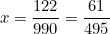
Our aim is to manipulate the recurring decimal to create two numbers each which have only the repeated digits after the decimal point.
One more example.
Example 4
Convert  to a fraction
Let 
If I multiply by 10, then I will have  – only repeated digits after the decimal point.
If I multiply by 1000, then I will have  – only repeated digits after the decimal point.
So I get,

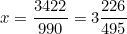
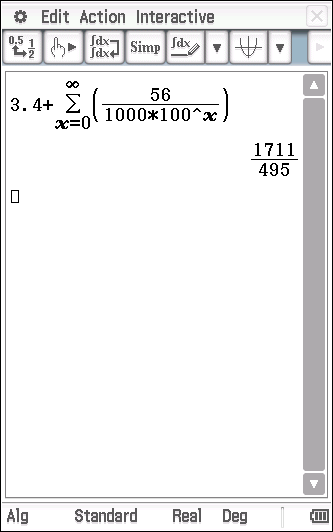
You can also use your Casio classpad to do the conversion. Although I think it is easier just to do it yourself.
Let’s think about example 4,

Which is


Filed under Arithmetic, Decimals, Fractions, Year 11 Specialist Mathematics
Perfect Squares
Find all of the positive integers that make the following expression a perfect square.
(1) 
Let

where is an integer.
Expand and simplify



Factorise (using difference of perfect squares)

Find all of the factors of 

First pair,



 must be an integer.
I then used a spreadsheet
 values.
Hence the integers that make  are perfect square are,
  and
and  .
.
Let’s try another one,

(2) 



Factors of 100,

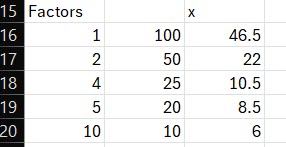
So the possible integers are and  .
.
Filed under Algebra, Arithmetic, Divisibility, Interesting Mathematics, Puzzles, Quadratic, Solving Equations
Cats and Dogs
In my town 10% of the dogs think they are cats and 10% of the cats think they are dogs. All the other cats and dogs are perfectly normal. When all the cats and dogs in my town were rounded up and subjected to a rigorous test, 20% of them thought they were cats. What percentage of them really were cats?
Hamilton Olympiad 2003 B4 – The Ultimate Mathematical Challenge
Let be the number of cats and  be the number of dogs. be the number of dogs.Then  think they are cats. think they are cats.But we also know 20% of the total think they are cats.  Therefore,     Percentage of cats is  Substitute  for for   % of the animals are cats % of the animals are cats |
Australian Mathematics Competition – Polynomial Question
I came across this question from the 2010 Senior Australian Mathematics Competition:
A polynomial
Australian Mathematics Competition 2006-2012is given. All we know about it is that all its coefficients are non-negative integers,
and
. What is the value of

I thought ‘excellent, a somewhat hard polynomial question for my students’ and then I tried it. Now I know why only 1% of students got it correct.
As we don’t know the order of the polynomial, let

We know all of the coefficients are greater than or equal to zero. We also know

Which means that all of the coefficients are between zero and six

We have also been given 

As all of the coefficients are between zero and six, this is  written in base 7.
Let’s calculate a few powers of 7
| Powers of 7 | |
 | 1 |
 | 7 |
 | 49 |
 | 343 |
 | 2401 |
 | 16807 |
| As numbers | As Powers of 7 |
 |  |
 |  |
 |  |
 |  |
Hence written in base  is
is 
Therefore 



I really like this question. I think it could work well as a class extension activity with a bit of scaffolding.
Filed under Number Bases, Polynomials
Fractions to decimals
People usually know some fractions as decimals, for example
![\[\frac{1}{4}=0.25\ \textnormal{or }\frac{4}{5}=0.8\]](https://www.racquelsanderson.com/wp-content/ql-cache/quicklatex.com-a4e5699f214509f3db1fbe34ea441f46_l3.png "Rendered by QuickLaTeX.com")
And denominators that are powers of ten are also easy,
![\[\frac{47}{100}=0.47\ \textnormal{or }\frac{256}{1000}=0.256\]](https://www.racquelsanderson.com/wp-content/ql-cache/quicklatex.com-2ed8b090ce130359c283cb7f78edd3e9_l3.png "Rendered by QuickLaTeX.com")
But what if it is something else? One that you don’t know. For example,
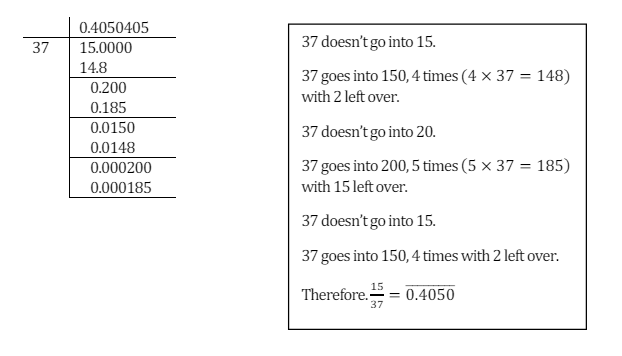
![\[\frac{5}{12}\ \textnormal{or }\frac{15}{37}\]](https://www.racquelsanderson.com/wp-content/ql-cache/quicklatex.com-0dc890d5409a9e8d693549075a7591a8_l3.png "Rendered by QuickLaTeX.com")
I like to do these as a long division
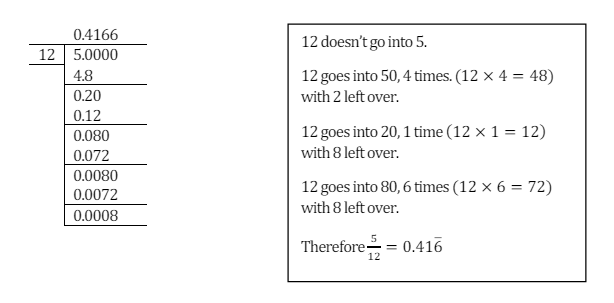
Filed under Arithmetic, Decimals, Fractions