Category Archives: Vectors

Find the Equation of a Plane Given Three Points

Find the Cartesian equation of the plane containing the points A(1, 2, 3), B(-3, 0, 2) and C(2, -4, -1)

Find \overrightarrow{AB} and \overrightarrow{AC}
\overrightarrow{AB}=\begin{pmatrix}-2\\0\\2\end{pmatrix}-\begin{pmatrix}1\\2\\3\end{pmatrix}=\begin{pmatrix}-3\\-2\\-1\end{pmatrix}
\overrightarrow{AC}=\begin{pmatrix}2\\-4\\-1\end{pmatrix}-\begin{pmatrix}1\\2\\3\end{pmatrix}=\begin{pmatrix}1\\-6\\-4\end{pmatrix}

Find the cross product \overrightarrow{AB}\times \overrightarrow{AC}
\begin{pmatrix}-3\\-2\\-1\end{pmatrix}\times\begin{pmatrix}1\\-6\\-4\end{pmatrix}=\begin{pmatrix}2\\-13\\20\end{pmatrix}
This is the normal, overrightarrow{n}, to the plane.
We know A is on the plane

    \begin{equation*}\overrightarrow{n}\cdot (\overrightarrow{r}-\overrightarrow{OA})=0\end{equation}


Hence \overrightarrow{n}\cdot \overrightarrow{r}=\overrightarrow{n}\cdot \overrightarrow{OA}
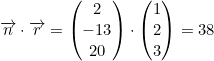
\overrightarrow{n}\cdot \overrightarrow{r}=\begin{pmatrix}2\\-13\\20\end{pmatrix} \cdot \begin{pmatrix}1\\2\\3\end{pmatrix}=38
Therefore the Cartesian equation of the plane is

    \begin{equation*}2x-13y+20z=38\end{equation}

Leave a Comment

Filed under Algebra, Cross Product, Vectors, Year 12 Specialist Mathematics

Eigenvalues and Eigenvectors

My Year 11 Specialist students have had an investigation which involves finding eigenvalues, eigenvectors and lines that are invariant under a particular linear transformation. This is not part of the course, but I feel for teachers who have to create new investigations every year.

Let’s find the eigenvalues and eigenvectors for matrix T=\begin{bmatrix}-\frac{1}{2}&-\frac{\sqrt{3}}{2}\\-\frac{\sqrt{3}}{2}&\frac{1}{2}\end{bmatrix}

We want to find \lambda such that

(1)   \begin{equation*}T\textbf{v}=\lambda \textbf{v}\end{equation*}

We solve det(T-\lambda I)=0

    \begin{equation*}T-\lambda I=\begin{bmatrix}-\frac{1}{2}-\lambda&-\frac{\sqrt{3}}{2}\\-\frac{\sqrt{3}}{2}&\frac{1}{2}-\lambda\end{bmatrix}\end{equation}

det\left (T-\lambda I \right )=\left (-\frac{1}{2}-\lambda \right ) \left ( \frac{1}{2}-\lambda \right )- \left (-\frac{\sqrt{3}}{2} \right ) \left ( -\frac{\sqrt{3}}{2} \right )

Hence 0=\lambda^2-1 and \lambda=\pm 1

When \lambda=1, \begin{bmatrix}-\frac{1}{2}&-\frac{\sqrt{3}}{2}\\-\frac{\sqrt{3}}{2}&\frac{1}{2}\end{bmatrix}\begin{bmatrix}x_1\\x_2\end{bmatrix}=\begin{bmatrix}x_1\\x_2\end{bmatrix}

Hence, -\frac{x_1}{2}-\frac{\sqrt{3}x_2}{2}=x_1

x_2=-\frac{3x_1}{\sqrt{3}} and the eigenvector is \begin{bmatrix}1\\-\sqrt{3}\end{bmatrix}

When \lambda=-1, \begin{bmatrix}-\frac{1}{2}&-\frac{\sqrt{3}}{2}\\-\frac{\sqrt{3}}{2}&\frac{1}{2}\end{bmatrix}\begin{bmatrix}x_1\\x_2\end{bmatrix}=\begin{bmatrix}-x_1\\-x_2\end{bmatrix}

Hence, -\frac{x_1}{2}-\frac{\sqrt{3}x_2}{2}=-x_1

x_2=\frac{x_1}{\sqrt{3}} and the eigenvector is \begin{bmatrix}1\\\frac{1}{\sqrt{3}}\end{bmatrix}

Which means the invariant lines are y=-\sqrt{3}x and y=\frac{x}{\sqrt{3}}

A quadrilateral with vertices on our lines
The vertices after they have been transformed – A and C remain in the same place (they are on the \lambda=1 line)
The quadrilateral (purple) after the transformation

Leave a Comment

Filed under Co-ordinate Geometry, Eigenvalues, Matrices, Transformations, Vectors, Year 11 Specialist Mathematics

Closest Approach (Shortest Distance) e-activity (Casio Classpad)

At 1pm, object H travelling with constant velocity \begin{pmatrix}200\\10\end{pmatrix}km/h is sighted at the point with position vector \begin{pmatrix}-90\\-100\end{pmatrix}km. At 2pm object J travelling with constant velocity \begin{pmatrix}100\\-100\end{pmatrix}km/h is sighted at the point with position vector \begin{pmatrix}20\\-120\end{pmatrix}km. Determine the minimum distance between H and J and when this occurs.

OT Lee Mathematics Specialist Year 11 Unit 1 and 2 Exercise 10.1 Question 6.

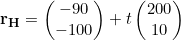
(1)   \begin{equation*}\mathbf{r_H}=\begin{pmatrix}-90\\-100\end{pmatrix}+t\begin{pmatrix}200\\10\end{pmatrix}\end{equation*}
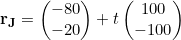
(2)   \begin{equation*}\mathbf{r_J}=\begin{pmatrix}-80\\-20\end{pmatrix}+t\begin{pmatrix}100\\-100\end{pmatrix}\end{equation*}

\begin{pmatrix}-80\\-20\end{pmatrix} is the position vector of J at 1pm.

Find the relative displacement of H to J

    \begin{equation*}\mathbf{_H}\mathbf{r_J}=\mathbf{r_H}-\mathbf{r_J}\end{equation}

    \begin{equation*}\mathbf{_H}\mathbf{r_J}=\begin{pmatrix}-90\\-100\end{pmatrix}+t\begin{pmatrix}200\\10\end{pmatrix}-(\begin{pmatrix}-80\\-20\end{pmatrix}+t\begin{pmatrix}100\\-100\end{pmatrix})\end{equation}

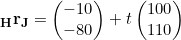
    \begin{equation*}\mathbf{_H}\mathbf{r_J}=\begin{pmatrix}-10\\-80\end{pmatrix}+t\begin{pmatrix}100\\110\end{pmatrix}\end{equation}

Find the relative velocity of H to J

    \begin{equation*}\mathbf{_H}\mathbf{v_J}=\begin{pmatrix}100\\110\end{pmatrix}\end{equation}

The relative displacement is perpendicular to the relative velocity at the closest approach.

That is

(3)   \begin{equation*}\mathbf{_H}\mathbf{r_J}\cdot\mathbf{_H}\mathbf{v_J}=0\end{equation*}

    \begin{equation*}(\begin{pmatrix}-10\\-80\end{pmatrix}+t\begin{pmatrix}100\\110\end{pmatrix})\cdot(\begin{pmatrix}100\\110\end{pmatrix})=0\end{equation}

    \begin{equation*}(-10+100t)(100)+(-80+110t)(110)=0\end{equation}

    \begin{equation*}-1000+10 000t-8800+12100t=0\end{equation}

    \begin{equation*}22100t=9800\end{equation}

    \begin{equation*}t=\frac{98}{221}\end{equation}

Substitute t=\frac{98}{221} into the relative displacement and find the magnitude.

    \begin{equation*}\mathbf{_H}\mathbf{r_J}=\begin{pmatrix}-10\\-80\end{pmatrix}+\frac{98}{221}\begin{pmatrix}100\\110\end{pmatrix}\end{equation}

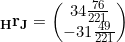
    \begin{equation*}\mathbf{_H}\mathbf{r_J}=\begin{pmatrix}34\frac{76}{221}\\-31\frac{49}{221}\end{pmatrix}\end{equation}

    \begin{equation*}\|\begin{pmatrix}34\frac{76}{221}\\-31\frac{49}{221}\end{pmatrix}\|=46.4\end{equation}

The closest objects H and J get to each other is 46.4km at 1:27pm.

I have made an e-activity for this.

Leave a Comment

Filed under Classpad Skills, Closest Approach, Vectors, Year 11 Mathematical Methods

Vector and Scalar Projection

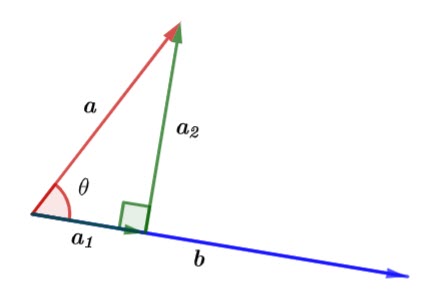
The vector projection (vector resolution or vector component) of \mathbf{a} onto a non-zero vector \mathbf{b} is splitting \mathbf{a} into two vectors, one is parallel to \mathbf{b} (the vector projection) and one perpendicular to \mathbf{b}
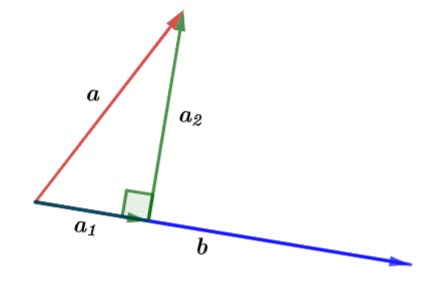
In the above diagram \mathbf{a_1} is the vector projection of \mathbf{a} onto \mathbf{b} and \mathbf{a_2} is perpendicular to \mathbf{b}.

How do we find \mathbf{a_1} and \mathbf{a_2}?

Using right trigonometry,

cos(\theta)=\frac{|\mathbf{a_1}|}{|\mathbf{a}|}

Remember the scalar product (dot product) of vectors is

(1)   \begin{equation*}\mathbf{a}\cdot\mathbf{b}=|\mathbf{a}||\mathbf{b}|cos(\theta)\end{equation*}

Hence cos(\theta)=\frac{\mathbf{a}\cdot\mathbf{b}}{|\mathbf{a}||\mathbf{b}|}

\frac{\mathbf{a}\cdot\mathbf{b}}{|\mathbf{a}||\mathbf{b}|}=\frac{|\mathbf{a_1}|}{|\mathbf{a}|}

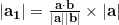
and, |\mathbf{a_1}|=\frac{\mathbf{a}\cdot\mathbf{b}}{|\mathbf{a}||\mathbf{b}|}\times|\mathbf{a}|

|\mathbf{a_1}|=\frac{\mathbf{a}\cdot\mathbf{b}}{|\mathbf{b}|}

This is the scalar projection of \mathbf{a} onto \mathbf{b}

To find the vector projection we need to multiply by \mathbf{\hat{b}}, that is find a vector with the same magnitude as \mathbf{a_1} in the direction of \mathbf{b}.

The vector projection is

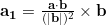
\mathbf{a_1}=\frac{\mathbf{a}\cdot\mathbf{b}}{|\mathbf{b}|}\times \mathbf{\hat{b}}

\mathbf{a_1}=\frac{\mathbf{a}\cdot\mathbf{b}}{|\mathbf{b}|}\times \frac{\mathbf{b}}{|\mathbf{b}|}

\mathbf{a_1}=\frac{\mathbf{a}\cdot\mathbf{b}}{(|\mathbf{b}|)^2}\times \mathbf{b}

Now for \mathbf{a_2}, we know \mathbf{a}=\mathbf{a_1}+\mathbf{a_2}

Hence, \mathbf{a_2}=\mathbf{a}-\mathbf{a_1}

Example

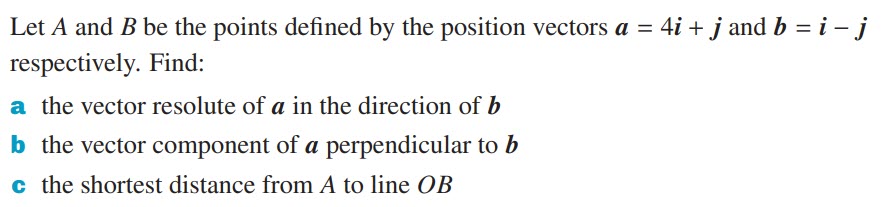
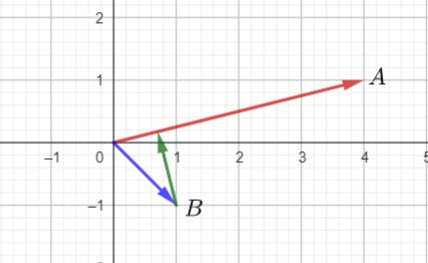
From Cambridge Year 11 Specialist Mathematics (Chapter 3)

(a) \frac{\mathbf{a}\cdot\mathbf{b}}{|\mathbf{b}|^2}\mathbf{b}

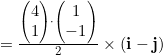
=\frac{\begin{pmatrix}4\\1\end{pmatrix}\cdot\begin{pmatrix}1\\-1\end{pmatrix}}{2}\times(\mathbf{i}-\mathbf{j})

=\frac{3}{2}{(\mathbf{i}-\mathbf{j})

(b)4\mathbf{i}+\mathbf{j}-\frac{3}{2}{(\mathbf{i}-\mathbf{j})=\frac{5}{2}\mathbf{i}+\frac{5}{2}\mathbf{j}

(c)

The shortest distance (green vector) is the vector component of \mathbf{a} perpendicular to \mathbf{b}, i.e. \frac{5}{2}\mathbf{i}+\frac{5}{2}\mathbf{j}

|\frac{5}{2}\mathbf{i}+\frac{5}{2}\mathbf{j}|=\sqrt{\frac{25}{4}+\frac{25}{4}}=\sqrt{\frac{50}{4}}=\frac{5\sqrt{2}}{2}

Leave a Comment

Filed under Right Trigonometry, Trigonometry, Vector Projection, Vectors, Year 11 Specialist Mathematics

Using a Vector Method to Find an Angle Bisector

Points A and B are defined by the position vectors \mathbf{a}=3\mathbf{i}+4\mathbf{j} and \mathbf{b}=12\mathbf{i}+5\mathbf{j}.

Find a vector that bisects \angle{AOB}.

If we think about how we add vectors using the parallelogram rule
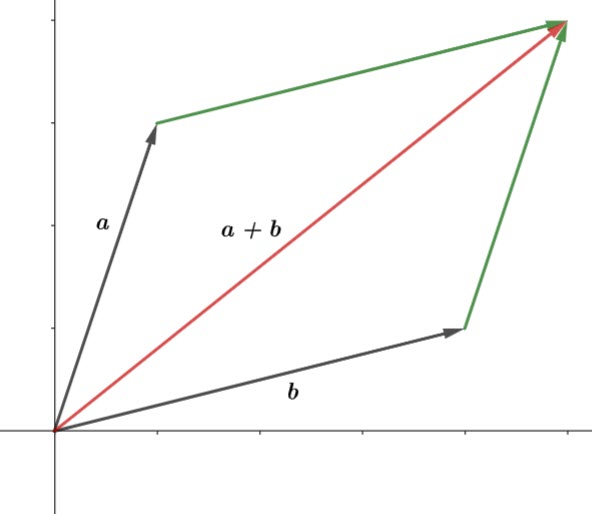
Finding the resultant vector using the parallelogram rule

we can take advantage of the geometric properties of parallelograms (or of a rhombus).

If \mathbf{a} and \mathbf{b} are unit vectors, then the parallelogram is a rhombus, and the diagonal (i.e the resultant) bisects the angle.
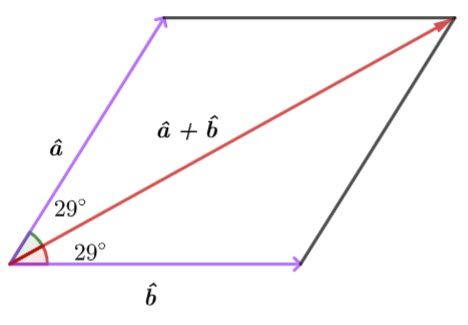
We need to find the sum of the unit vectors.

|\mathbf{a}|=\sqrt{3^2+4^2}=5

\therefore \hat{\mathbf{a}}=\frac{3}{5}\mathbf{i}+\frac{4}{5}\mathbf{j}

|\mathbf{b}|=\sqrt{12^2+5^2}=13

\therefore \hat{\mathbf{b}}=\frac{12}{13}\mathbf{i}+\frac{5}{13}\mathbf{j}

The vector that bisects \angle{AOB} is

\frac{3}{5}\mathbf{i}+\frac{4}{5}\mathbf{j}+\frac{12}{13}\mathbf{i}+\frac{5}{13}\mathbf{j}=\frac{99}{65}\mathbf{i}+\frac{64}{65}\mathbf{j}

Leave a Comment

Filed under Geometry, Vectors, Year 11 Specialist Mathematics

Vectors – Closest Approach (2D)

At 10am, object M travelling with constant velocity (20, 10) km/h is sighted at the point with position vector (-100, 100) km. At 11am object N travelling with constant velocity v=(x,y) km/h is sighted at the point with position vector (-20,-50) km respectively. Use a scalar product method to determine v given that the two objects were closest together at a distance of 40 km at 4pm.

OT Lee Mathematics Specialist Year 11

At 4pm M is at the point with position vector (-100+6\times 20, -100+6\times 10)=(20, -40)

and N is at the point with position vector (-20+5\times x, -50+5\times y)=(-20+5x, -50+5y)

We know the distance between M and N at 4pm is 40 km.

Hence,

    \begin{equation*}40^2=(20-(-20+5x))^2+(-40-(-50+5y))^2\end{equation}

    \begin{equation*}40^2=(40-5x)^2+(10-5y)^2\end{equation}

    \begin{equation*}1600=25x^2-400x+1600+25y^2-100y+100\end{equation}

(1)   \begin{equation*}0=x^2+y^2-16x-4y+4\end{equation*}

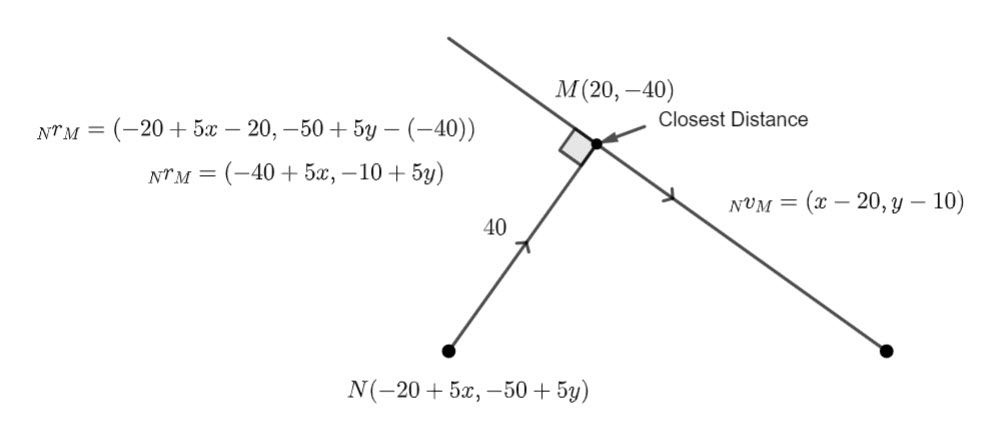
In the diagram below, I have found the position vector of N relative to M (_Nr_M) and the velocity of N relative to M (N_v_M)

We know that when _Nr_M\cdot_Nv_M=0 M and N are the closest distance apart.

    \begin{equation*}(-40+5x,-10+5y)\cdot(x-20,y-10)=0\end{equation}

    \begin{equation*}(-40+5x)(x-20)+(-10+5y)(y-10)\end{equation}

    \begin{equation*}5x^2+5y^2-140x-60y+900=0\end{equation}

(2)   \begin{equation*}x^2+y^2-28x-12y+180=0\end{equation*}

Two equations and two unknowns which we can solve simultaneously. Both equations are circles.
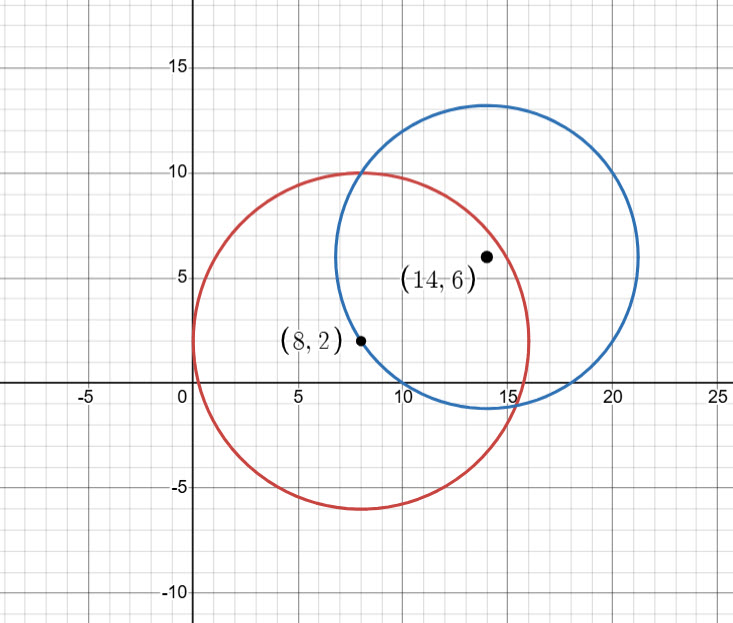
Equation (1) becomes

(3)   \begin{equation*}(x-8)^2+(y-2)^2=64\end{equation*}

and equation (2) becomes

(4)   \begin{equation*}(x-14)^2+(y-6)^2=52\end{equation*}

From equation (3)

    \begin{equation*}x=\sqrt{64-(y-2)^2}+8\end{equation}

We will worry about the negative version later.

Substitute for x into equation (4)

    \begin{equation*}(\sqrt{64-(y-2)^2}+8-14)^2+(y-6)^2=52\end{equation}

    \begin{equation*}(\sqrt{64-(y-2)^2}-6)^2+(y-6)^2=52\end{equation}

    \begin{equation*}64-(y-2)^2-12\sqrt{64-(y-2)^2}+36+y^2-12y+36=52\end{equation}

    \begin{equation*}136-y^2+4y-4+y^2-12y-12\sqrt{64-(y-2)^2}=52\end{equation}

    \begin{equation*}-12\sqrt{64-(y-2)^2}=-80+8y\end{equation}

    \begin{equation*}\sqrt{64-(y-2)^2}=\frac{20}{3}-\frac{2}{3}y\end{equation}

Square both sides of the equation

    \begin{equation*}64-(y-2)^2=\frac{400}{9}-\frac{80}{9}y+\frac{4}{9}y^2\end{equation}

    \begin{equation*}60-y^2+4y=\frac{400}{9}-\frac{80}{9}y+\frac{4}{9}y^2\end{equation}

    \begin{equation*}0=\frac{13}{9}y^2-\frac{116}{9}y-\frac{140}{9}\end{equation}

    \begin{equation*}0=13y^2-116y-140\end{equation}

    \begin{equation*}0=13y^2-130y+14y-140\end{equation}

    \begin{equation*}0=13y(y-10)+14(y-10)\end{equation}

    \begin{equation*}0=(y-10)(13y+14)\end{equation}

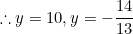
(5)   \begin{equation*}\therefore y=10, y=-\frac{14}{13}\end{equation*}

Substitute y=10 into x=\sqrt{64-(y-2)^2}+8

    \begin{equation*}x=\sqrt{64-(y-2)^2}+8\end{equation}

(6)   \begin{equation*}x=8\end{equation*}

Substitute y=-\frac{14}{13} into x

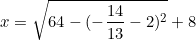
    \begin{equation*}x=\sqrt{64-(-\frac{14}{13}-2)^2}+8\end{equation}

(7)   \begin{equation*}x=\frac{200}{13}\end{equation*}

Now we need to consider the negative version of x. If you work through (like I did above) you end with the same equation for y.

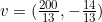
Hence our two values for v are v=(8,10) or v=(\frac{200}{13},-\frac{14}{13}).

Would someone be expected to do this in an exam? I hope not, but I think its worth doing.

Leave a Comment

Filed under Closest Approach, Vectors, Year 11 Specialist Mathematics