Monthly Archives: March 2026

Complex Loci

Sketch on an Argand diagram

    \begin{equation*}\lvert{z-6}\rvert-\lvert{z+6}\rvert=3\end{equation}

where z\in \mathbb{C}

Let z=x+yi

    \begin{equation*}\lvert{x+yi-6}\rvert-\lvert{x+yi+6\rvert=3\end{equation}

    \begin{equation*}\lvert{x-6+yi}\rvert-\lvert{x+6+yi\rvert=3\end{equation}

    \begin{equation*}\sqrt{(x-6)^2+y^2}-\sqrt{(x+6)^2+y^2}=3\end{equation}

    \begin{equation*}\sqrt{(x-6)^2+y^2}=3+\sqrt{(x+6)^2+y^2}\end{equation}

Square both sides of the equation

    \begin{equation*}{(x-6)^2+y^2=9+6\sqrt{(x+6)^2+y^2}+(x+6)^2+y^2\end{equation}

    \begin{equation*}x^2-12x+36+y^2-9-x^2-12x-36-y^2=6\sqrt{(x+6)^2+y^2}\end{equation}

(1)   \begin{equation*}-24x-9=6\sqrt{(x+6)^2+y^2}\end{equation*}

From equation 1 we know -24x-9\ge0

Hence x\le\frac{-3}{8}, which means we only have the left section of the hyperbola.

    \begin{equation*}-8x-3=2\sqrt{(x+6)^2+y^2}\end{equation}

Square both sides of the equation

    \begin{equation*}(-8x-3)^2=4((x+6)^2+y^2)\end{equation}

    \begin{equation*}64x^2+48x+9=4x^2+48x+144+y^2\end{equation}

    \begin{equation*}60x^2-y^2=135\end{equation}

    \begin{equation*}\frac{4x^2}{9}-\frac{y^2}{135}=1\end{equation}

(2)   \begin{equation*}\frac{x^2}{\frac{9}{4}}-\frac{y^2}{135}=1\end{equation*}

Remember, we have the left part of the hyperbola.

The x- intercept =-\sqrt{\frac{9}{4}}=-\frac{3}{2} and the asymptotes are y=\pm \frac{\sqrt{135}}{\frac{3}{2}}x

y=\pm 2\sqrt{15}x

Leave a Comment

Filed under Algebra, Complex Numbers, Simplifying fractions, Sketching Complex Regions, Solving Equations, Year 12 Specialist Mathematics

Function Composition

If g(f(x))=\frac{x}{x+1} and f(x)=\frac{1}{1-2x}, find g(x).

    \begin{equation*}g(f(x))=g(\frac{1}{1-2x})=\frac{x}{x+1}\end{equation}

Sometimes you can do this type of question by inspection, but this one is a bit harder. I am going to use a variable substitution.

Let u=\frac{1}{1-2x}

    \begin{equation*}u=\frac{1}{1-2x}\end{equation}

    \begin{equation*}1-2x=\frac{1}{u}\end{equation}

    \begin{equation*}1-\frac{1}{u}=2x\end{equation}

    \begin{equation*}\frac{u-1}{u}=2x\end{equation}

    \begin{equation*}x=\frac{u-1}{2u}\end{equation}

Therefore

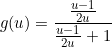
    \begin{equation*}g(u)=\frac{\frac{u-1}{2u}}{\frac{u-1}{2u}+1}\end{equation}

    \begin{equation*}g(u)=\frac{\frac{u-1}{2u}}{\frac{u-1+2u}{2u}}\end{equation}

    \begin{equation*}g(u)=\frac{u-1}{3u-1}\end{equation}

Therefore

    \begin{equation*}g(x)=\frac{x-1}{3x-1}\end{equation}

Let’s test it

g(x)=\frac{x-1}{3x-1} and f(x)=\frac{1}{1-2x}

    \begin{equation*}g(f(x))=\frac{\frac{1}{1-2x}-1}{\frac{3}{1-2x}-1}\end{equation}

    \begin{equation*}g(f(x))=\frac{\frac{1-(1-2x)}{1-2x}}{\frac{3-(1-2x)}{1-2x}}\end{equation}

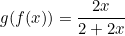
    \begin{equation*}g(f(x))=\frac{2x}{2+2x}\end{equation}

    \begin{equation*}g(f(x))=\frac{x}{x+1}\end{equation}

Leave a Comment

Filed under Algebra, Composition, Functions, Simplifying fractions, Year 12 Specialist Mathematics