Tag Archives: complex numbers

Complex Numbers – Roots of Unity

    \begin{equation*}z^n=1, z\in\mathbb{C}\end{equation}

In polar form 1=cis (2\pi)

Hence,

    \begin{equation*}z^n=cis(2\pi k), k\in\mathbb{Z}\end{equation}

    \begin{equation*}z^n=cis(\frac{2\pik}{n})\end{equation}

For example,

    \begin{equation*}z^4=1\end{equation}

    \begin{equation*}z^4=cis(2\pi k)\end{equation}

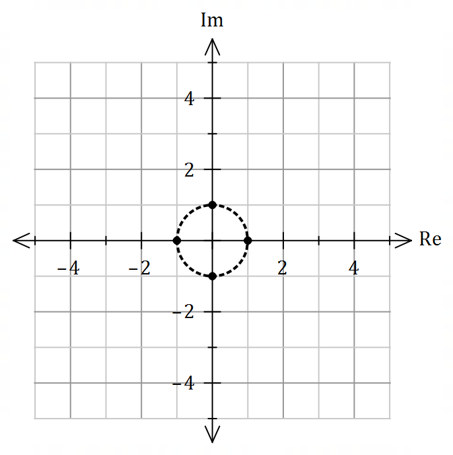
    \begin{equation*}z_k=cis(\frac{2\pi k}{4})=cis(\frac{\pi k}{2})\end{equation}

    \begin{equation*}z_0=1\end{equation}

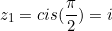
    \begin{equation*}z_1=cis(\frac{\pi}{2})=i\end{equation}

    \begin{equation*}z_2=cis(\pi)=-1\end{equation}

    \begin{equation*}z_3=cis(\frac{3\pi}{2})=-i\end{equation}

The roots of unity are spread evenly (\frac{2\pi}{n} or \frac{360}{n} apart) around a circle of radius 1.

Properties of the roots of Unity

All the roots of unity can be generated by powers of a single root \omega=cis(\frac{2\pi}{n}). The roots form the sequence 1, \omega, \omega^2, \omega^3, ..., \omega^{n-1} Note: \omega \ne 1

For example,

    \begin{equation*}z^4=1\end{equation}

    \begin{equation*}\omega_1=cis(\frac{\pi}{2})\end{equation}

    \begin{equation*}\omega_1^2=cis(\pi)=-1=\omega_2\end{equation}

    \begin{equation*}\omega_1^3=cis(\frac{3\pi}{2})=-i=\omega_3\end{equation}

    \begin{equation*}\omega_1^4=cis(2\pi)=1=\omega_0\end{equation}

A root that can generate the remaining roots is a primitive root.

\omega^k is a primitive root if n and k are coprime.

The sum of the n^{th} roots of unity is always zero.

    \begin{equation*}\Sigma_{k=0}^{n-1}1+\omega+\omega^2+...+\omega^{n-1}=0\end{equation}

The product of the n^{th} roots of unity is

    \begin{equation*}\Pi_{k=0}^{n-1}\omega^k=(-1)^{n-1}\end{equation}

It is 1 when n is odd and -1 when n is even.

Example WATP 2024 Question 7a

(a) Evaluate (4\omega^2+3)(4\omega+3) where \omega is a complex root of unity, \omega\ne 1.

    \begin{equation*}(4\omega^2+3)(4\omega+3)=16\omega^3+12\omega^2+12\omega+9\end{equation}

    \begin{equation*}16\omega^3+12\omega^2+12\omega+9=16(1)+9(\omega^2+\omega+1)+3\omega^2+3\omega\end{equation}

    \begin{equation*}16\omega^3+12\omega^2+12\omega+9=16+9(0)+3(\omega^2+\omega)\end{equation}

    \begin{equation*}16\omega^3+12\omega^2+12\omega+9=16+3(-1)\end{equation}

    \begin{equation*}=13\end{equation}

Remember the sum of the roots is zero, \omega^2+\omega+1=0 hence \omega^2+\omega=-1

Leave a Comment

Filed under Algebra, Complex Numbers, Roots of Unity, Year 12 Specialist Mathematics

Complex Numbers and Trig Idenities

My Year 12 Specialist Students are using complex numbers to prove trigonometric identities.

Things like

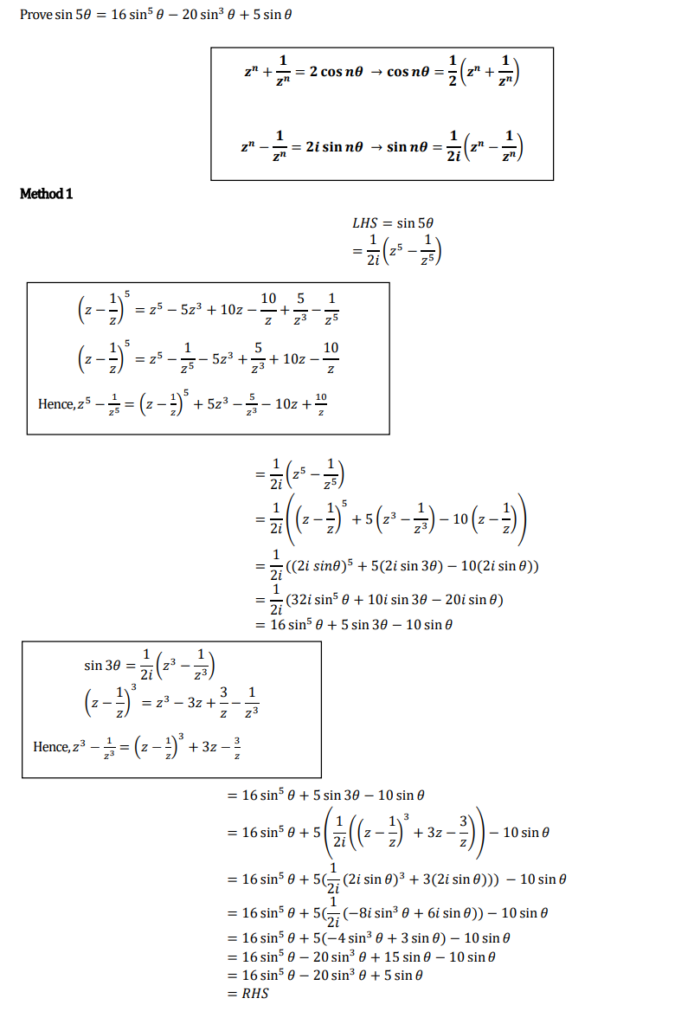
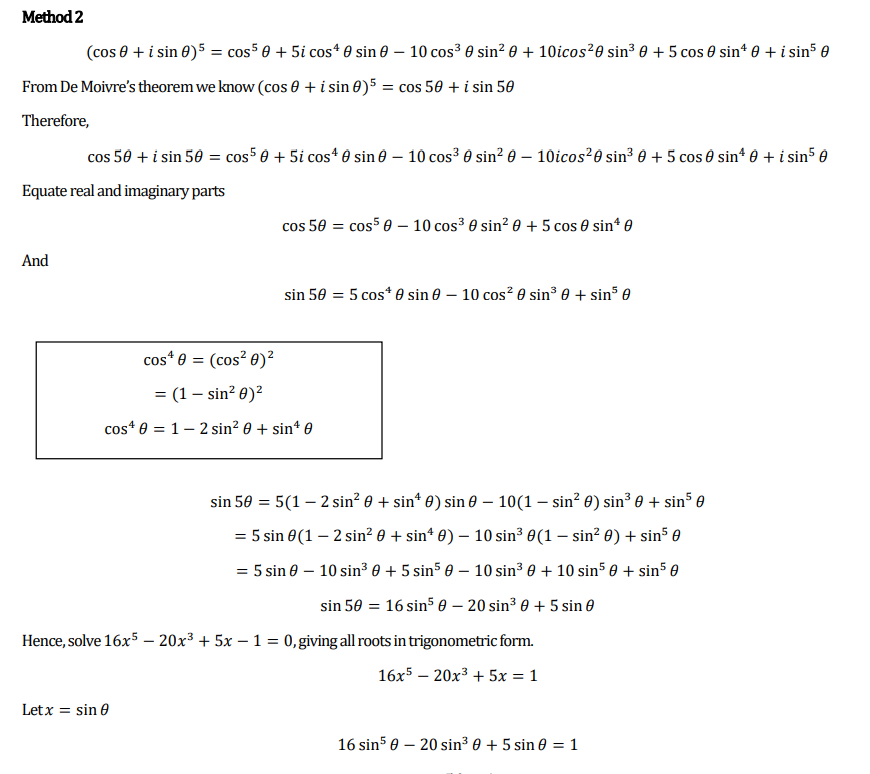
    \begin{equation*}sin(5\theta)=16sin^5(\theta) -20sin^3(\theta)+5sin(\theta) \end{equation}

Method 2 might be a little bit easier depending upon how your brain works.

Leave a Comment

Filed under Algebra, Binomial Expansion Theorem, Complex Numbers, Identities, Trig Identities, Trigonometry, Year 12 Specialist Mathematics

Using De Moivre’s Theorem for Trigonometric Identities

We are going to use De Moivre’s theorem to prove trigonometric identities.

Remember, De Moivre’s Theorem

If z=r(cos(\theta)+isin(\theta)), then z^n=r^n(cos(n\theta)+isin(n\theta))

Or a shorter version z=rcis(\theta), then z^n=r^ncis(n\theta)

Now, let z=cos(\theta)+isin(\theta), find z+\frac{1}{z}

z+z^{-1}=cos(\theta)+isin(\theta)+cos(-\theta)+isin(-\theta)

Remember cos(\theta)=cos(\theta) and sin(-\theta)=-sin(\theta)

z+\frac{1}{z}=cos(\theta)+isin(\theta)+cos(\theta)-isin(\theta)

z+\frac{1}{z}=2cos(\theta)

It is the same for z^n+\frac{1}{z^n}

z^n+z^{-n}=cos(n\theta)+isin(n\theta)+cos(-n\theta)+isin(-n\theta)

z^n+\frac{1}{z^n}=2cos(n\theta)

Prove cos(2\theta)=2cos^2(\theta)-1
LHS=\frac{1}{2}(z^2+\frac{1}{z^2})
LHS=\frac{1}{2}(z^2+\frac{1}{z^2})+z\times\frac{1}{z}-z\times\frac{1}{z}
LHS=\frac{1}{2}(z^2+2z\times\frac{1}{z}+\frac{1}{z^2})-z\times\frac{1}{z}
LHS=\frac{1}{2}(z+\frac{1}{z})^2-1
LHS=\frac{1}{2}(2cos(\theta))^2-1
LHS=\frac{1}{2}(4cos^2(\theta))-1
LHS=2cos^2(\theta)-1
LHS=RHS

We can do something similar with sine.

z-\frac{1}{z}=cos(\theta)+isin(\theta)-(cos(-\theta)+isin(-\theta))

z-\frac{1}{z}=cos(\theta)+isin(\theta)-(cos(-\theta)+isin(-\theta))

z-\frac{1}{z}=cos(\theta)+isin(\theta)-(cos(\theta)-isin(\theta))

z-\frac{1}{z}=cos(\theta)+isin(\theta)-cos(\theta)+isin(\theta)

z-\frac{1}{z}=2isin(\theta)

Hence z^n-\frac{1}{z^n}=2isin(n\theta)

Prove sin(2\theta)=2sin(\theta)cos(\theta)
LHS=sin(2\theta)
LHS=\frac{1}{2i}(z^2-\frac{1}{z^2})
LHS=\frac{1}{2i}(z-\frac{1}{z})(z+\frac{1}{z})
LHS=\frac{1}{2i}(2isin(\theta)(2cos(\theta))
LHS=sin(\theta)2cos(\theta)
LHS=2sin(\theta)cos(\theta)
LHS=RHS

Let’s find an identity for cos(3\theta)

cos(3\theta)=\frac{1}{2}(z^3+\frac{1}{z^3})

=\frac{1}{2}(z^3+\frac{1}{z^3}+3z^2\times\frac{1}{z}+3z\times\frac{1}{z^2}-3z^2\times\frac{1}{z}-3z\times\frac{1}{z^2})

=\frac{1}{2}((z+\frac{1}{z})^3-3z-\frac{3}{z})

=\frac{1}{2}((z+\frac{1}{z})^3-3(z+\frac{1}{z}))

=\frac{1}{2}(2cos(\theta))^3-3(2cos(\theta)))

=\frac{1}{2}(8cos^3(\theta)-6cos(\theta))

=4cos^3(\theta)-3cos(\theta)

\therefore cos(3\theta)=4cos^3(\theta)-3cos(\theta)

And sin(3\theta)?

sin(3\theta)=\frac{1}{2i}(z^3-\frac{1}{z^3})

=\frac{1}{2i}(z^3-\frac{1}{z^3}-3z^2\times\frac{1}{z}+3z\times\frac{1}{z^2}+3z^2\times\frac{1}{z}-3z\times\frac{1}{z^2}

=\frac{1}{2i}((z-\frac{1}{z})^3+3z-\frac{3}{z})

=\frac{1}{2i}(2isin(\theta))^3+3(z-\frac{1}{z}))

=\frac{1}{2i}(-8isin^3(\theta)+6isin(\theta))

=-4sin^3(\theta)+3sin(\theta)

\therefore sin(3\theta)=3sin(\theta)-4sin^3(\theta)

Leave a Comment

Filed under Complex Numbers, Identities, Trig Identities, Trigonometry

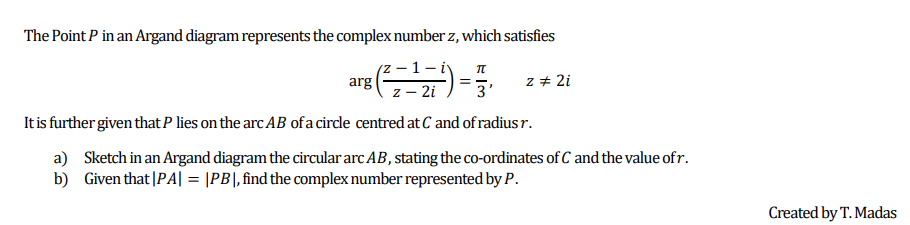
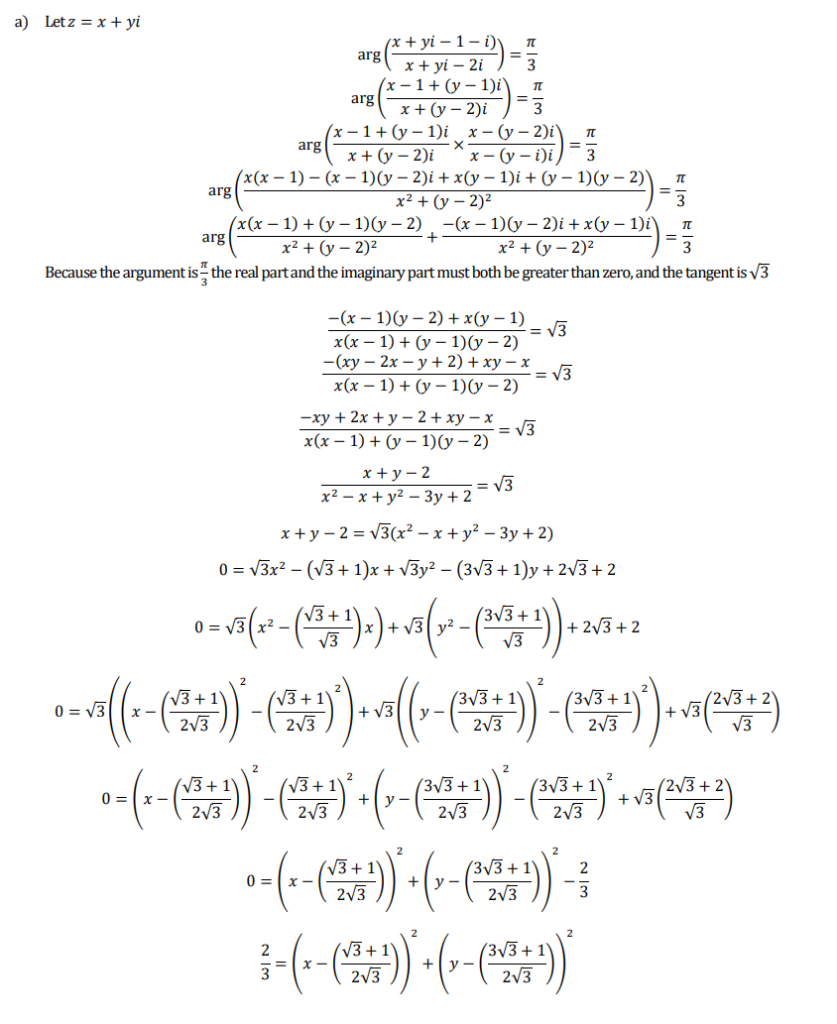
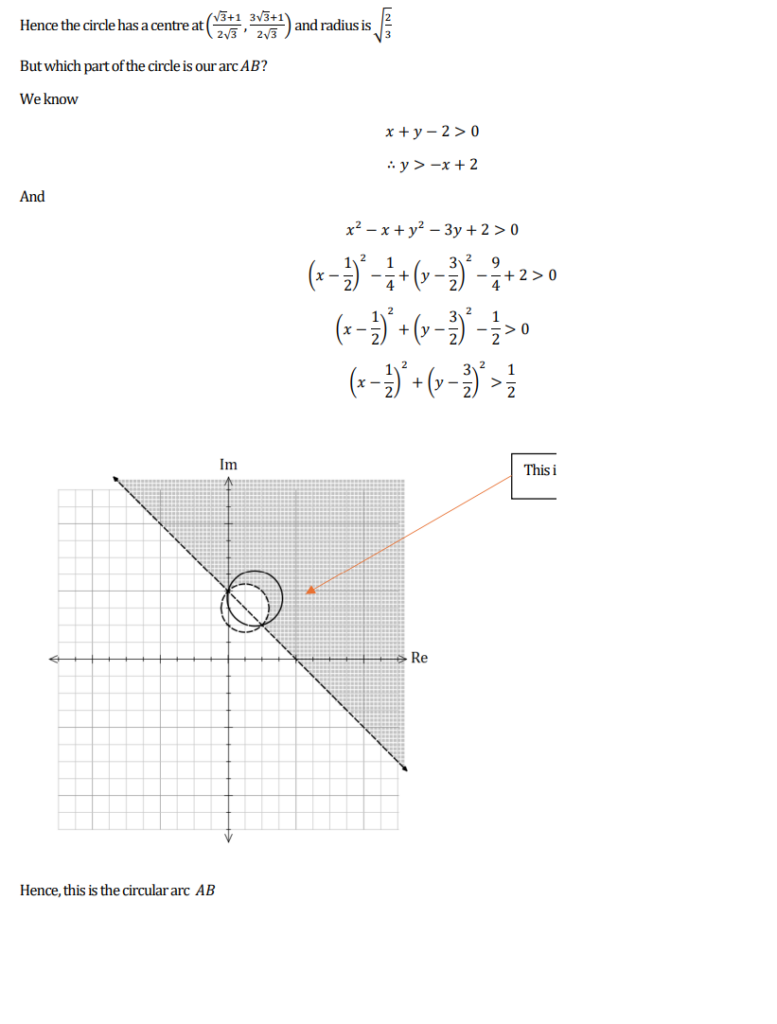
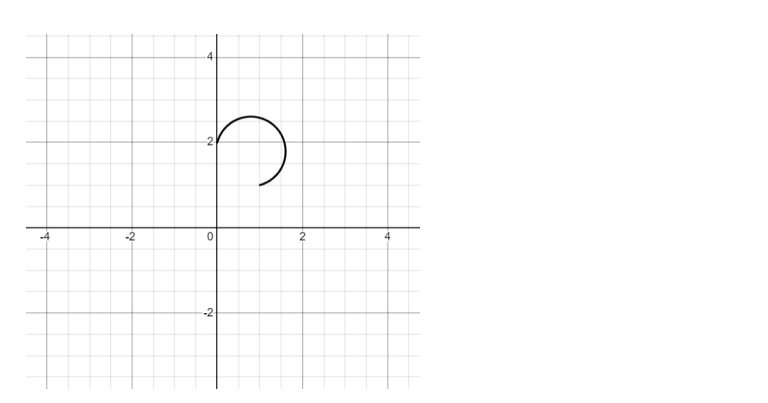
Sketching Subsets of the Complex Plane – Problem 2

I found this question on the madasmaths site – his resources are fabulous.

I am not sure I would have been able to do this in an exam.

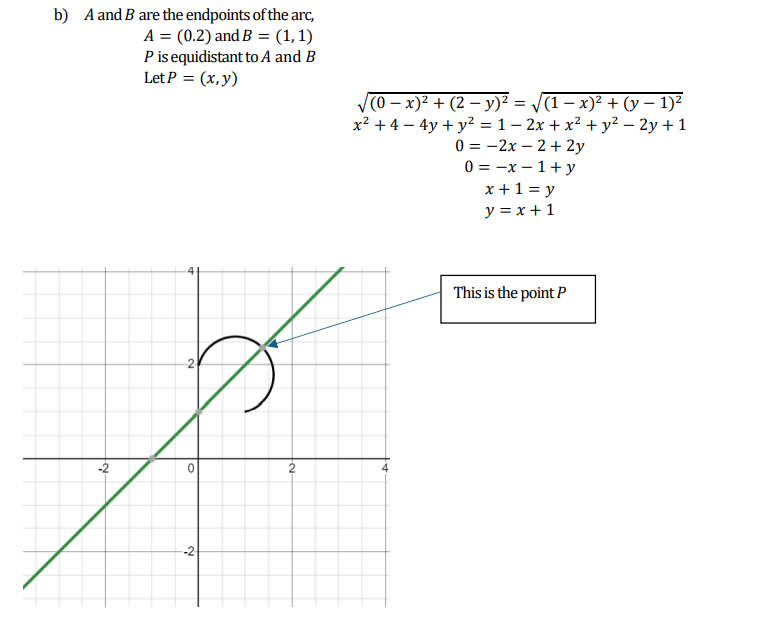
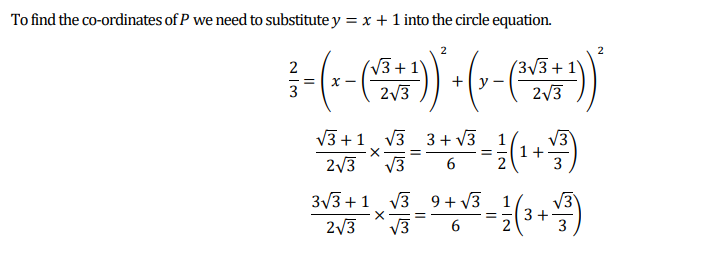
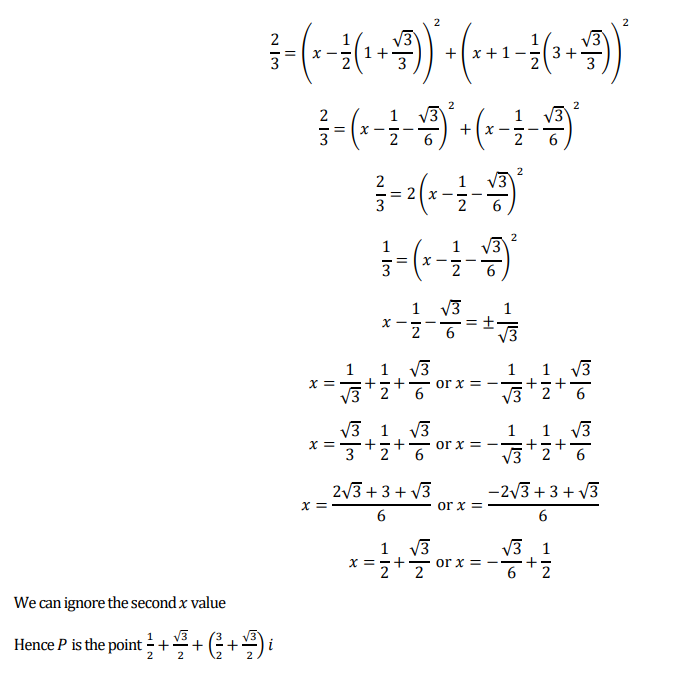
I have split my solution into 6 images and there is a pdf version at the bottom

PDF version of my solution

Leave a Comment

Filed under Complex Numbers, Sketching Complex Regions