Tag Archives: complex loci

Complex Loci

Sketch on an Argand diagram

    \begin{equation*}\lvert{z-6}\rvert-\lvert{z+6}\rvert=3\end{equation}

where z\in \mathbb{C}

Let z=x+yi

    \begin{equation*}\lvert{x+yi-6}\rvert-\lvert{x+yi+6\rvert=3\end{equation}

    \begin{equation*}\lvert{x-6+yi}\rvert-\lvert{x+6+yi\rvert=3\end{equation}

    \begin{equation*}\sqrt{(x-6)^2+y^2}-\sqrt{(x+6)^2+y^2}=3\end{equation}

    \begin{equation*}\sqrt{(x-6)^2+y^2}=3+\sqrt{(x+6)^2+y^2}\end{equation}

Square both sides of the equation

    \begin{equation*}{(x-6)^2+y^2=9+6\sqrt{(x+6)^2+y^2}+(x+6)^2+y^2\end{equation}

    \begin{equation*}x^2-12x+36+y^2-9-x^2-12x-36-y^2=6\sqrt{(x+6)^2+y^2}\end{equation}

(1)   \begin{equation*}-24x-9=6\sqrt{(x+6)^2+y^2}\end{equation*}

From equation 1 we know -24x-9\ge0

Hence x\le\frac{-3}{8}, which means we only have the left section of the hyperbola.

    \begin{equation*}-8x-3=2\sqrt{(x+6)^2+y^2}\end{equation}

Square both sides of the equation

    \begin{equation*}(-8x-3)^2=4((x+6)^2+y^2)\end{equation}

    \begin{equation*}64x^2+48x+9=4x^2+48x+144+y^2\end{equation}

    \begin{equation*}60x^2-y^2=135\end{equation}

    \begin{equation*}\frac{4x^2}{9}-\frac{y^2}{135}=1\end{equation}

(2)   \begin{equation*}\frac{x^2}{\frac{9}{4}}-\frac{y^2}{135}=1\end{equation*}

Remember, we have the left part of the hyperbola.

The x- intercept =-\sqrt{\frac{9}{4}}=-\frac{3}{2} and the asymptotes are y=\pm \frac{\sqrt{135}}{\frac{3}{2}}x

y=\pm 2\sqrt{15}x

Leave a Comment

Filed under Algebra, Complex Numbers, Simplifying fractions, Sketching Complex Regions, Solving Equations, Year 12 Specialist Mathematics

Complex Locus Question

My Year 12 Specialist students are working on complex loci again. The following type of question always creates confusion.

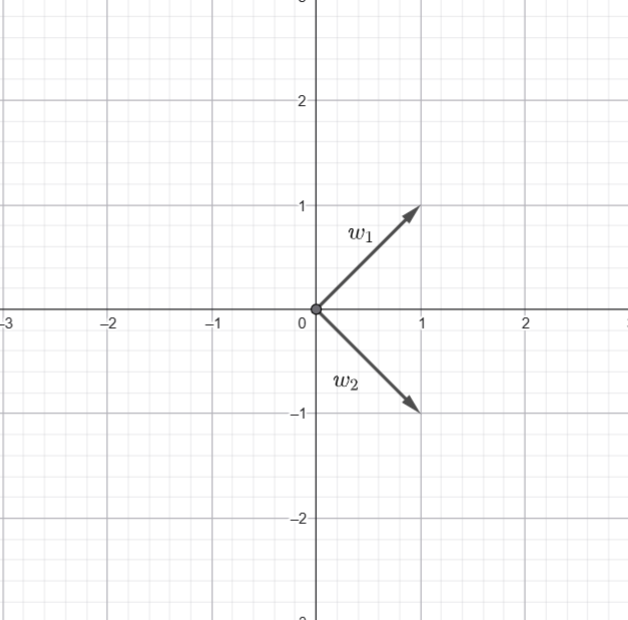
Let z \in \mathbb{C}, w_1=1+i, and w_2=1-i
(a) Show that the locus of points satisfying

    \begin{equation*}arg(z-w_1)-arg(z-w_2)=\frac{\pi}{6}\end{equation}

is the arc of a circle.
(b) Find the centre and radius of the circle, expressing your answers in exact form.

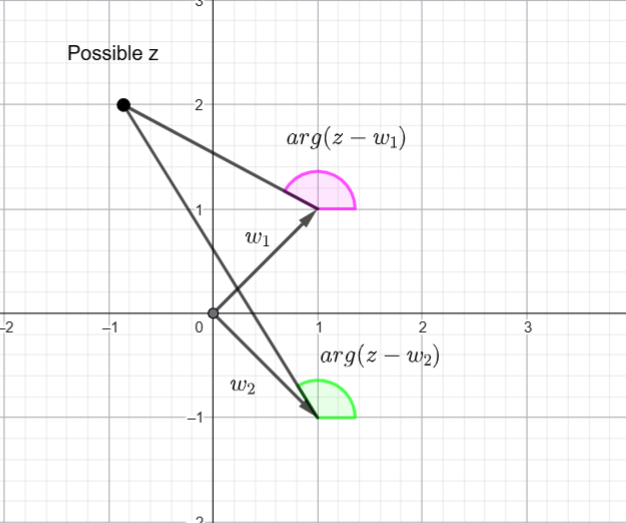
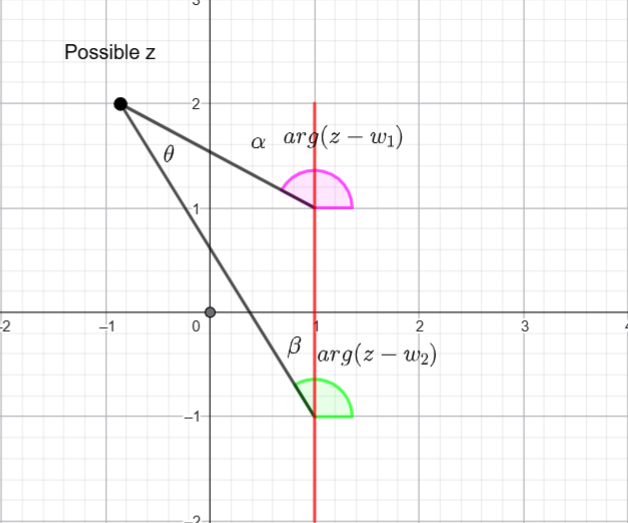
arg(z-w_1) is the angle the vector from w_1 to z makes with the positive x- axis, likewise for arg(z-w_2).

I am going to plot a possible z and try to see the geometry that works.

We want arg(z-w_1)-arg(z-w_2)=\frac{\pi}{6}

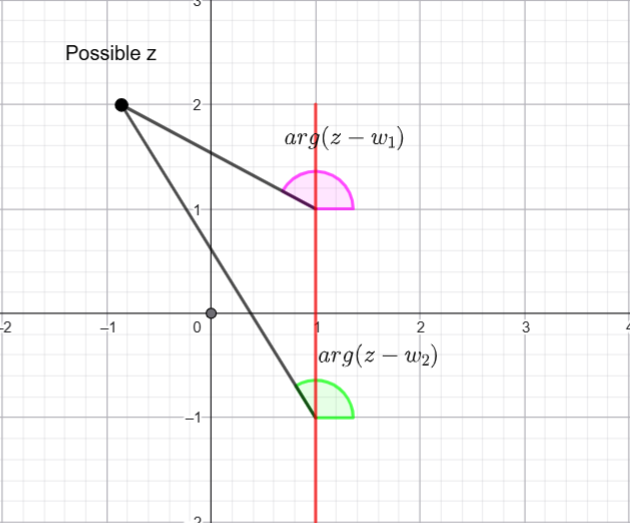
I am going to take advantage of some triangle geometry

Using the External Angle Theorem, we know \alpha=\beta+\theta

    \begin{equation*}arg(z-w_1)-arg(z-w_2)=(\alpha+\frac{\pi}{2})-(\beta+\frac{\pi}{2}0=\alpha-\beta=\theta\end{equation}

Therefore \theta=\frac{\pi}{6}

So we want all of the z values that have an angle of \frac{\pi}{6}

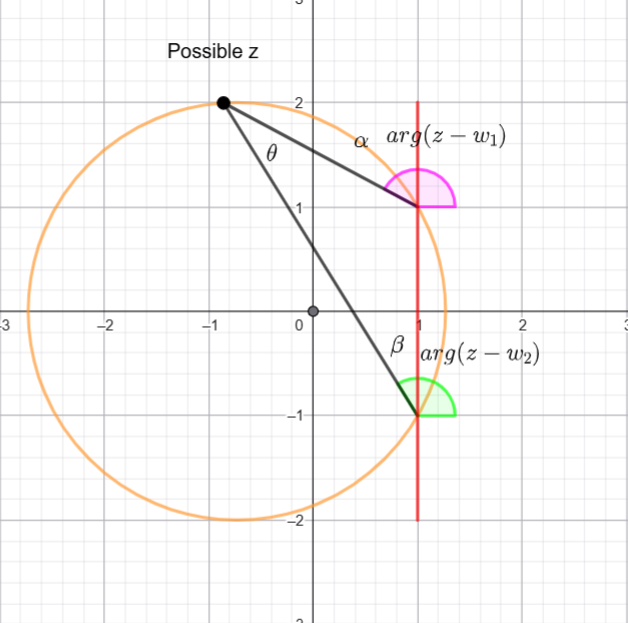
Now we are going to use some circle geometry -The angle at the circumference subtended by the same arc are congruent. So we need to find a circle that has those three points (z, w_1 and w_2) on the circumference.

Hence the locus is

Now we need to find the radius and centre of the circle.

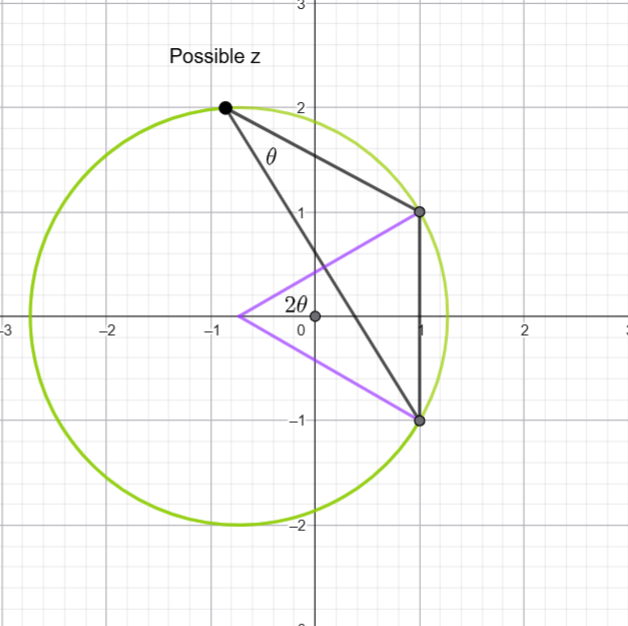
Using another circle theorem, the angle at the centre is twice the angle at the circumference.

The triangle must be equilateral (it is isosceles with a vertex angle of \frac{\pi}{3})

Hence the radius is 2.

h=\sqrt{2^2-1^2}=\sqrt{3}

Hence the centre is (-\sqrt{3}+1, 0)

Leave a Comment

Filed under Circle Theorems, Complex Numbers, Geometry, Interesting Mathematics, Pythagoras, Sketching Complex Regions, Year 12 Specialist Mathematics

Sketching Subsets of the Complex Plane – Problem 2

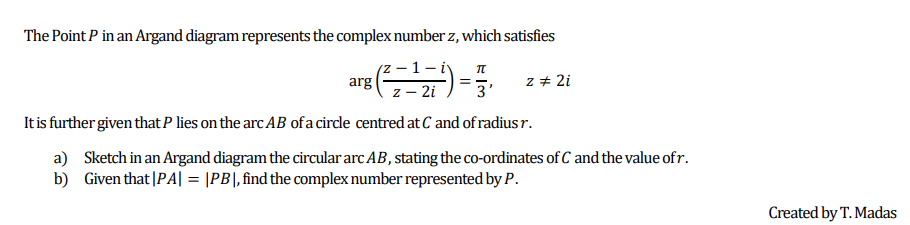
I found this question on the madasmaths site – his resources are fabulous.

I am not sure I would have been able to do this in an exam.

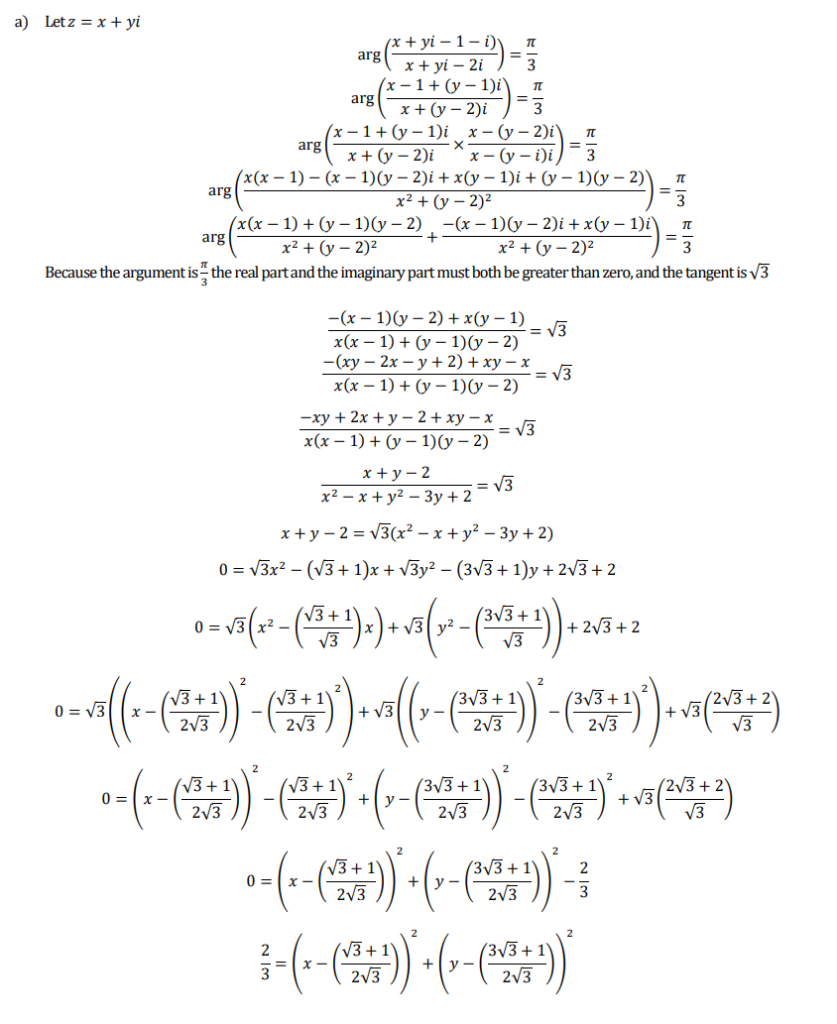
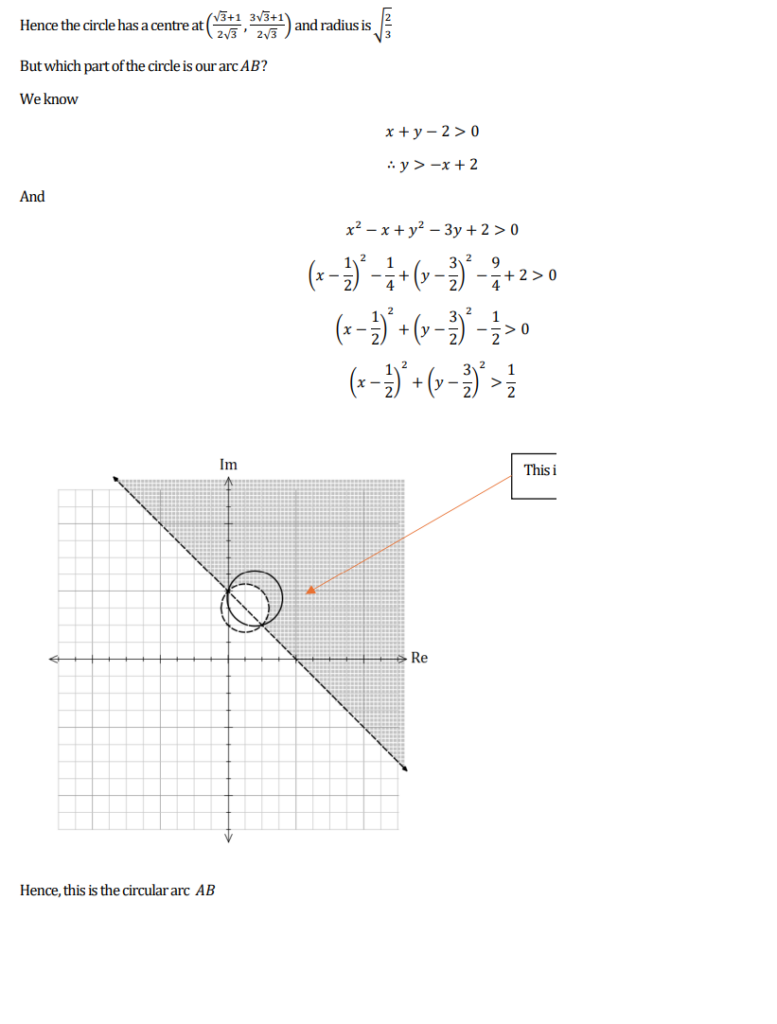
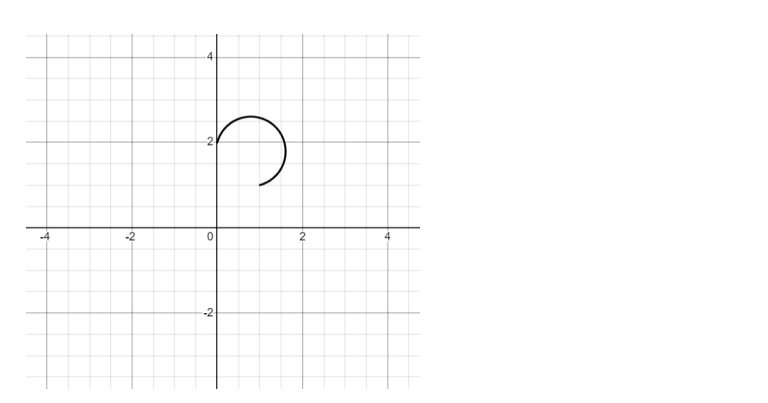
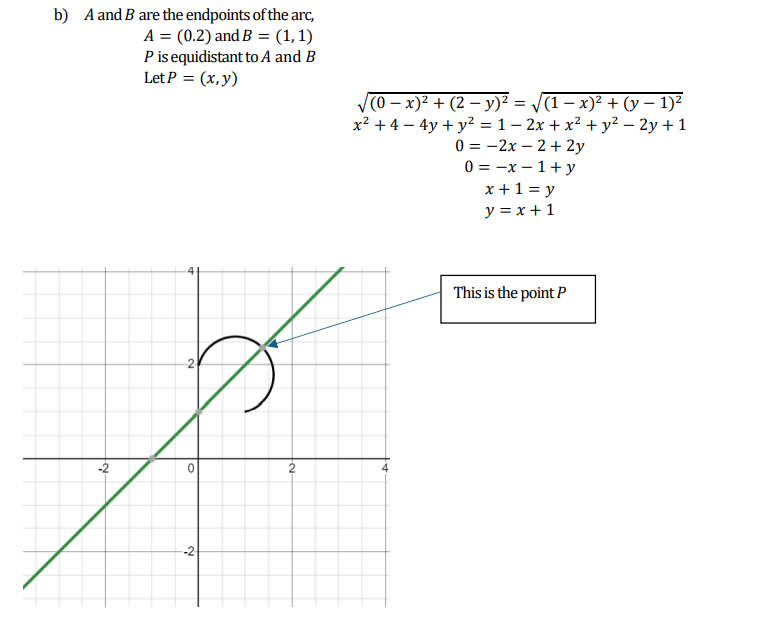
I have split my solution into 6 images and there is a pdf version at the bottom

PDF version of my solution

Leave a Comment

Filed under Complex Numbers, Sketching Complex Regions