Tag Archives: cube roots of unity

Complex Numbers – Roots of Unity

    \begin{equation*}z^n=1, z\in\mathbb{C}\end{equation}

In polar form 1=cis (2\pi)

Hence,

    \begin{equation*}z^n=cis(2\pi k), k\in\mathbb{Z}\end{equation}

    \begin{equation*}z^n=cis(\frac{2\pik}{n})\end{equation}

For example,

    \begin{equation*}z^4=1\end{equation}

    \begin{equation*}z^4=cis(2\pi k)\end{equation}

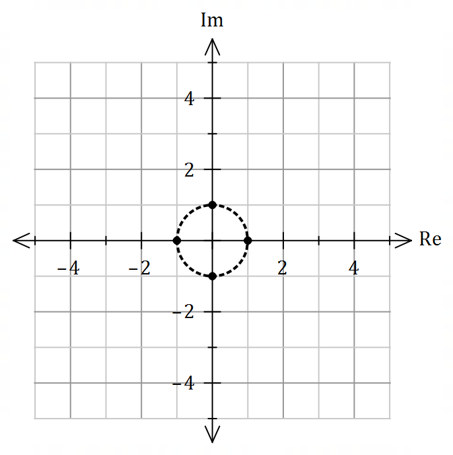
    \begin{equation*}z_k=cis(\frac{2\pi k}{4})=cis(\frac{\pi k}{2})\end{equation}

    \begin{equation*}z_0=1\end{equation}

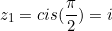
    \begin{equation*}z_1=cis(\frac{\pi}{2})=i\end{equation}

    \begin{equation*}z_2=cis(\pi)=-1\end{equation}

    \begin{equation*}z_3=cis(\frac{3\pi}{2})=-i\end{equation}

The roots of unity are spread evenly (\frac{2\pi}{n} or \frac{360}{n} apart) around a circle of radius 1.

Properties of the roots of Unity

All the roots of unity can be generated by powers of a single root \omega=cis(\frac{2\pi}{n}). The roots form the sequence 1, \omega, \omega^2, \omega^3, ..., \omega^{n-1} Note: \omega \ne 1

For example,

    \begin{equation*}z^4=1\end{equation}

    \begin{equation*}\omega_1=cis(\frac{\pi}{2})\end{equation}

    \begin{equation*}\omega_1^2=cis(\pi)=-1=\omega_2\end{equation}

    \begin{equation*}\omega_1^3=cis(\frac{3\pi}{2})=-i=\omega_3\end{equation}

    \begin{equation*}\omega_1^4=cis(2\pi)=1=\omega_0\end{equation}

A root that can generate the remaining roots is a primitive root.

\omega^k is a primitive root if n and k are coprime.

The sum of the n^{th} roots of unity is always zero.

    \begin{equation*}\Sigma_{k=0}^{n-1}1+\omega+\omega^2+...+\omega^{n-1}=0\end{equation}

The product of the n^{th} roots of unity is

    \begin{equation*}\Pi_{k=0}^{n-1}\omega^k=(-1)^{n-1}\end{equation}

It is 1 when n is odd and -1 when n is even.

Example WATP 2024 Question 7a

(a) Evaluate (4\omega^2+3)(4\omega+3) where \omega is a complex root of unity, \omega\ne 1.

    \begin{equation*}(4\omega^2+3)(4\omega+3)=16\omega^3+12\omega^2+12\omega+9\end{equation}

    \begin{equation*}16\omega^3+12\omega^2+12\omega+9=16(1)+9(\omega^2+\omega+1)+3\omega^2+3\omega\end{equation}

    \begin{equation*}16\omega^3+12\omega^2+12\omega+9=16+9(0)+3(\omega^2+\omega)\end{equation}

    \begin{equation*}16\omega^3+12\omega^2+12\omega+9=16+3(-1)\end{equation}

    \begin{equation*}=13\end{equation}

Remember the sum of the roots is zero, \omega^2+\omega+1=0 hence \omega^2+\omega=-1

Leave a Comment

Filed under Algebra, Complex Numbers, Roots of Unity, Year 12 Specialist Mathematics