Tag Archives: vectors

3D Vector Motion Question

The particle P is moving with velocity v_{P}=(1,1,2)  metres per second from its initial point with position vector (-38, 31, -18) metres. The particle Q is moving with velocity v_{Q}=(1,\lambda,-2) metres per second, where \lambda is a constant. At T seconds, where T>0, particle Q passes through the point with position vector (-35,56,\mu) metres, where \mu is a constant.

Both particles start their motion at the same time, the paths of the particles are perpendicular, and the paths of the particles intersect at point A.

(a)   Determine the position vector of A.

The paths of particles P and Q are perpendicular, so the dot product of their velocity vectors is zero:

(1,1,2)\cdot(1,\lambda,-2)=0

1+\lambda-4=0

\lambda=3

The position vectors are

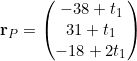
\mathbf{r}_P=\begin{pmatrix}-38+t_1\\31+t_1\\-18+2t_1\end{pmatrix}


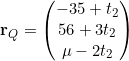
\qquad\mathbf{r}_Q=\begin{pmatrix}-35+t_2\\56+3t_2\\\mu-2t_2\end{pmatrix}

Solve simultaneously:

-38+t_1=-35+t_2

31+t_1=56+3t_2

Equation 1 subtract equation 2:

-69=-91-2t_2

t_2=11

Substitute t_2=11 into equation 1:

-38+t_1=-35+11

t_1=14

Hence, the position vector of A is

\begin{pmatrix}-24\\45\\10\end{pmatrix}

(b) Determine the value of \mu and the value of T so that the particles P and Q will collide

The \mathbf{j}-component of A is 10, therefore

\mu-2t_2=10

t_2=11

\mu=10+2(11)

\mu=32

For the two particles to collide,

t_1=t_2

Particle Q is at the point (-35,56,32) at time T, and it is at point (-24,45,10) 11 seconds later. Both particles start at the same time, hence

T=3

Both particles arrive at A at 14 seconds.

Particle N is moving with constant velocity \mathbf{v}_N) so that its path is perpendicular to both paths of particles P and Q.

(c) Determine the speed of particle N, correct to 0.001 metres per second

As \mathbf{v}_N is perpendicular to P and Q, the vector must be parallel to

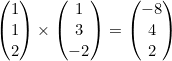
\begin{pmatrix}1\\1\\2\end{pmatrix} \times \begin{pmatrix}1\\3\\-2\end{pmatrix}=\begin{pmatrix}-8\\4\\2\end{pmatrix}

Using the given \mathbf{j}-component of \mathbf{v}_N,

0.8=k\times2

k=0.4

Therefore,

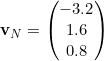
\mathbf{v}_N=\begin{pmatrix}-3.2\\1.6\\0.8\end{pmatrix}

and the speed of particle N is

\sqrt{(-3.2)^2+(1.6)^2+(0.8)^2}

\frac{2\sqrt{101}}{5}\approx 4.02\text{ metres per second}.

Leave a Comment

Filed under Algebra, Cross Product, Simultaneous Equations, Vectors, Year 12 Specialist Mathematics

Using a Vector Method to Find an Angle Bisector

Points A and B are defined by the position vectors \mathbf{a}=3\mathbf{i}+4\mathbf{j} and \mathbf{b}=12\mathbf{i}+5\mathbf{j}.

Find a vector that bisects \angle{AOB}.

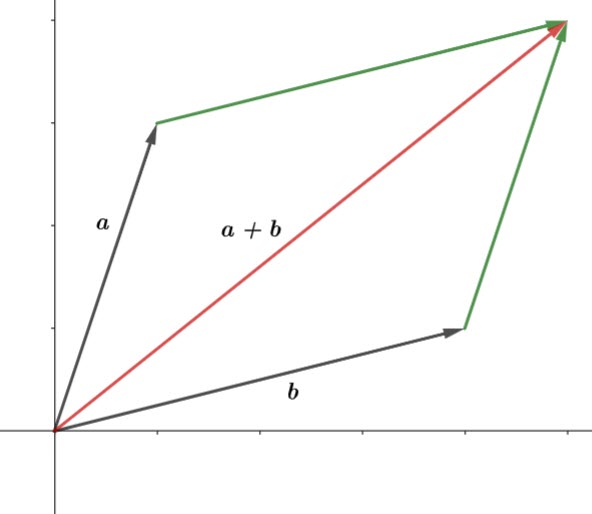
If we think about how we add vectors using the parallelogram rule

Finding the resultant vector using the parallelogram rule

we can take advantage of the geometric properties of parallelograms (or of a rhombus).

If \mathbf{a} and \mathbf{b} are unit vectors, then the parallelogram is a rhombus, and the diagonal (i.e the resultant) bisects the angle.
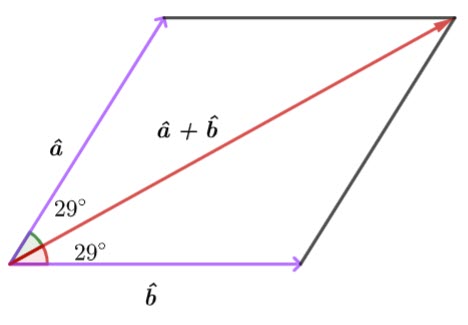

We need to find the sum of the unit vectors.

|\mathbf{a}|=\sqrt{3^2+4^2}=5

\therefore \hat{\mathbf{a}}=\frac{3}{5}\mathbf{i}+\frac{4}{5}\mathbf{j}

|\mathbf{b}|=\sqrt{12^2+5^2}=13

\therefore \hat{\mathbf{b}}=\frac{12}{13}\mathbf{i}+\frac{5}{13}\mathbf{j}

The vector that bisects \angle{AOB} is

\frac{3}{5}\mathbf{i}+\frac{4}{5}\mathbf{j}+\frac{12}{13}\mathbf{i}+\frac{5}{13}\mathbf{j}=\frac{99}{65}\mathbf{i}+\frac{64}{65}\mathbf{j}

Leave a Comment

Filed under Geometry, Vectors, Year 11 Specialist Mathematics