Category Archives: Year 12 Specialist Mathematics

Function Composition

If g(f(x))=\frac{x}{x+1} and f(x)=\frac{1}{1-2x}, find g(x).

    \begin{equation*}g(f(x))=g(\frac{1}{1-2x})=\frac{x}{x+1}\end{equation}

Sometimes you can do this type of question by inspection, but this one is a bit harder. I am going to use a variable substitution.

Let u=\frac{1}{1-2x}

    \begin{equation*}u=\frac{1}{1-2x}\end{equation}

    \begin{equation*}1-2x=\frac{1}{u}\end{equation}

    \begin{equation*}1-\frac{1}{u}=2x\end{equation}

    \begin{equation*}\frac{u-1}{u}=2x\end{equation}

    \begin{equation*}x=\frac{u-1}{2u}\end{equation}

Therefore

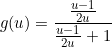
    \begin{equation*}g(u)=\frac{\frac{u-1}{2u}}{\frac{u-1}{2u}+1}\end{equation}

    \begin{equation*}g(u)=\frac{\frac{u-1}{2u}}{\frac{u-1+2u}{2u}}\end{equation}

    \begin{equation*}g(u)=\frac{u-1}{3u-1}\end{equation}

Therefore

    \begin{equation*}g(x)=\frac{x-1}{3x-1}\end{equation}

Let’s test it

g(x)=\frac{x-1}{3x-1} and f(x)=\frac{1}{1-2x}

    \begin{equation*}g(f(x))=\frac{\frac{1}{1-2x}-1}{\frac{3}{1-2x}-1}\end{equation}

    \begin{equation*}g(f(x))=\frac{\frac{1-(1-2x)}{1-2x}}{\frac{3-(1-2x)}{1-2x}}\end{equation}

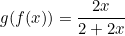
    \begin{equation*}g(f(x))=\frac{2x}{2+2x}\end{equation}

    \begin{equation*}g(f(x))=\frac{x}{x+1}\end{equation}

Leave a Comment

Filed under Algebra, Composition, Functions, Simplifying fractions, Year 12 Specialist Mathematics

Complex Locus Question

My Year 12 Specialist students are working on complex loci again. The following type of question always creates confusion.

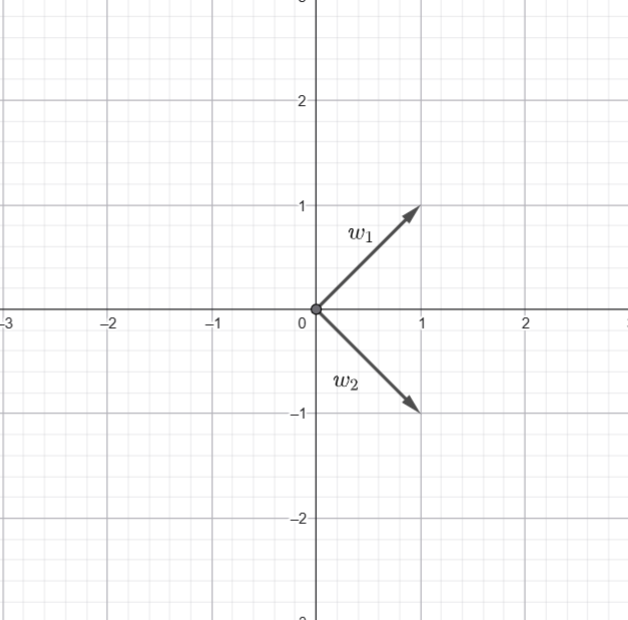
Let z \in \mathbb{C}, w_1=1+i, and w_2=1-i
(a) Show that the locus of points satisfying

    \begin{equation*}arg(z-w_1)-arg(z-w_2)=\frac{\pi}{6}\end{equation}

is the arc of a circle.
(b) Find the centre and radius of the circle, expressing your answers in exact form.

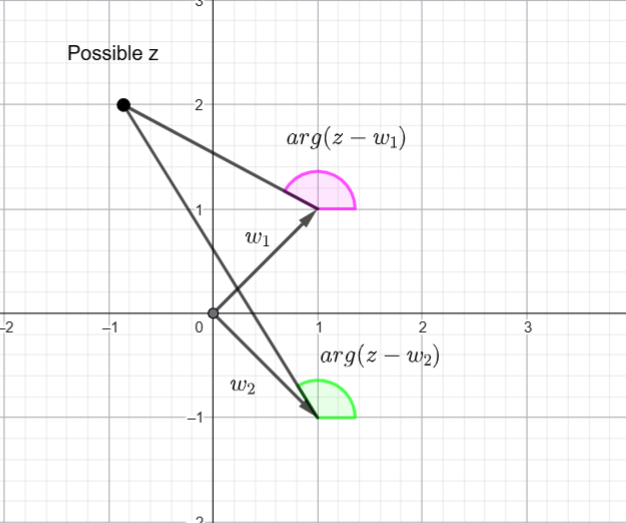
arg(z-w_1) is the angle the vector from w_1 to z makes with the positive x- axis, likewise for arg(z-w_2).

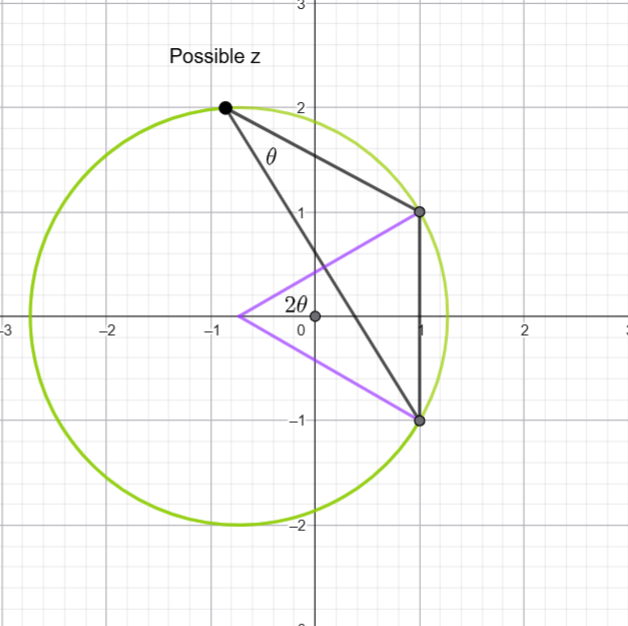
I am going to plot a possible z and try to see the geometry that works.

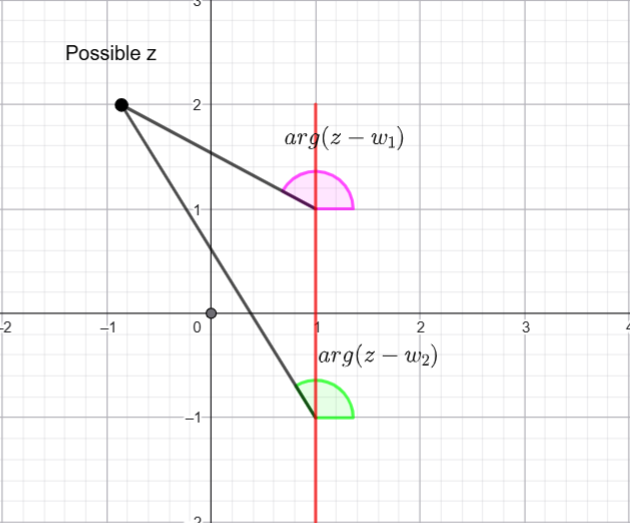
We want arg(z-w_1)-arg(z-w_2)=\frac{\pi}{6}

I am going to take advantage of some triangle geometry

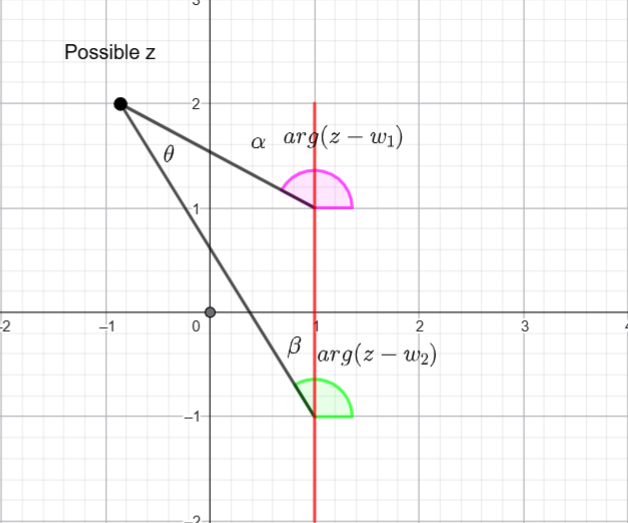
Using the External Angle Theorem, we know \alpha=\beta+\theta

    \begin{equation*}arg(z-w_1)-arg(z-w_2)=(\alpha+\frac{\pi}{2})-(\beta+\frac{\pi}{2}0=\alpha-\beta=\theta\end{equation}

Therefore \theta=\frac{\pi}{6}

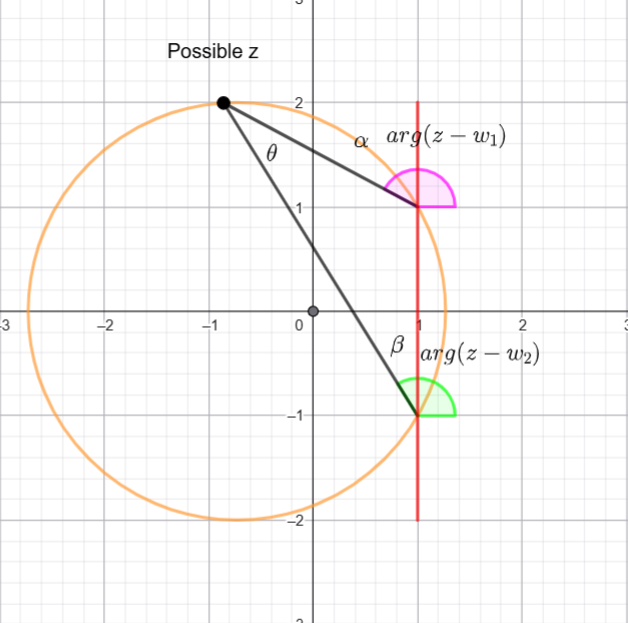
So we want all of the z values that have an angle of \frac{\pi}{6}

Now we are going to use some circle geometry -The angle at the circumference subtended by the same arc are congruent. So we need to find a circle that has those three points (z, w_1 and w_2) on the circumference.

Hence the locus is

Now we need to find the radius and centre of the circle.

Using another circle theorem, the angle at the centre is twice the angle at the circumference.

The triangle must be equilateral (it is isosceles with a vertex angle of \frac{\pi}{3})

Hence the radius is 2.

h=\sqrt{2^2-1^2}=\sqrt{3}

Hence the centre is (-\sqrt{3}+1, 0)

Leave a Comment

Filed under Circle Theorems, Complex Numbers, Geometry, Interesting Mathematics, Pythagoras, Sketching Complex Regions, Year 12 Specialist Mathematics

Complex Numbers and Trig Idenities

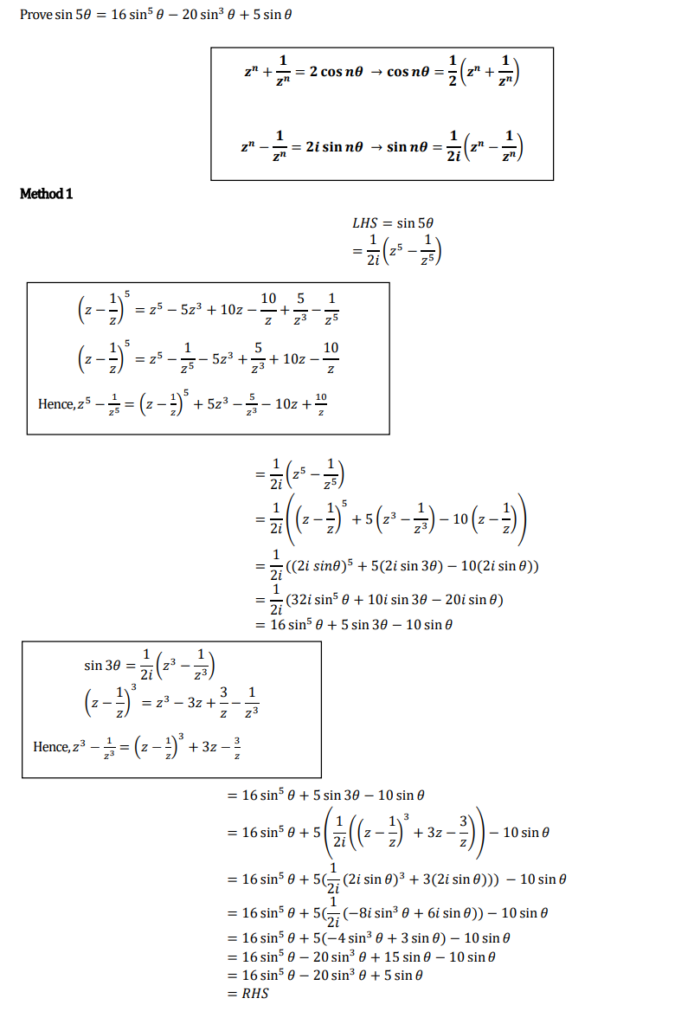
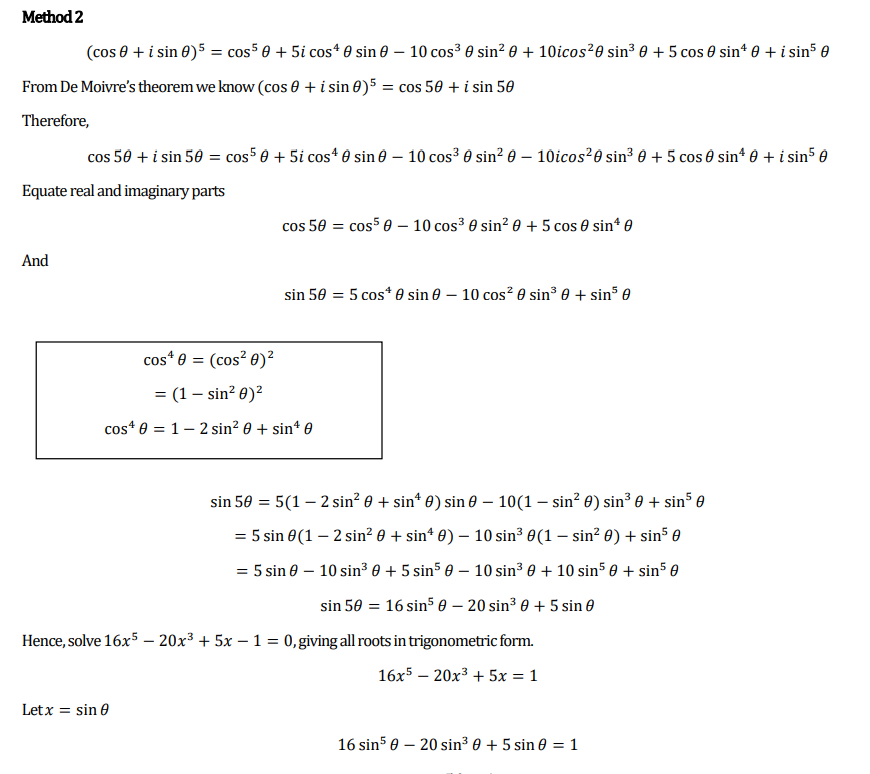
My Year 12 Specialist Students are using complex numbers to prove trigonometric identities.

Things like

    \begin{equation*}sin(5\theta)=16sin^5(\theta) -20sin^3(\theta)+5sin(\theta) \end{equation}

Method 2 might be a little bit easier depending upon how your brain works.

Leave a Comment

Filed under Algebra, Binomial Expansion Theorem, Complex Numbers, Identities, Trig Identities, Trigonometry, Year 12 Specialist Mathematics

Complex Loci Question

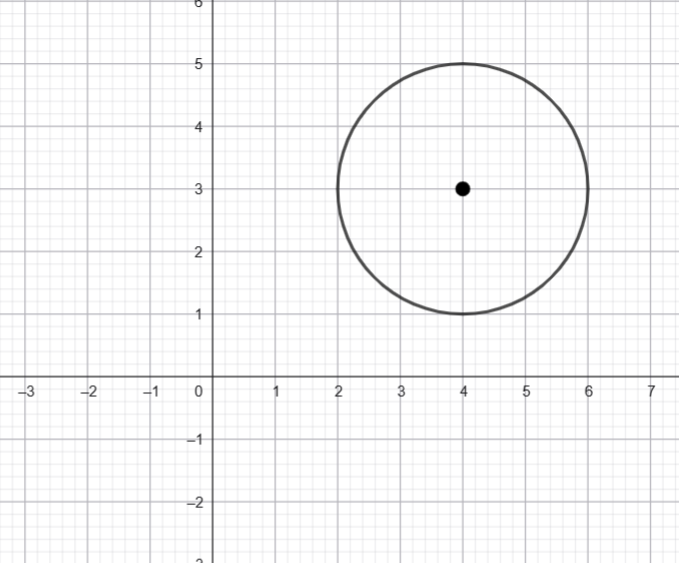
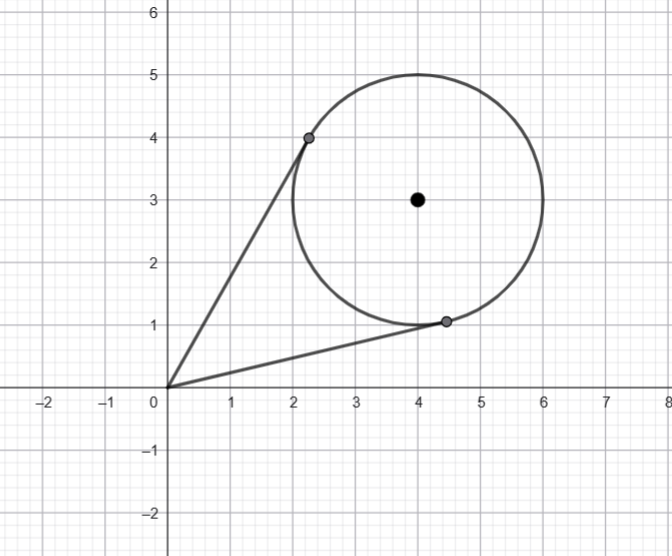
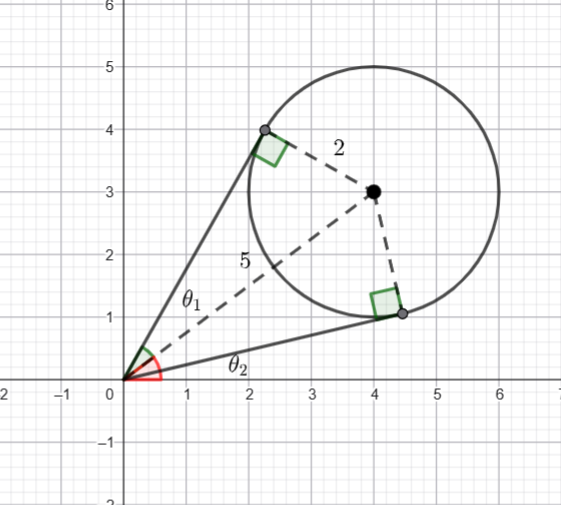
A sketch of the locus of a complex number z is shown above, determine the maximum value of arg(z) correct to two decimal places where 0\le z \le 2\pi

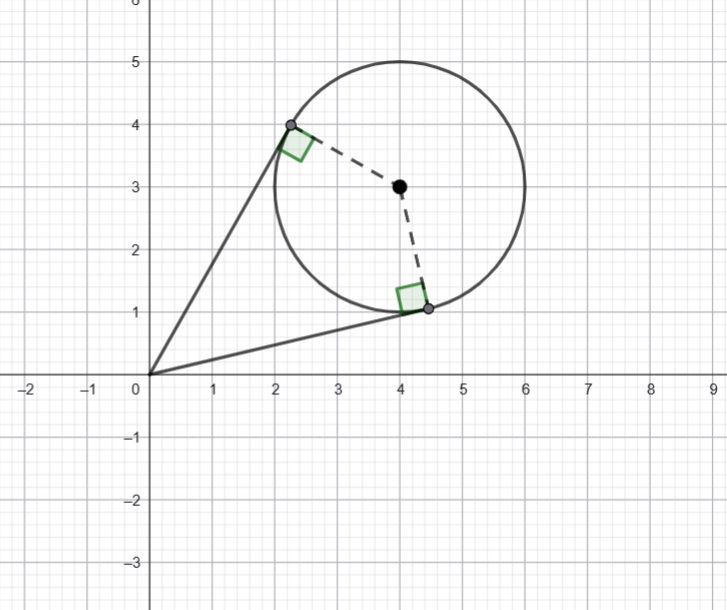
Draw tangent lines from the origin to the circle.

Remember tangent lines are perpendicular to the radii

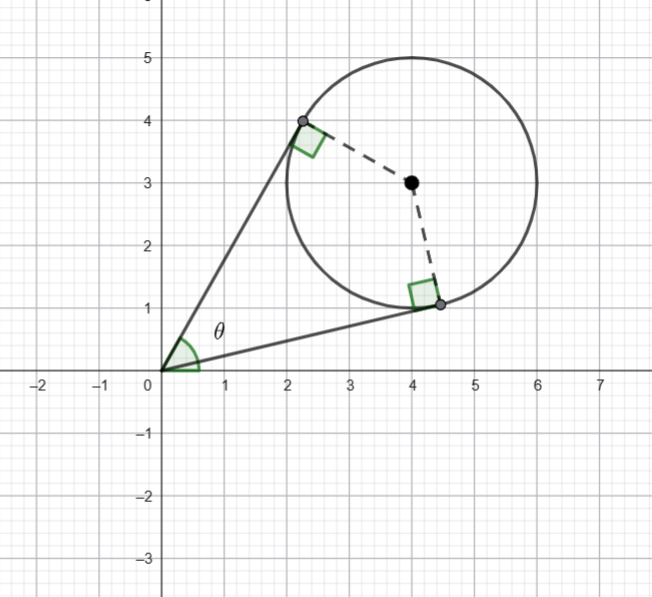
The maximum argument is this angle

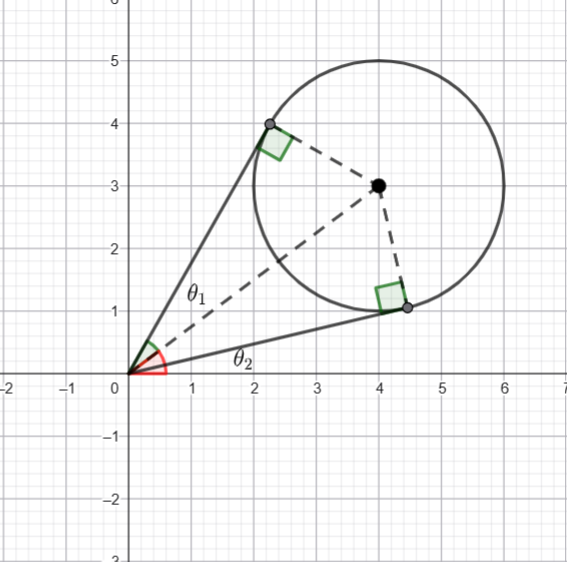
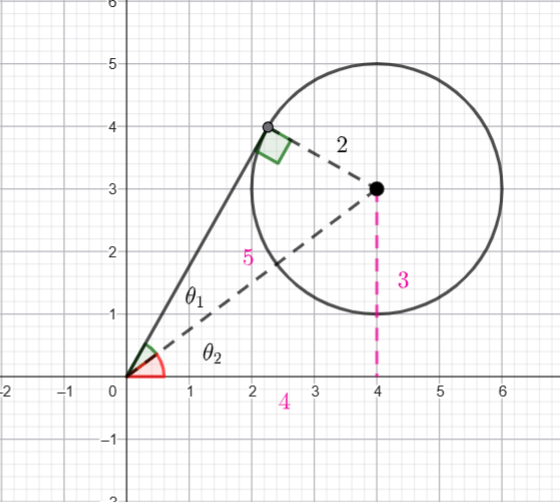
I am going to find the angle in two sections

From the diagram the radius of the circle is 2 and the centre is (4, 3). Hence the distance from the origin to the centre is 5.

    \begin{equation*}sin(\theta_1)=\frac{2}{5}\end{equation}

    \begin{equation*}\theta_1=0.412\end{equation}

    \begin{equation*}sin(\theta_2)=\frac{3}{5}\end{equation}

    \begin{equation*}\theta_2=0.644\end{equation}

Hence maximum arg(z)=1.06

Leave a Comment

Filed under Complex Numbers, Right Trigonometry, Sketching Complex Regions, Trigonometry, Year 12 Specialist Mathematics

Logistic Growth Worked Example

A brumby is a free-roaming wild horse found in large number in parts of Australia. The culling of brumbies was banned in the year 2000. At this time the estimated population of brumbies in
Kosciuszko National Park was 1600. Scientists have modelled the population, P(t), of brumbies in
Kosciuszko National Park t years since the ban, by
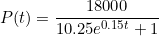
    \begin{equation*}P(t)=\frac{18000}{10.25e^{0.15t}+1}\end{equation}

(a) Use the model to determine how long it will take the brumbies to increase to a number that is triple the number when the ban came into effect.

(b) From this model, determine the estimated long run number of brumbies in Kosciuszko National Park.

It can be shown that the growth rate of the population of brumbies can be expressed as
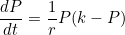
    \begin{equation*}\frac{dP}{dt}=\frac{1}{r}P(k-P)\end{equation}

(c) Determine the values of the constants r and k.

(d) Determine the greatest growth rate for the population of brumbies.

ATAR 2024 Specialist Mathematics Question 13

(a) 1600\times 3=4800

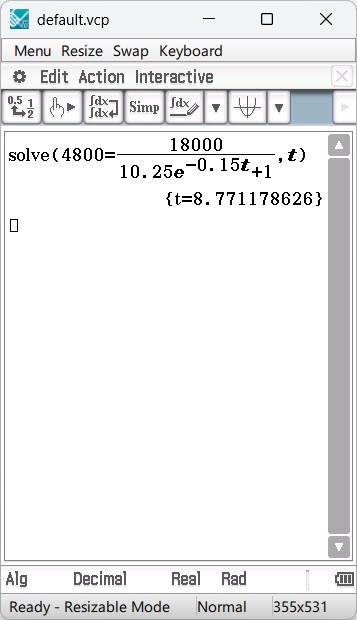
4800=\frac{18000}{10.25e^{0.15t}+1}
t=8.8 years.

(b) \lim_{\limits_{t \to \infty}\frac{18000}{10.25e^{0.15t}+1}=18000

(c)k is the carrying capacity (long run number of Brumbies), therefore k=18000.
Remember,

    \begin{equation*}\frac{dP}{dt}=rP(k-P)\Longleftrightarrow P=\frac{KP_0}{(k-P_0)e^{-rkt}+P_0}\end{equation}

We have \frac{1}{r} instead of r.

Therefore,

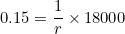
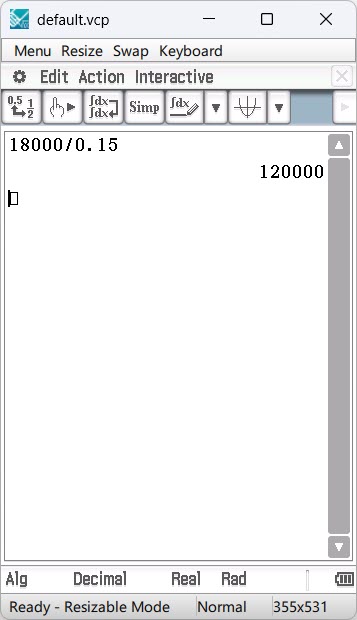
    \begin{equation*}0.15=\frac{1}{r}\times 18000\end{equation}

r=120000

(d) The greatest growth rate occurs when P=\frac{k}{2}=9000
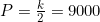
    \begin{equation*}\frac{dP}{dt}=\frac{1}{r}P(k-P)\end{equation}

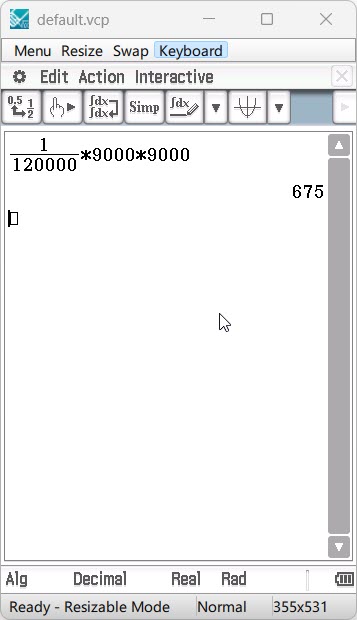
    \begin{equation*}\frac{dP}{dt}=\frac{1}{120000}(9000)(9000)\end{equation}

The greatest growth rate is 675 Brumbies per year.
1 Comment

Filed under Differential Equations, Logistic Growth, Year 12 Specialist Mathematics

Deriving the Logistic Growth Equation

The logistic differential equation

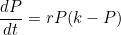
    \begin{equation*}\frac{dP}{dt}=rP(k-P)\end{equation}

where r is the growth parameter and k is the carrying capacity.

And the maximum rate of increase happens when P=\frac{k}{2}

    \begin{equation*}\frac{dP}{dt}=rP(k-P)\end{equation}

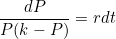
    \begin{equation*}\frac{dP}{P(k-P)}=r dt{\end{equation}

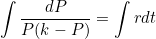
    \begin{equation*}\int \frac{dP}{P(k-P)}=\int r dt{\end{equation}

I am going to separate the denominator on the left hand side

\frac{1}{P(k-P)}=\frac{A}{P}+\frac{B}{k-P}
Hence,
\frac{1}{P(k-P)}=\frac{A(k-P)+BP}{P(k-P)}
1=A(k-P)+BP
When P=0,
1=Ak\Rightarrow A=\frac{1}{k}
When P=k,
1=BK\Rightarrow B=\frac{1}{k}

So our equation is,

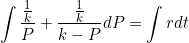
    \begin{equation*}\int \frac{\frac{1}{k}}{P}+\frac{\frac{1}{k}}{k-P} dP=\int r dt\end{equation}

    \begin{equation*}\frac{1}{k}\int \frac{1}{P}+\frac{1}{k-P} dP=\int r dt\end{equation}

    \begin{equation*}\int \frac{1}{P}+\frac{1}{k-P} dP=\int kr dt\end{equation}

    \begin{equation*}ln\lvert{P}\rvert-ln\lvert{k-P}\rvert=krt+c\end{equation}

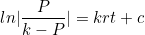
    \begin{equation*}ln\lvert{\frac{P}{k-P}\rvert=krt+c\end{equation}

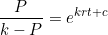
    \begin{equation*}\frac{P}{k-P}=e^{krt+c}\end{equation}

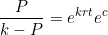
    \begin{equation*}\frac{P}{k-P}=e^{krt}e^{c} \end{equation}

When t=0, P=P_0,

    \begin{equation*}\frac{P_0}{k-P_0}=e^{c} \end{equation}

The equation is now

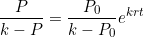
    \begin{equation*}\frac{P}{k-P}=\frac{P_0}{k-P_0}e^{krt}\end{equation}

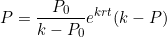
    \begin{equation*}P=\frac{P_0}{k-P_0}e^{krt}(k-P)\end{equation}

    \begin{equation*}P=k\frac{P_0}{k-P_0}e^{krt}-P\frac{P_0}{k-P_0}e^{krt}\end{equation}

    \begin{equation*}P+P\frac{P_0}{k-P_0}e^{krt}=k\frac{P_0}{k-P_0}e^{krt}\end{equation}

    \begin{equation*}P(1+\frac{P_0}{k-P_0}e^{krt})=k\frac{P_0}{k-P_0}e^{krt}\end{equation}

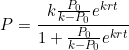
    \begin{equation*}P=\frac{k\frac{P_0}{k-P_0}e^{krt}}{1+\frac{P_0}{k-P_0}e^{krt}}\end{equation}

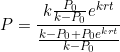
    \begin{equation*}P=\frac{k\frac{P_0}{k-P_0}e^{krt}}{\frac{k-P_0+P_0e^{krt}}{k-P_0}}\end{equation}

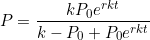
    \begin{equation*}P=\frac{kP_0e^{rkt}}{k-P_0+P_0e^{rkt}}\end{equation}

Divide by e^{rkt}

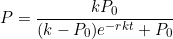
    \begin{equation*}P=\frac{kP_0}{(k-P_0)e^{-rkt}+P_0}\end{equation}

    \begin{equation*}}\frac{dP}{dt}=rP(k-P)\Longleftrightarrow P=\frac{kP_0}{(k-P_0)e^{-rkt}+P_0}\end{equation}

Proving the Maximum Rate of Increase Happens When P=\frac{k}{2}

    \begin{equation*}\frac{dP}{dt}=rP(k-P)\end{equation}

    \begin{equation*}\frac{d^2P}{dt^2}=r\frac{dP}{dt}(k-P)+rP(-\frac{dP}{dt})\end{equation}

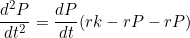
    \begin{equation*}\frac{d^2P}{dt^2}=\frac{dP}{dt}(rk-rP-rP)\end{equation}

    \begin{equation*}\frac{d^2P}{dt^2}=0\end{equation}

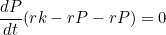
    \begin{equation*}\frac{dP}{dt}(rk-rP-rP)=0\end{equation}

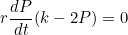
    \begin{equation*}r\frac{dP}{dt}(k-2P)=0\end{equation}

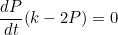
    \begin{equation*}\frac{dP}{dt}(k-2P)=0\end{equation}

    \begin{equation*}rP(k-P)(k-2P)=0\end{equation}

Hence P=k or P=\frac{k}{2}

(1)   \begin{equation*}\frac{d^3P}{dt^3}=\frac{dP^2}{dt^2}(rk-2rP)+\frac{dP}{dt}(-2\frac{dP}{dt})\end{equation*}

Substitute P=k into equation 1

    \begin{equation*}\frac{d^3P}{dt^3}=rk(k-k)(rk-2rk)(rk-2rk)-2(rk(k-k))^2=0\end{equation}

Hence, not a maximum.

Substitute P=\frac{k}{2} into equation 1

    \begin{equation*}\frac{d^3P}{dt^3}=rk(k-\frac{k}{2})(rk-2r\frac{k}{2})(rk-2r\frac{k}{2})-2(rk(k-\frac{k}{2}))^2=0\end{equation}

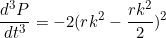
    \begin{equation*}\frac{d^3P}{dt^3}=-2(rk^2-\frac{rk^2}{2})^2\end{equation}

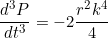
    \begin{equation*}\frac{d^3P}{dt^3}=-2\frac{r^2k^4}{4}\end{equation}

-2\frac{r^2k^4}{4}\le 0 For all values of P, r and k.

Hence maximum when P=\frac{k}{2}

We will look at a worked example in the next post.

Leave a Comment

Filed under Differential Equations, Differentiation, Implicit, Logistic Growth, Optimisation, Product Rule, Uncategorized, Year 12 Specialist Mathematics

Volume of revolution about a line that is not an axis

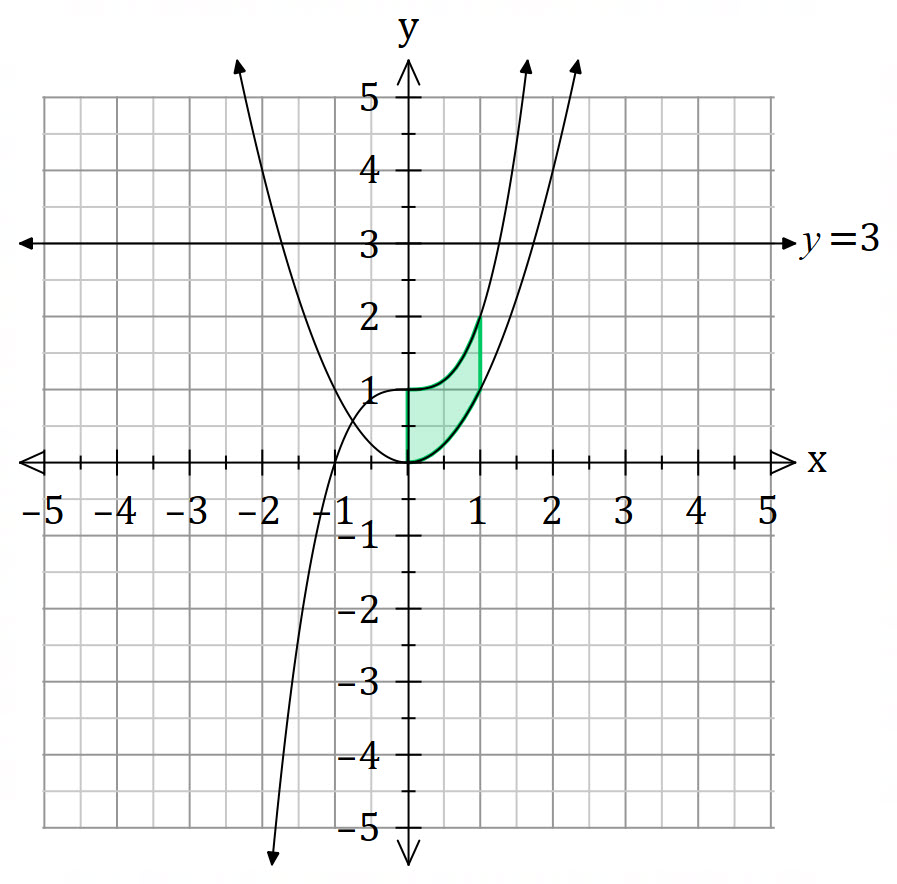
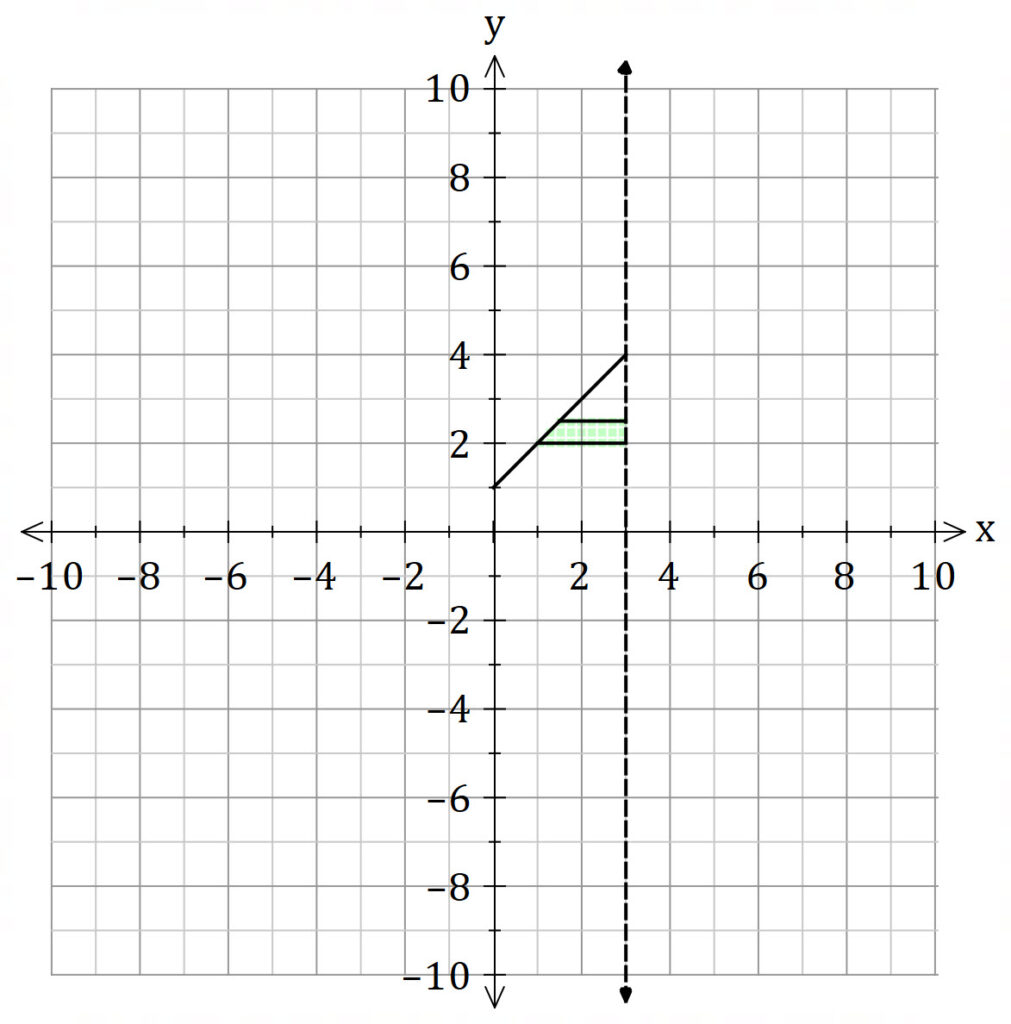
Find the volume of the solid of revolution obtained by rotating the region bounded by f(x)=x^3+1, g(x)=x^2, 0\le x\le 1 about the line y=3.

Rotate the green region about the line y=3

Washer Method

    \begin{equation*}V=\pi \int [f(x)]^2 dx \end{equation}

The volume of the solid is the volume of y=x^2 rotated about y=3 subtract the volume of y=x^3+1 rotated about y=3.

    \begin{equation*}V=\pi \int_0^1((3-x^2)^2-(3-(x^3+1))^2 dx\end{equation}

3-x^2 is the distance (i.e radius) of the curve and the line.


    \begin{equation*}V=\pi \int_0^1(9-6x^2+x^4-(4-4x^3+x^6)) dx\end{equation}

    \begin{equation*}V=\pi \int_0^1(5-6x^2+4x^3+x^4-x^6) dx\end{equation}

    \begin{equation*}V=\pi (5x-2x^3+x^4+\frac{x^5}{5}-\frac{x^7}{7}]_0^1\end{equation}

    \begin{equation*}V=\pi (5-2+1+\frac{1}{5}-\frac{1}{7})\end{equation}

    \begin{equation*}V=\frac{142 \pi}{35}\end{equation}

Shell Method

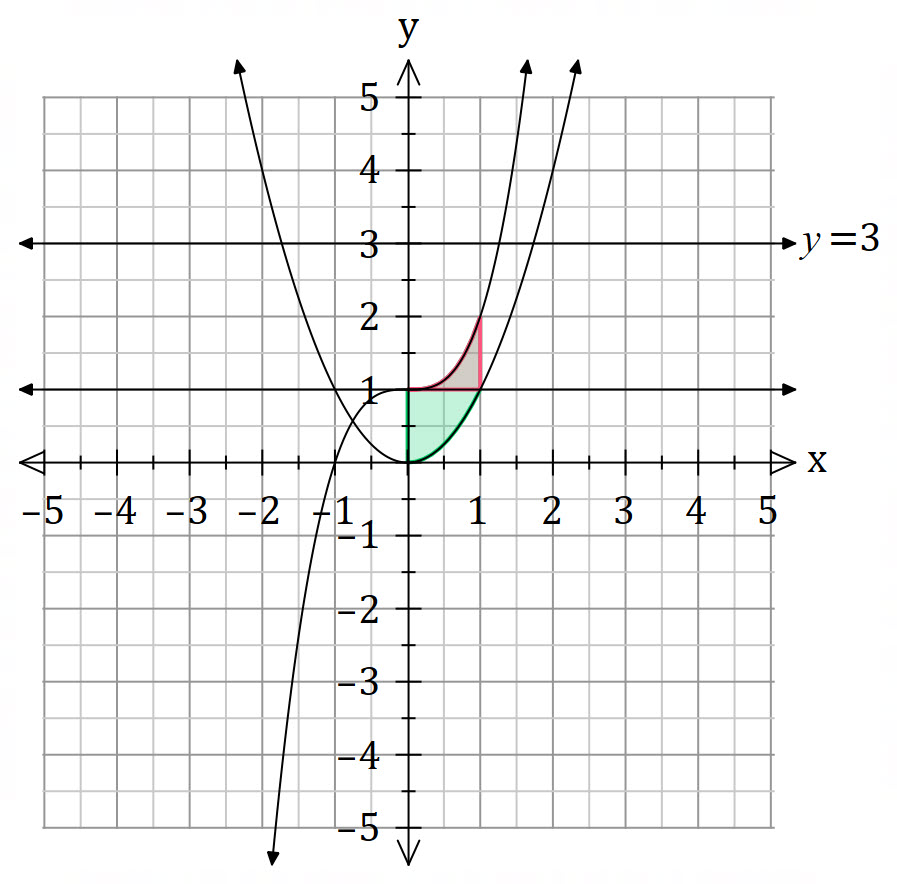
The shell method is much harder because we need to split the integral into two parts.

We need to rotate the green region about y=3 and the red region

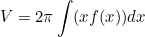
    \begin{equation*}V=2\pi\int (xf(x))dx\end{equation}

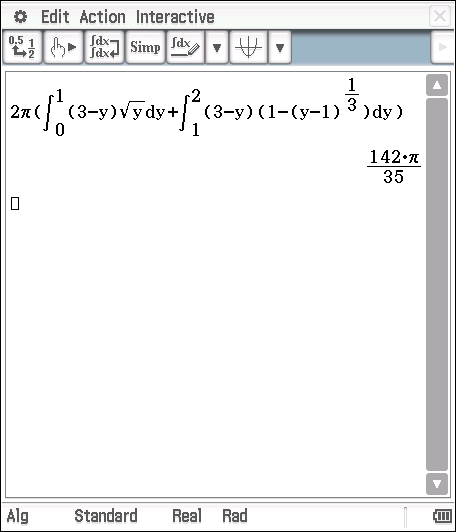
    \begin{equation*}V=2\pi[\int_0^1(3-y)\sqrt{y} dy+\int_1^2 (3-y)(y-1)^{\frac{1}{3}} dy]\end{equation}

3-y is the distance between each y-value and the line of rotation. For example, if we were rotating about the x-axis, the distance is y.

\sqrt{y} is the height of the cylinder between 0 and 1. 1-(y-1)^{\frac{1}{3}} is the height of the cylinder between 1 and 2. Refer back to Shell method for more information.
I used a calculator to find this integral

Leave a Comment

Filed under Integration, Volume of Revolution, Year 12 Specialist Mathematics

Volume of Revolution Method Two (Shell Method)

I am going to use the same example as I did for Method One (Disc or Washer Method).

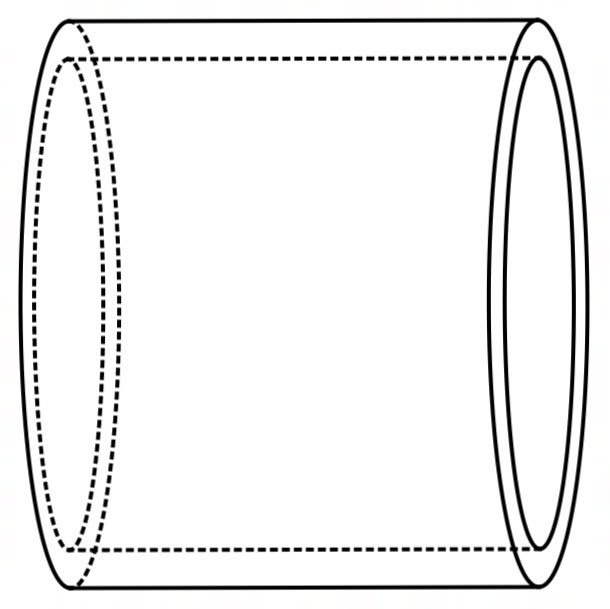
If we rotate the shaded region about the x- axis, we get an open hollow cylinder (like a pipe).

The width of the integral is \delta y and the midpoint is y.

The height of the cylinder is x, but we need it in terms of y, hence x=f(y)

The volume of the hollow cylinder is the volume of the outer cylinder subtract the volume of the inner cylinder.

    \begin{equation*}V=\pi (y+\frac{\delta y}{2})^2f(y)-\pi (y-\frac{\delta y}{2})^2 f(y)\end{equation}

    \begin{equation*}V=\pi f(y)((y+\frac{\delta y}{2})^2-(y-\frac{\delta y}{2})^2)\end{equation}

Which we can expand using a difference of squares.

    \begin{equation*}V=\pi f(y)(y+\frac{\delta y}{2}+y-\frac{\delta y}{2})(y+\frac{\delta y}{2}-y+\frac{\delta y}{2})\end{equation}

    \begin{equation*}V=\pi f(y)(2y \delta y)\end{equation}

    \begin{equation*}V=2\pi yf(y)\delta y\end{equation}

The volume of the entire sold will be

    \begin{equation*}V=\Sigma_{y=a}^b 2 \pi yf(y)\delta y\end{equation}

As \delta y \rightarrow 0

    \begin{equation*}V=\lim\limits_{\delta y \to 0}\Sigma_{y=a}^b 2 \pi yf(y)\delta y=\int_a^b 2\pi yf(y) dy\end{equation}

Even though we are rotating the line about the x-axis, we are integrating with respect to the y- axis.

Example

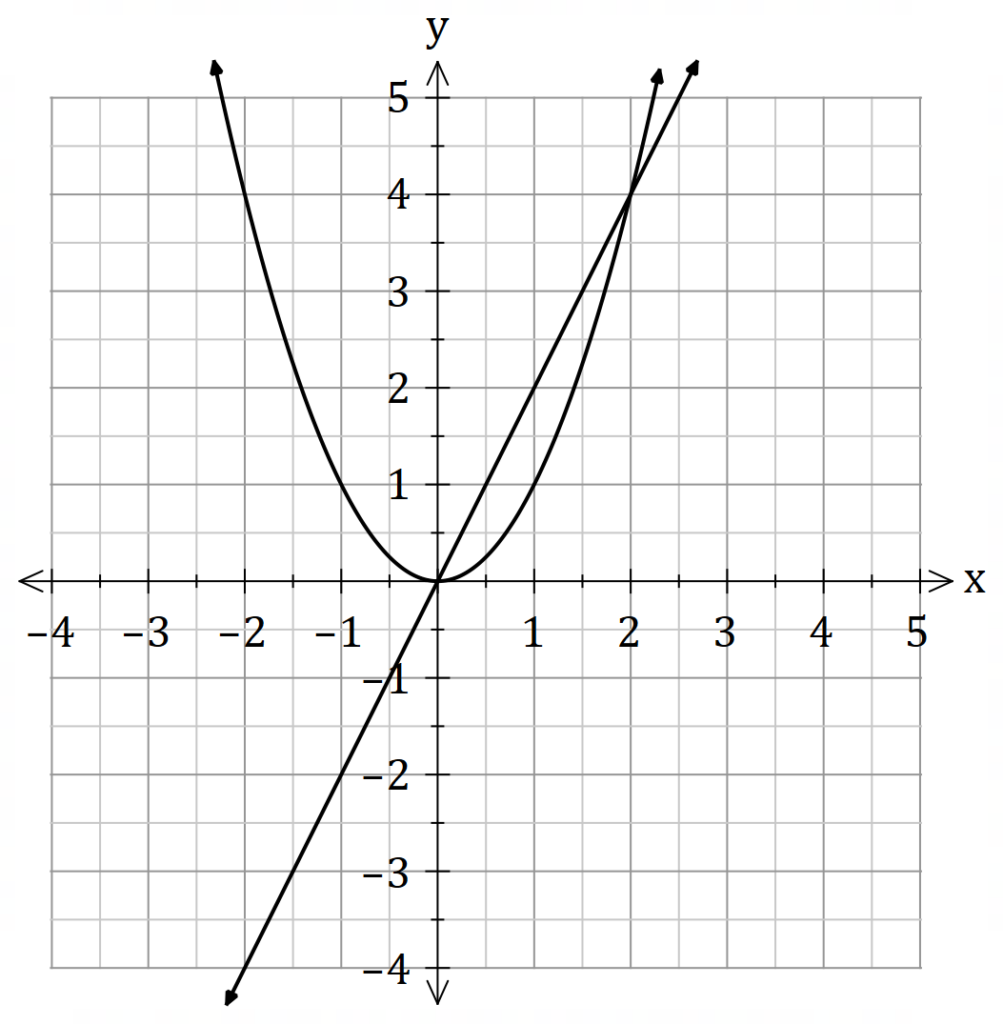
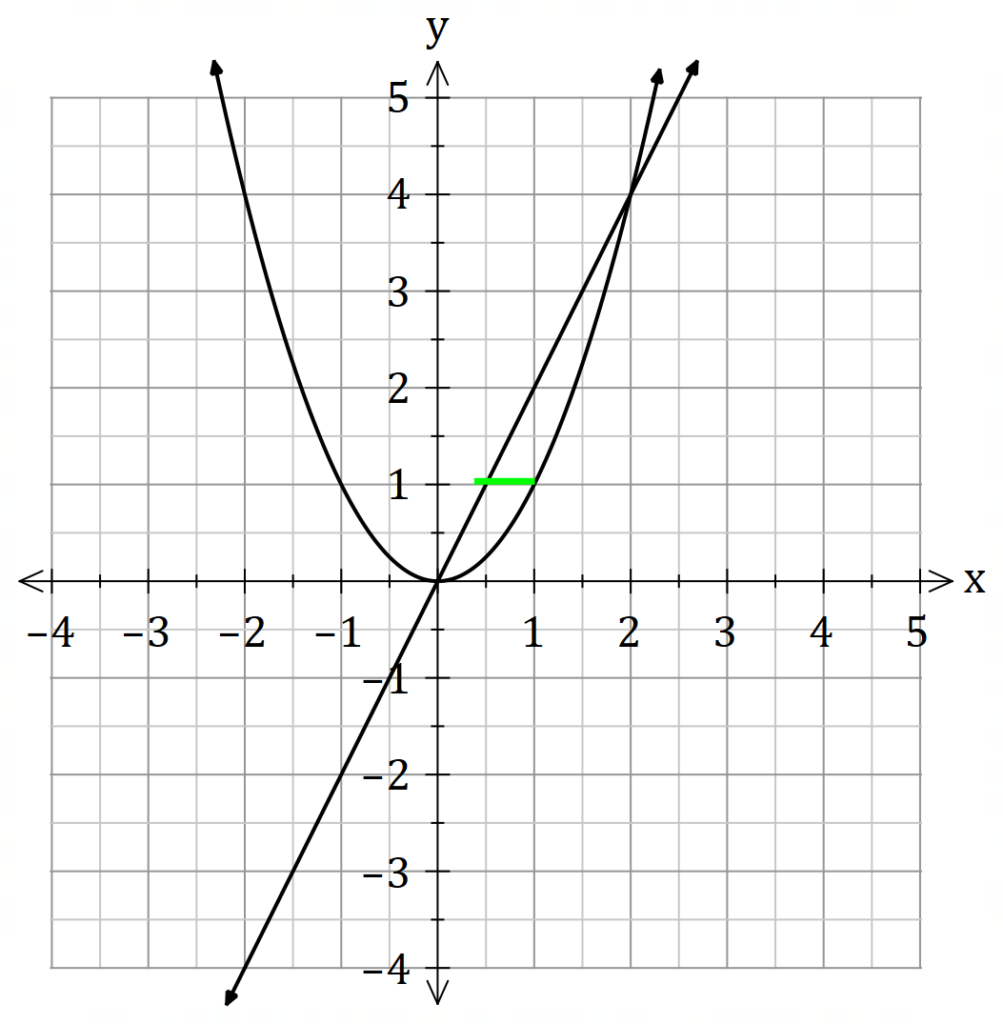
Find the volume of the solid generated by revolving the region between y=x^2 and y=2x about the y-axis.

If we are rotating about the y-axis, we will integrate with respect to x.

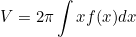
    \begin{equation*}V=2\pi \int x f(x) dx\end{equation}

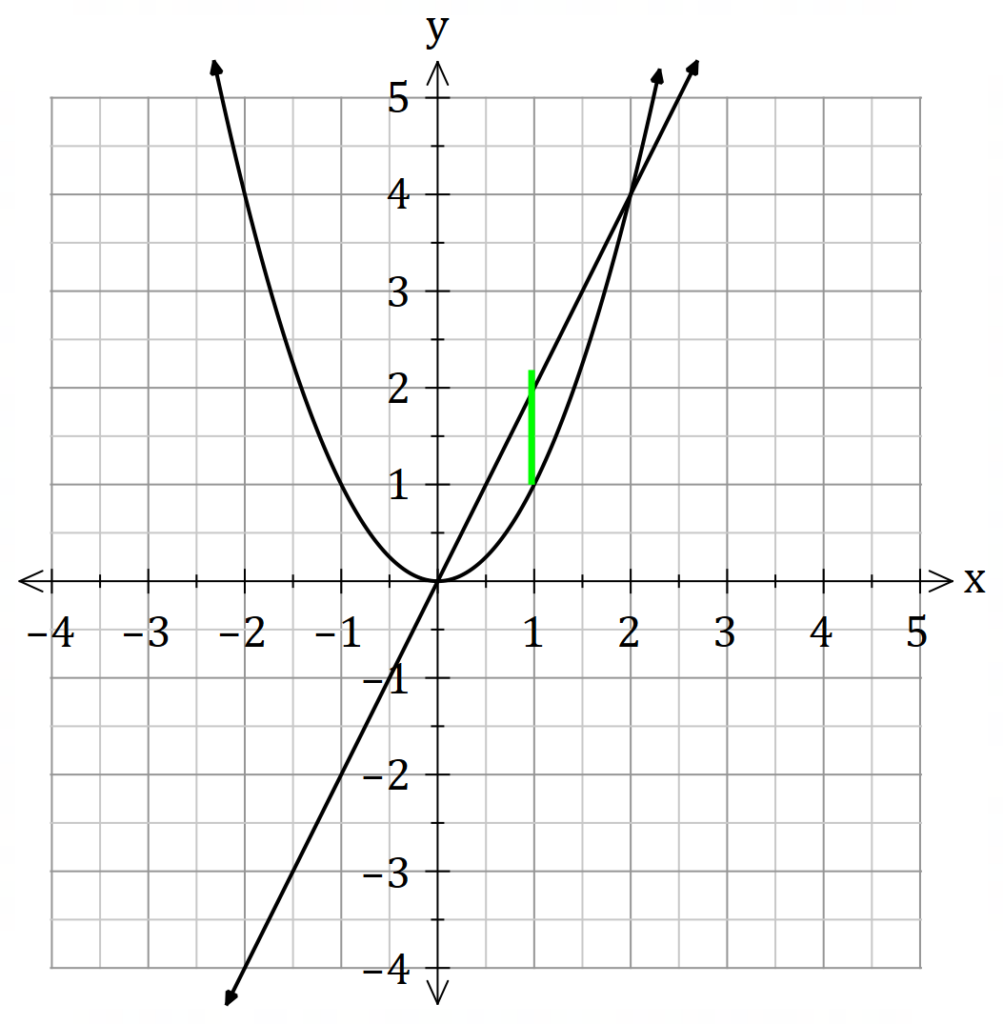
The height of our hollow cylinder is 2x-x^2

Hence

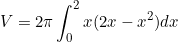
    \begin{equation*}V=2\pi\int_0^2 x(2x-x^2) dx\end{equation}

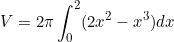
    \begin{equation*}V=2\pi \int_0^2 (2x^2-x^3) dx\end{equation}

    \begin{equation*}V=2\pi (\frac{2x^3}{3}-\frac{x^4}{4}]_0^2\end{equation}

    \begin{equation*}V=2\pi (\frac{2}{3}\times 8-\frac{1}{4}\times 16 )\end{equation}

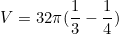
    \begin{equation*}V=32 \pi(\frac{1}{3}-\frac{1}{4})\end{equation}

    \begin{equation*}V=\frac{8\pi}{3}\end{equation}

Let’s check with method one.

x^2=y and x=\frac{y}{2}

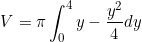
    \begin{equation*}V=\pi \int_0^4 y-\frac{y^2}{4} dy\end{equation}

    \begin{equation*}V=\pi (\frac{y^2}{2}-\frac{y^3}{12})]_0^4\end{equation}

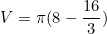
    \begin{equation*}V=\pi(8-\frac{16}{3})\end{equation}

    \begin{equation*}V=\frac{8\pi}{3}\end{equation}

I try to pick the method that makes the integration easier.

1 Comment

Filed under Integration, Volume of Revolution, Year 12 Specialist Mathematics

Volume of Revolution – Method One (Disc or Washer Method)

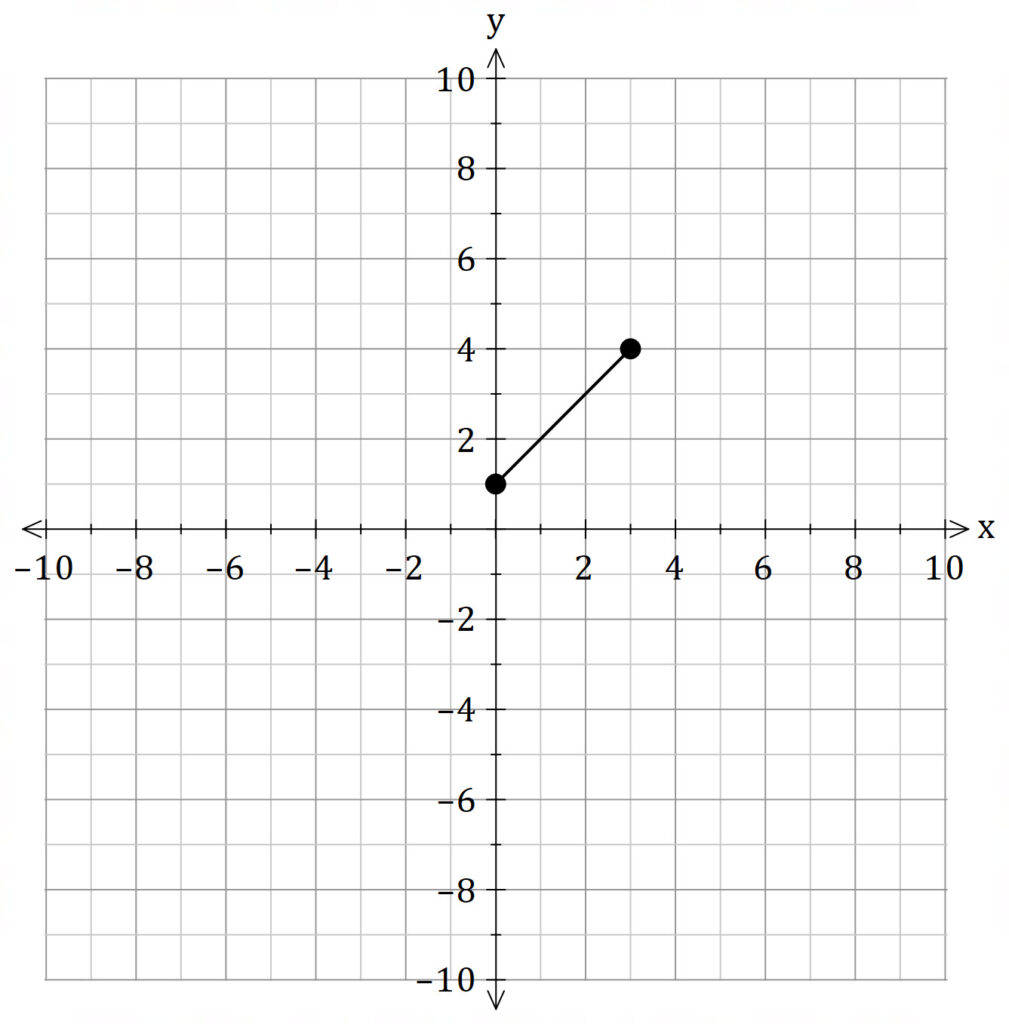
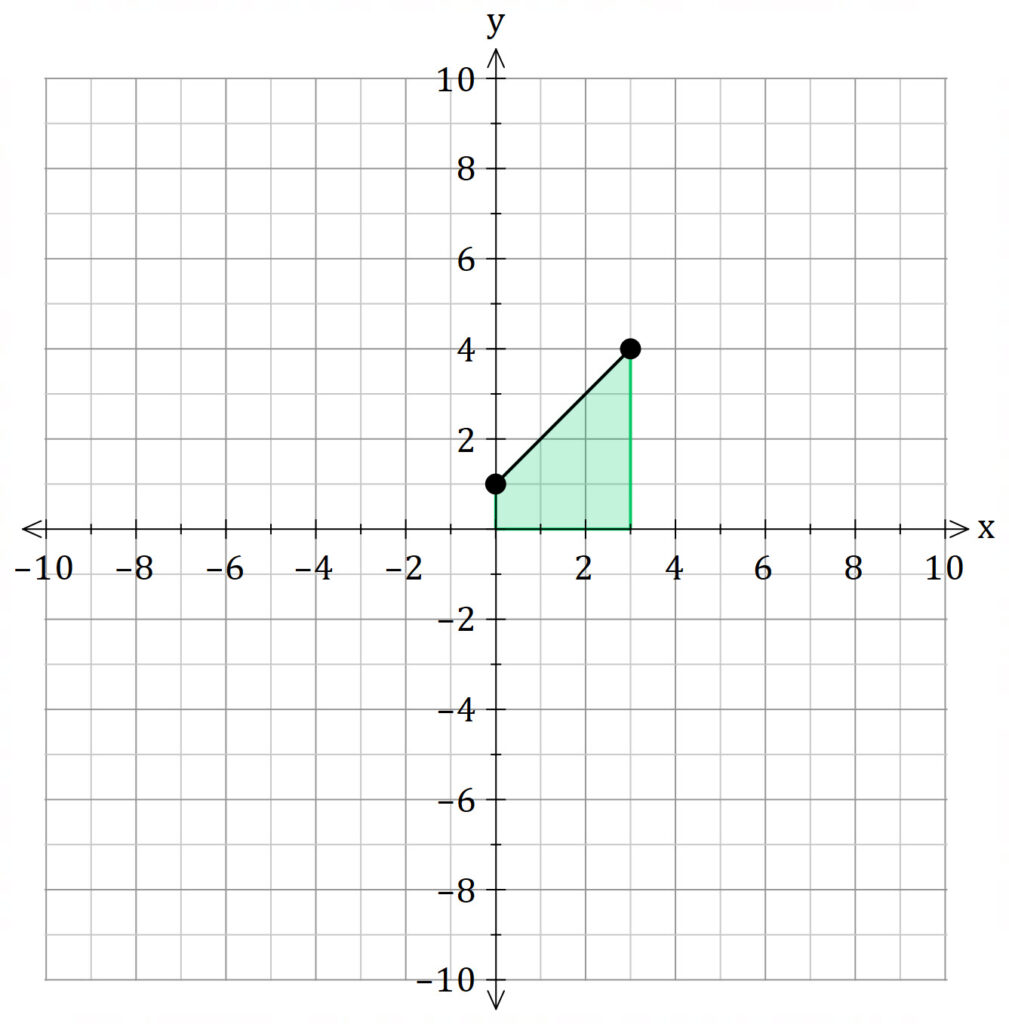
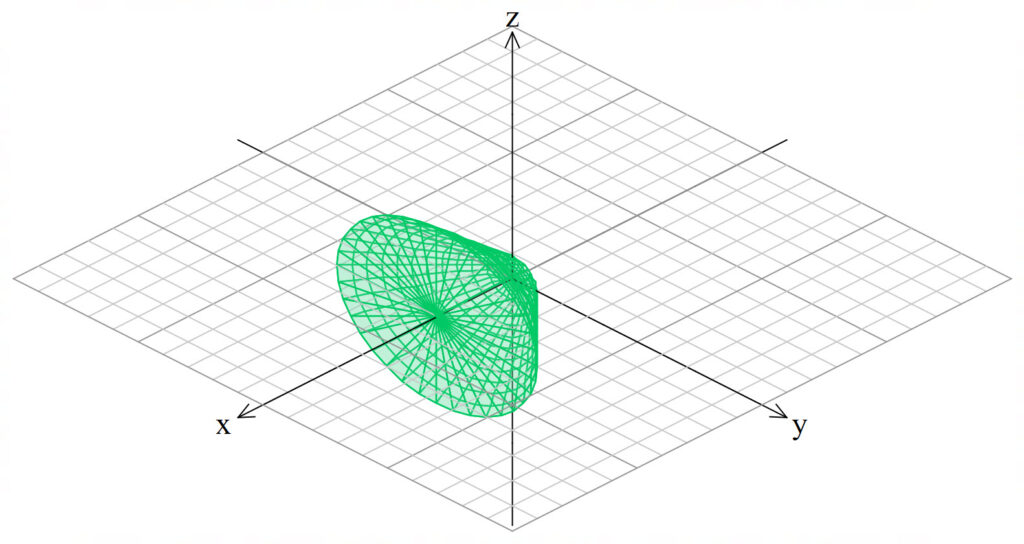
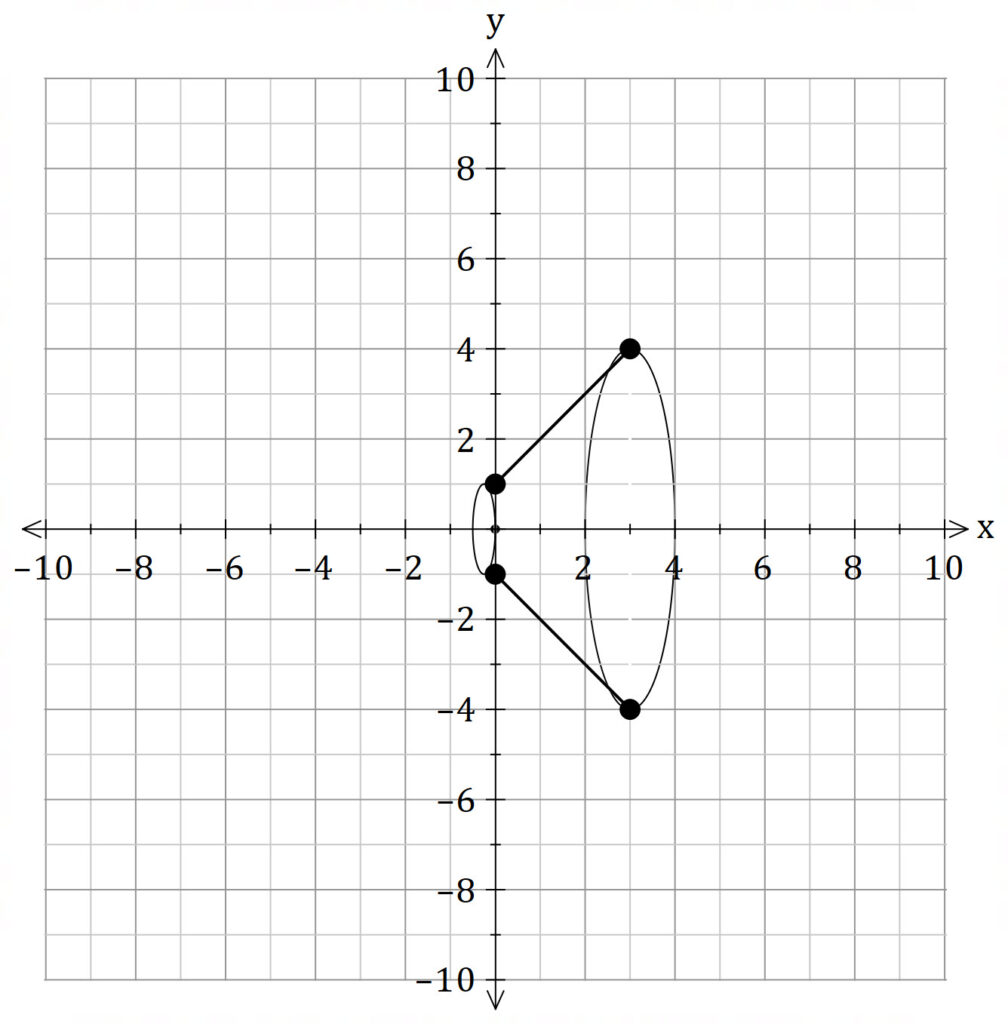
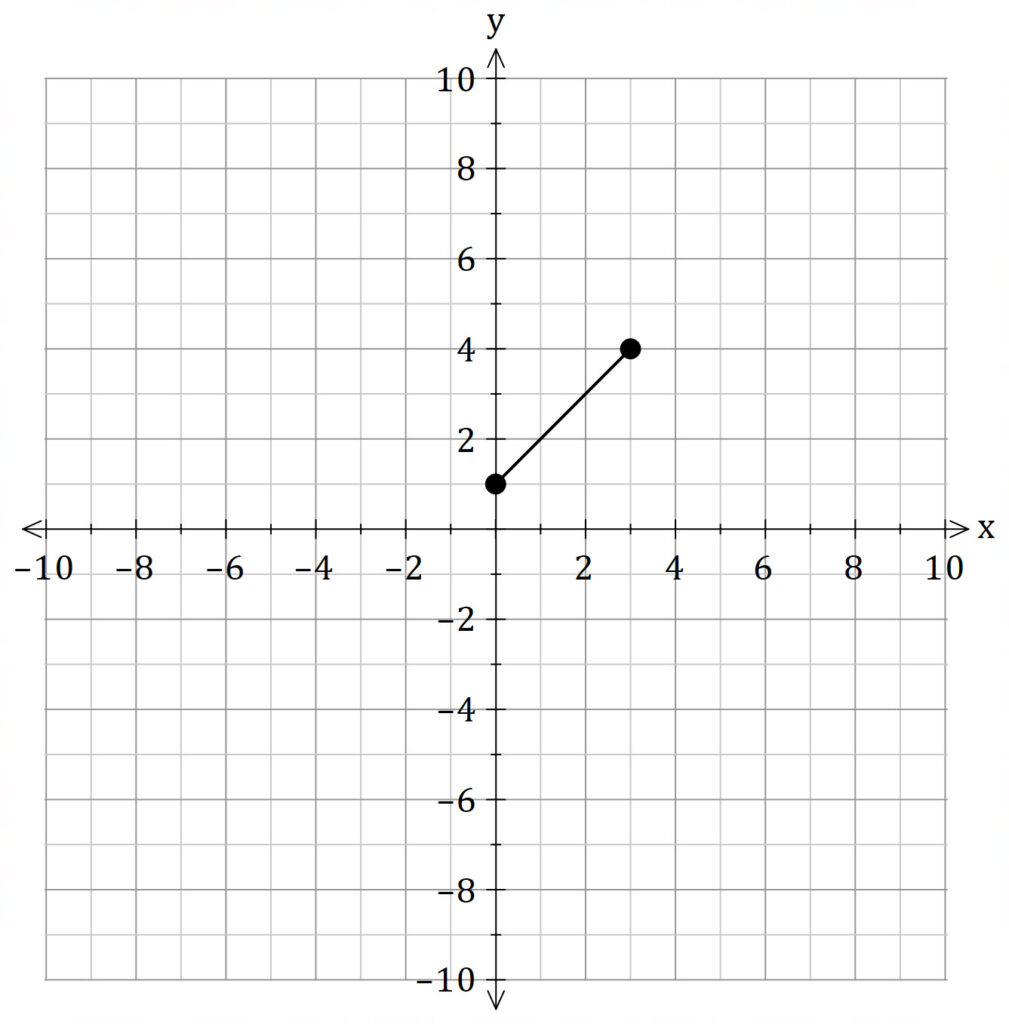
If we rotate this line segment around the x-axis, we generate a three dimensional solid.

We are going to find the volume of this solid.

This is a better view of the solid

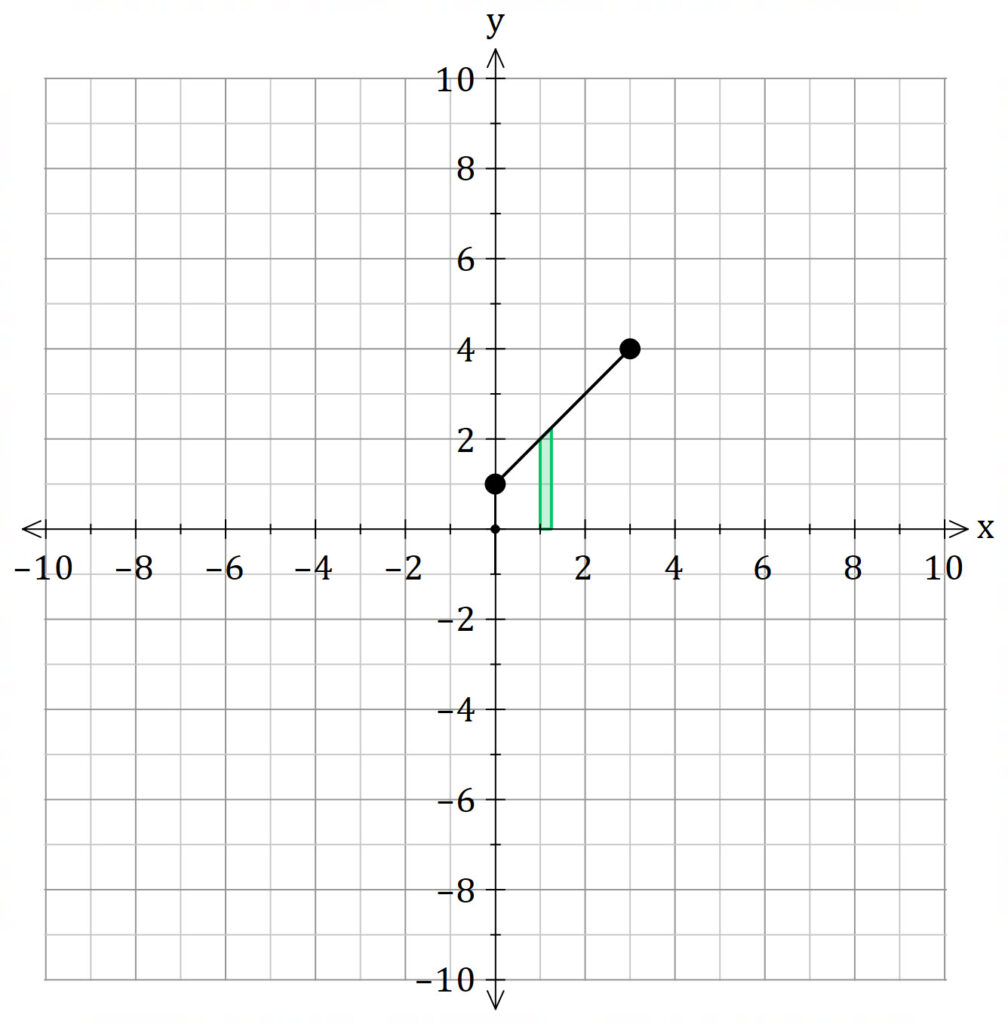
Consider a small section of the line segment and rotate this about the x-axis.

As the width of the section (\delta x) gets smaller (i.e. \rightarrow 0), the solid is a cylinder.

The radius of the cylinder is f(x) and the height of the cylinder is \delta x.

The volume of a cylinder is V=\pi r^2 h

Hence the volume of our section is

    \begin{equation*}V=\pi[f(x)]^2\delta x\end{equation}

If we divide our line segment into a large number of cylinders (of equal height) then,

    \begin{equation*}V=\Sigma_a^b(\pi [f(x)]^2\delta x\end{equation}

where a is the lower x value and b the upper.

Now we want \delta x\rightarrow 0 so V=\lim\limits_{\delta x \to 0} \Sigma_a^b(\pi [f(x)]^2\delta x

Which is

    \begin{equation*}V=\int_a^b \pi [f(x)]^2 dx\end{equation}

Example

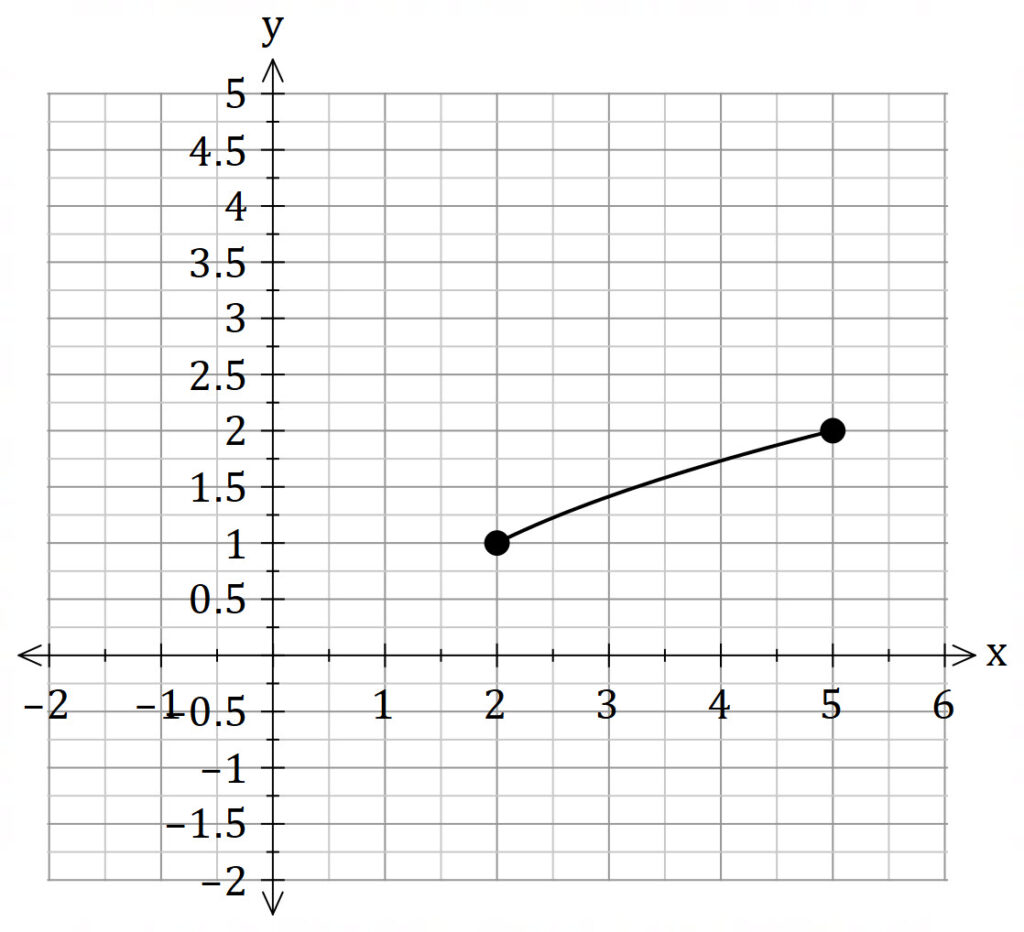
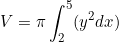
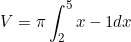
The curve y=\sqrt{x-1}, where 2\le x\le5 is rotated about the x-axis to form a solid of revolution. Find the volume of this solid.

    \begin{equation*}V=\pi \int_2^5( y^2 dx)\end{equation}

    \begin{equation*}V=\pi \int_2^5 x-1 \space dx \end{equation}

    \begin{equation*}V=\pi (\frac{x^2}{2}-x]_2^5)\end{equation}

    \begin{equation*}V=\pi(\frac{25}{2}-5-(\frac{4}{2}-2))\end{equation}

    \begin{equation*}V=\frac{15 \pi}{2}\end{equation}

1 Comment

Filed under Integration, Volume of Revolution, Year 12 Specialist Mathematics