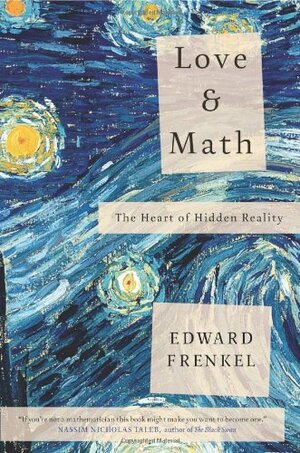
Love & Math – Edward Frenkel

Love & Math – Edward Frenkel

A friend left this behind when they moved countries (knowing that I liked maths). This was my second attempt at reading it.

Here’s the blurb …

What if you had to take an art class in which you were only taught how to paint a fence? What if you were never shown the paintings of van Gogh and Picasso, weren’t even told they existed? Alas, this is how math is taught, and so for most of us it becomes the intellectual equivalent of watching paint dry.

In Love and Math , renowned mathematician Edward Frenkel reveals a side of math we’ve never seen, suffused with all the beauty and elegance of a work of art. In this heartfelt and passionate book, Frenkel shows that mathematics, far from occupying a specialist niche, goes to the heart of all matter, uniting us across cultures, time, and space.

Love and Math tells two intertwined stories: of the wonders of mathematics and of one young man’s journey learning and living it. Having braved a discriminatory educational system to become one of the twenty-first century’s leading mathematicians, Frenkel now works on one of the biggest ideas to come out of math in the last 50 years: the Langlands Program. Considered by many to be a Grand Unified Theory of mathematics, the Langlands Program enables researchers to translate findings from one field to another so that they can solve problems, such as Fermat’s last theorem, that had seemed intractable before.

At its core, Love and Math is a story about accessing a new way of thinking, which can enrich our lives and empower us to better understand the world and our place in it. It is an invitation to discover the magic hidden universe of mathematics.

I believe the aim of this book was to show non-maths people the beauty and joy of mathematics. However, I think it would be hard going if you didn’t have a mathematics background. This is high level mathematics (at one stage he mentions that there are probably about 12 people in the world who understand what he is discussing). Having said that, I liked it. I particularly liked the personal aspects of the narrative – his life experiences, and the people he met and with whom he worked.

A review

Leave a Comment

Filed under Book Review

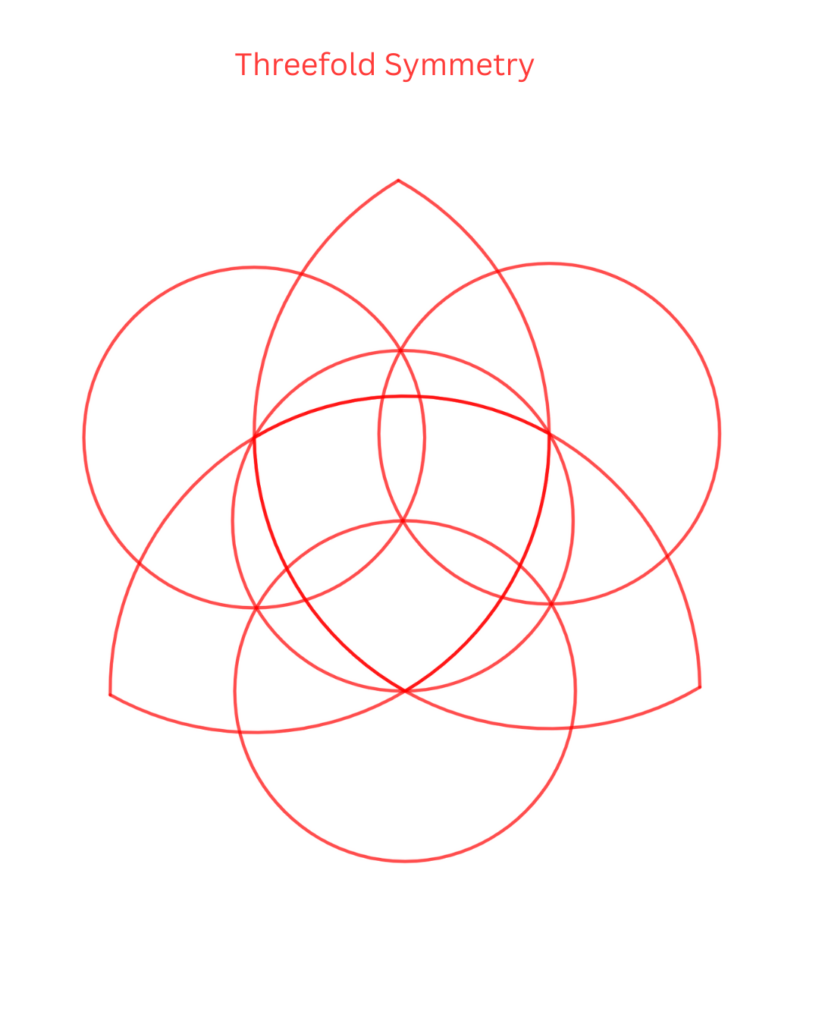
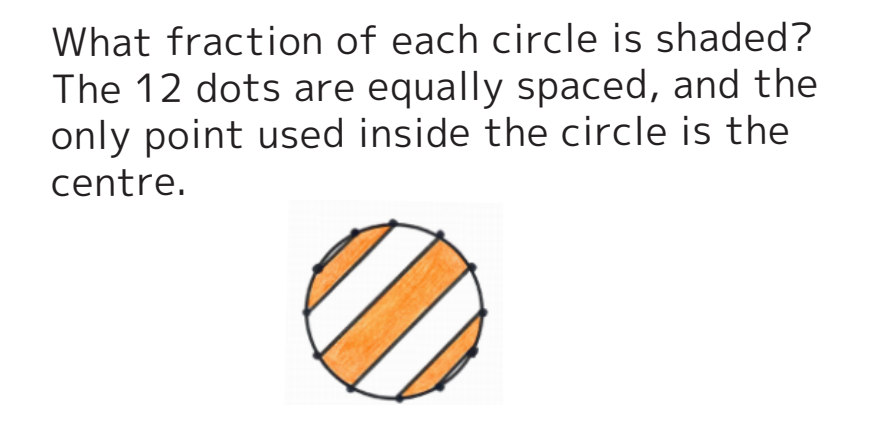
Geometry Puzzle (finding a fraction of an area)

Geometry Puzzles in Felt Tip: A Compilation of puzzles from 2018 – Catriona Shearer

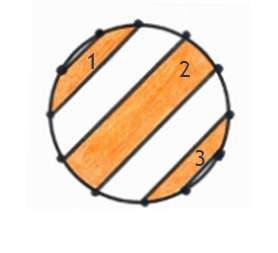
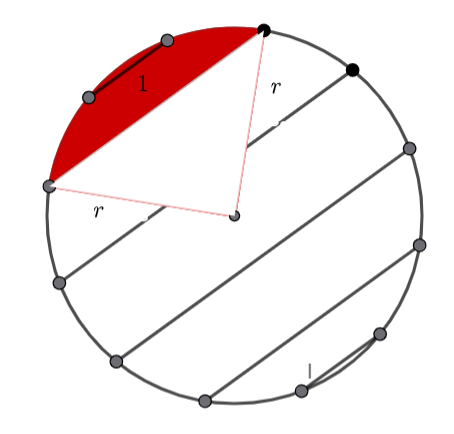
Band 1 and 3 have the same area.

We want to find the area of the shaded segment.

As the dots are equally spaced, the sector’s angle is \frac{\pi}{2} = (\frac{2\pi}{12}\times 3)

Remember the area of a segment is A=\frac{1}{2}r^2(\theta-sin(\theta)) where the angle measurement is in radians.

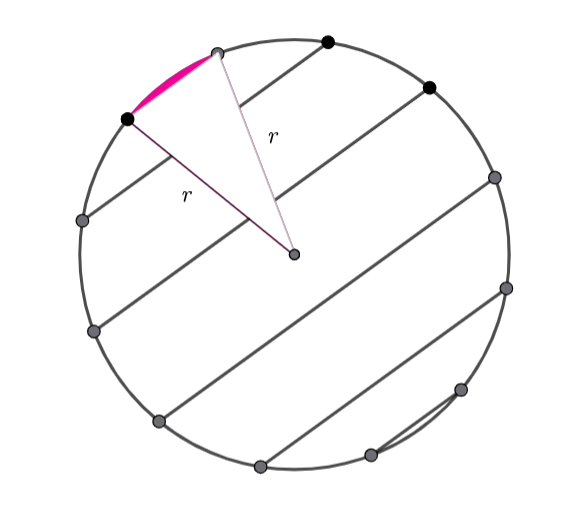
(1)   \begin{equation*}A=\frac{1}{2}r^2(\frac{\pi}{2}-sin(\frac{\pi}{2}))=\frac{1}{2}r^2(\frac{\pi}{2}-1))=\frac{\pi r^2}{4}-\frac{r^2}{2}\end{equation*}

We want to find the area of the shaded segment.

As the dots are equally spaced, the sector’s angle is \frac{2\pi}{12} = (\frac{\pi}{6})

(2)   \begin{equation*}A=\frac{1}{2}r^2(\frac{\pi}{6}-sin(\frac{\pi}{6}))=\frac{\pi r^2}{12}-\frac{r^2}{4}\end{equation*}

The area of band 1 is equation 1 -equation 2.

(3)   \begin{equation*}\frac{\pi r^2}{4}-\frac{r^2}{2}-(\frac{\pi r^2}{12}-\frac{r^2}{4})=\frac{\pi r^2}{6}-\frac{r^2}{4}\end{equation*}

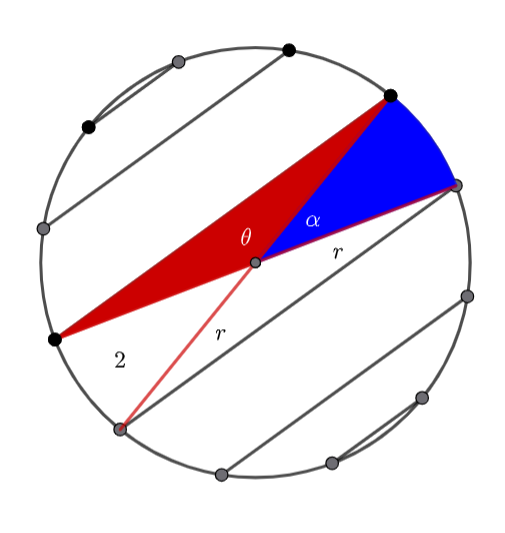
Band 2 consists of two congruent triangles and two congruent sectors.

    \begin{equation*}\theta=\frac{2\pi}{12}\times 5=\frac{5\pi}{6}, \alpha=\frac{\pi}{6}\end{equation}

(4)   \begin{equation*}A=2(\frac{1}{2}r^2sin(\frac{5\pi}{6}))+2(\frac{1}{2}r^2\frac{\pi}{6})=\frac{r^2}{2}+\frac{r^2 \pi}{6}\end{equation*}

Hence the shaded area is 2(\frac{\pi r^2}{6}-\frac{r^2}{4})+\frac{r^2}{2}+\frac{r^2 \pi}{6}=\frac{\pi r^2}{2}

The area of the circle is \pi r^2

Hence the fraction of the shaded area is =\frac{\frac{\pi r^2}{2}}{\pi r^2}=\frac{1}{2}

Leave a Comment

Filed under Area, Area of Triangles (Sine), Finding an area, Geometry, Puzzles, Simplifying fractions

Christmas Cartesian Co-ordinates

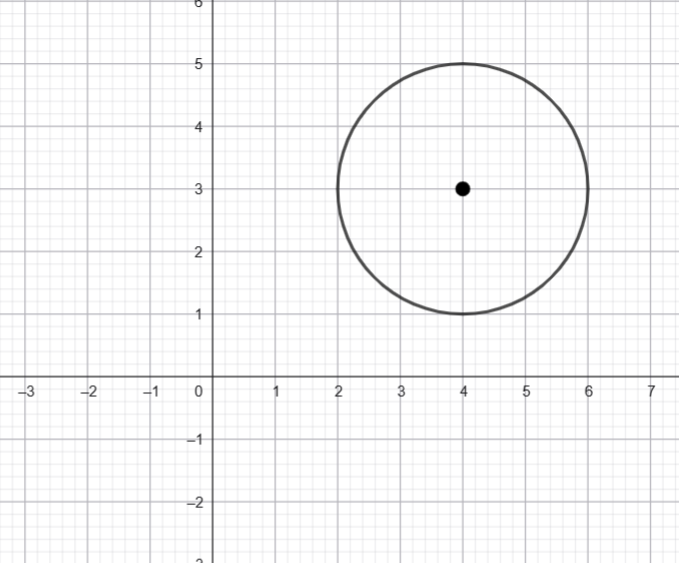
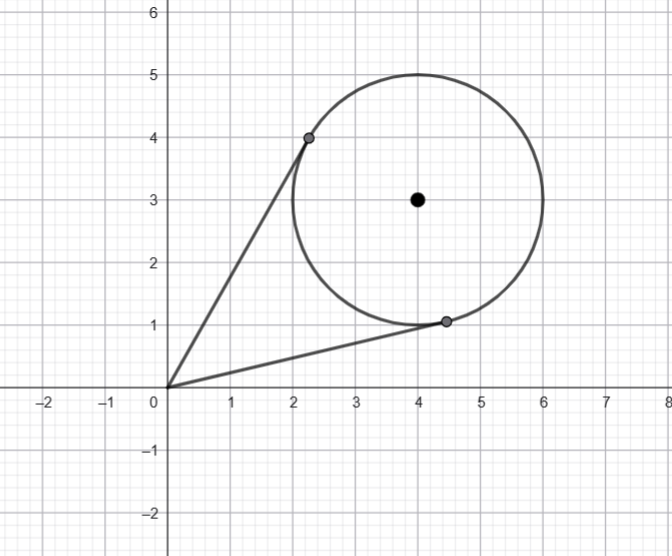
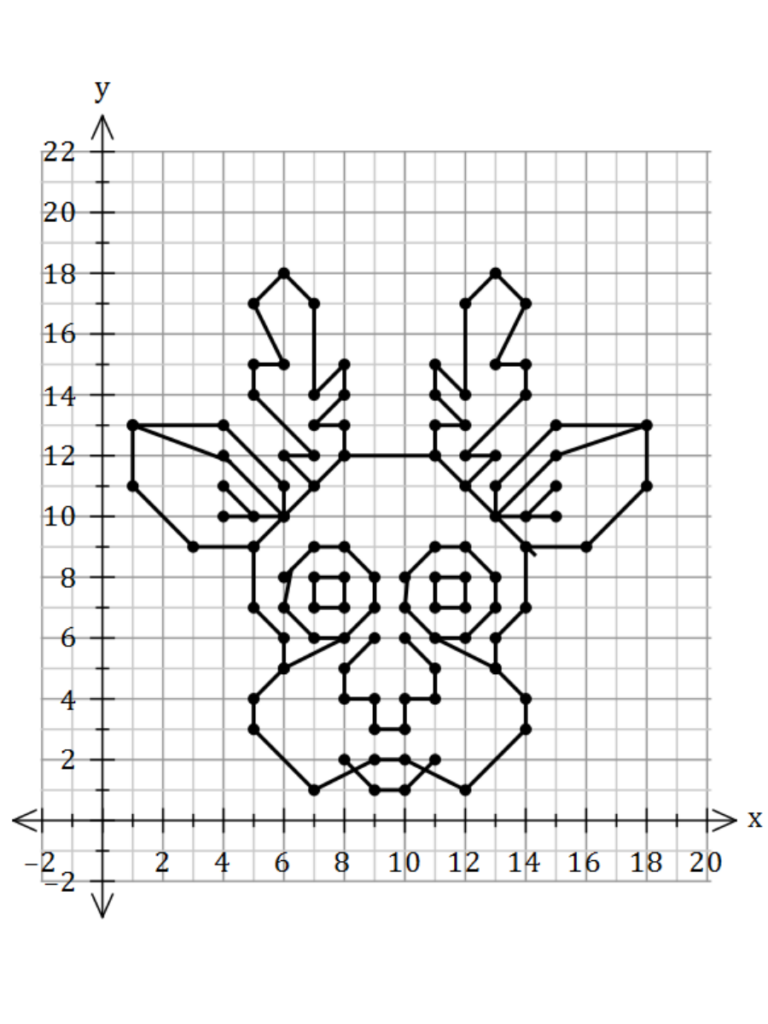
I found a co-ordinate puzzle here.

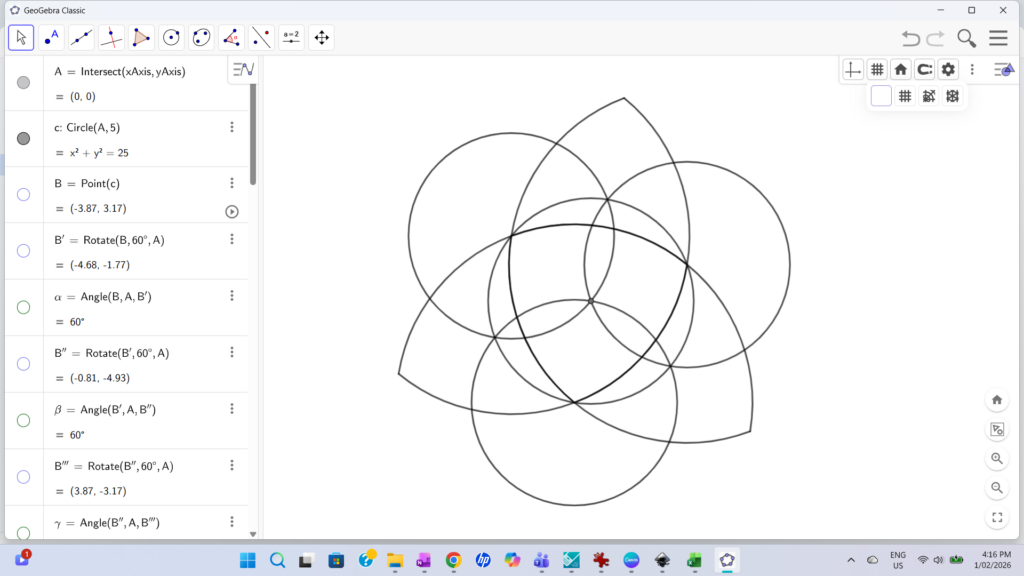
Finished image

Leave a Comment

Filed under Co-ordinate Geometry

Algebra Time Question

This question is from Challenging Problems in Algebra

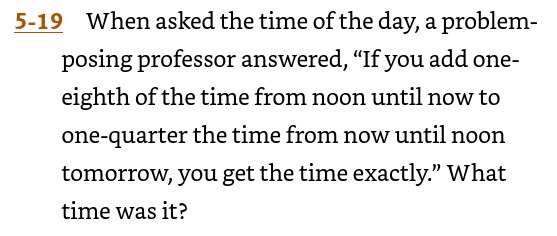
It’s the type of question students hate – “Who talks like that?”

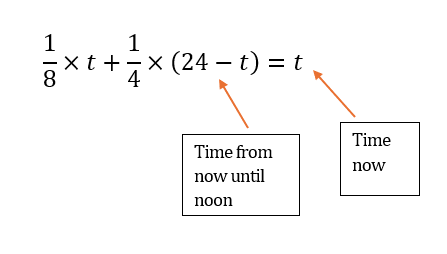
Let t be the number of hours from noon.

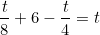
    \begin{equation*}\frac{t}{8}+6-\frac{t}{4}=t\end{equation}

    \begin{equation*}6=\frac{9t}{8}\end{equation}

    \begin{equation*}t=\frac{48}{9}=5\frac{1}{3}\end{equation}

Hence the time is 5:20pm

Leave a Comment

Filed under Algebra, Puzzles, Simplifying fractions, Solving Equations

Geometry Problem

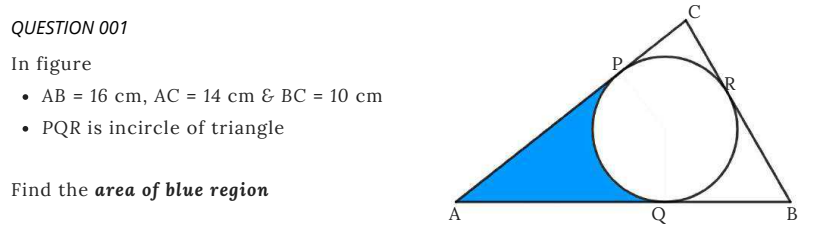
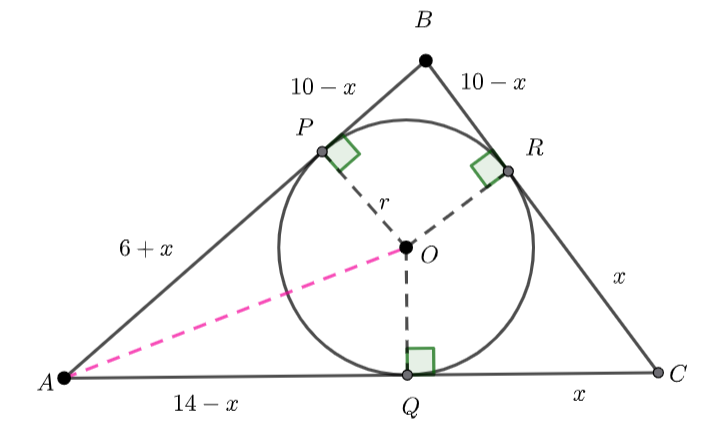
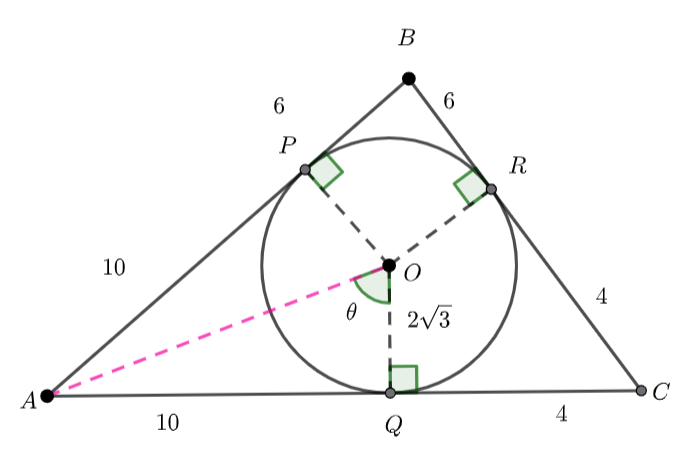
The blue shaded area is the area of triangles APO and AQO subtract the sector POQ.

We can use Heron’s law to find the area of the triangle \Delta{ABC}

    \begin{equation*}A=\sqrt{s(s-a)(s-b)(s-c)}\end{equation}

where s=\frac{a+b+c}{2}

    \begin{equation*}A=\sqrt{20(20-16)(20-10)(20-14)}=40\sqrt{3}\end{equation}

We also know the area of triangle \Delta{ABC}=sr where r is the radius of the inscribed circle.

Hence, 40\sqrt{3}=20r and r=2\sqrt{3}

We know AP=AQ, CQ=CR, and BP=BR – tangents to a circle are congruent.

    \begin{equation*}14-x=6+x\end{equation}

(1)   \begin{equation*}8=2x\end{equation*}

(2)   \begin{equation*}x=4\end{equation*}

Area \Delta{AQO}=\frac{1}{2}10\times 2\sqrt{3}=10\sqrt{3}

Area \Delta{APO}=Area \Delta{AQO}

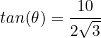
    \begin{equation*}tan(\theta)=\frac{10}{2\sqrt{3}}\end{equation}

    \begin{equation*}\theta=70.9^{\circ}\end{equation}

Area of sector OPQ=\frac{2\times70.9}{360}\pi (2\sqrt{3})^2=14.8

Blue area = 20\sqrt{3}-14.8=19.8cm^2

Leave a Comment

Filed under Algebra, Area, Finding an angle, Finding an area, Geometry, Heron's Law, Interesting Mathematics, Puzzles, Radius and Semi-Perimeter, Right Trigonometry, Solving Equations, Trigonometry

Area of a triangle from the semi-perimeter and the radius of the incircle.

    \begin{equation*}A=sr\end{equation}

Where s is the semi-perimeter, s=\frac{a+b+c}{2} and r is the radius of the incircle.

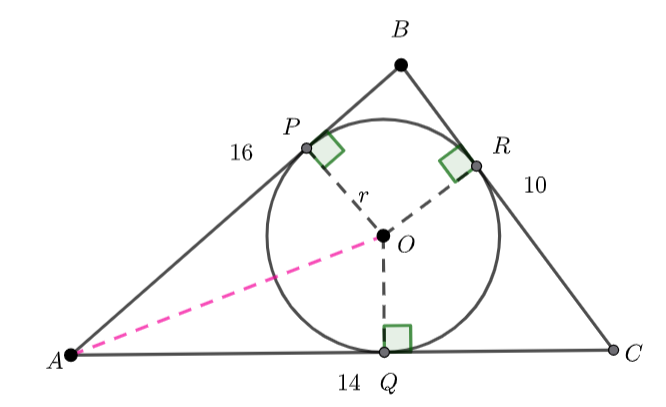
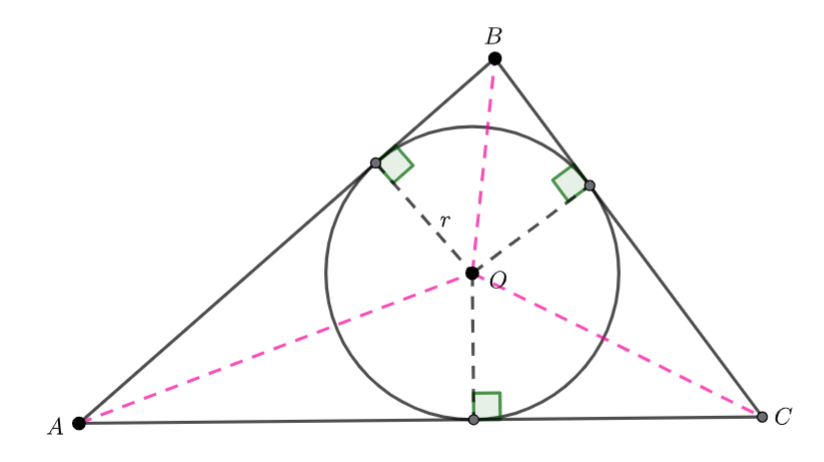
AB, BC and AC are tangents to the circle. And the radii are perpendicular to the tangents.

Add line segments AO, CO and BO.

\Delta{ABC} is split into three triangles, \Delta{AOB}, \Delta{AOC} and \Delta{BOC}.

Hence Area \Delta{ABC}=\Delta{AOB}+\Delta{AOC}+\Delta{BOC}

\Delta{ABC}=\frac{1}{2}cr+\frac{1}{2}br+\frac{1}{2}ar

\Delta{ABC}=\frac{1}{2}r(a+b+c)

Remember s=\frac{1}{2}(a+b+c)

\Delta{ABC}=sr

1 Comment

Filed under Area, Finding an area, Geometry, Interesting Mathematics, Radius and Semi-Perimeter

Trigonometric Equation

Solve cos(4\theta)+cos(2\theta)+cos(\theta)=0 for 0\le \theta \le\pi

Remember the identity

(1)   \begin{equation*}cos(A)+cos(B)=2cos(\frac{A+B}{2})cos(\frac{A-B}{2})\end{equation*}

Hence

    \begin{equation*}cos(4\theta)+cos(2\theta)=2cos(3\theta)cos(\theta)\end{equation}

Now I have

    \begin{equation*}2cos(3\theta)cos(\theta)+cos(\theta)=0\end{equation}

    \begin{equation*}cos(\theta)(2cos(3\theta)+1)=0\end{equation}

cos(\theta)=0 or cos(3\theta)=\frac{-1}{2}

\theta=\frac{\pi}{2}

cos(3\theta)=-\frac{1}{2} for 0 \le \theta \le 3\pi

3\theta=\frac{2\pi}{3}, \frac{4\pi}{3}, \frac{8\pi}{3}

\theta=\frac{2\pi}{9}, \frac{4\pi}{9}, \frac{8\pi}{9}

Hence \theta =\frac{\pi}{2},\frac{2\pi}{9}, \frac{4\pi}{9}, \frac{8\pi}{9}

Leave a Comment

Filed under Identities, Quadratic, Solving Equations, Solving Trig Equations, Trigonometry, Year 11 Specialist Mathematics

Polynomial Long Division

I usually choose to use synthetic division when factorising polynomials, but I know some teachers are unhappy when their students do this. So for completeness, here is my PDF for Polynomial Long Division.

Leave a Comment

Filed under Algebra, Cubics, Factorisation, Factorising, Factorising, Polynomials, Quadratics, Solving, Solving, Solving Equations, Year 11 Mathematical Methods

Geometry Circle Question

In the diagram below, A, B, C and D lie on the circle with centre O. If \angle{DBC} = 41^{\circ} and \angle{ACD} = 53^{\circ}, determine with reasoning \angle{BAC} and \angle{AOB}

We know OA=OB=OD – radii of the circle.

Which means, \Delta{AOB} is isosceles and \angle{OAB}=\angle{OBA} – equal angles isosceles triangle.

\angle{AOD}=2\angle{ACD} – angle at the centre twice the angle at the circumference.

\angle{AOB}=106^{\circ}

This means \angle{AOB}=74^{\circ} – angles on a straight line are supplementary

\angle{OAD}=\angle{ODA}=37^{\circ} – equal angles isosceles triangle and the angle sum of a triangle.

\angle{DBA}=\angle{DCA}=53^{\circ} – angle at the circumference subtended by the same arc are congruent.

\angle{CAD}=\angle{CBD}=41^{\circ} – angles at the circumference subtended by the same arc are congruent.

\angle{OAB}=53^{\circ} – equal angle isosceles triangle

Hence \angle{BAC}=12^{\circ}

Leave a Comment

Filed under Circle Theorems, Finding an angle, Geometry, Year 11 Specialist Mathematics

Completing the Square

x^2+6x-4 \rightarrow (x+3)^2-13

Completing the square is useful to

  • sketch parabolas.
  • solve quadratics.
  • factorising quadratics
  • finding the centre and radius version of the equation of a circle.

When completing the square we take advantage of perfect squares. For example, (x+3)^2=(x+3)(x+3)=x^2+6x+9

6=2\times 3 and 9=3\times 3

Example 1

Put x^2+8x-5 into completed square form.

What perfect square has an 8x term?

(x+4)^2=x^2+8x+16

We don’t want +16, we want -5, so subtract 16+5

x^2+8x-5=(x+4)^2-21


x^2+bx+c=(x+\frac{b}{2})^2-(\frac{b}{2})^2+c

What about a non-monic quadratic? For example,

2x^2+12x+11

Factorise the 2

2(x^2+6x+\frac{11}{2})

And continue as before

2[(x+3)^2-9+\frac{11}{2}]=2[(x+3)^2-\frac{18}{2}+\frac{11}{2}]=2[(x+3)^2-\frac{7}{2}]=2(x+3)^2-7

Example 2

y=2x^2+7x-5

2(x^2+\frac{7}{2}x-\frac{5}{2})

2[(x+\frac{7}{4})^2-(\frac{7}{4})^2-\frac{5}{2}]

2[(x+\frac{7}{4})^2-\frac{49}{16}-\frac{40}{16}]

2[(x+\frac{7}{4})^2-\frac{89}{16}]

2(x+\frac{7}{4})^2-\frac{89}{8}


ax^2+bx+c=a(x+\frac{b}{2a})^2-a((\frac{b}{2a})^2+\frac{c}{a})

Casio Classpad e-activity

Leave a Comment

Filed under Algebra, Arithmetic, Classpad Skills, Completing the Square, Fractions, Quadratic, Quadratics, Year 10 Mathematics, Year 9 Mathematics