Remember 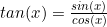 .
.
I use the quotient rule to differentiate  .
.
(1) ![\begin{equation*}\frac{d}{dx}(\frac{f(x)}{g(x)})=\frac{f'(x)g(x)-g'(x)f(x)}{[g(x)]^2}\end{equation*}](https://www.racquelsanderson.com/wp-content/ql-cache/quicklatex.com-d7f44004ea63a9b3172080e77f4c66d8_l3.png "Rendered by QuickLaTeX.com")
If  then from equation
(2) ![\begin{equation*}h'(x)=\frac{cos(x)cos(x)-(-sin(x)sin(x))}{[cos(x)]^2}\end{equation*}](https://www.racquelsanderson.com/wp-content/ql-cache/quicklatex.com-61cae2669c09f225f8776d3406fc68d9_l3.png "Rendered by QuickLaTeX.com")
(3) 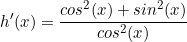
Remember the Pythagorean identity
(4) 
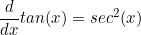
Hence
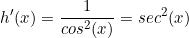
(5) 
Remember .
I use the quotient rule to differentiate .
(1)
If then from equation
(2)
(3)
Remember the Pythagorean identity
(4)
Hence
(5)
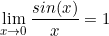
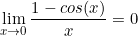
In the last post we looked at two trig limits:
(1) 
(2) 
We are going to use these two limits to differentiate sine and cosine functions from first principals.


Use the trig identity





Evaluate the limits

Hence,  .
.
Now we are going to do the same for  .
.

Use the trigonometric identity




Evaluate the limits

Hence 
Filed under Calculus, Differentiation, Identities, Trigonometry, Year 12 Mathematical Methods

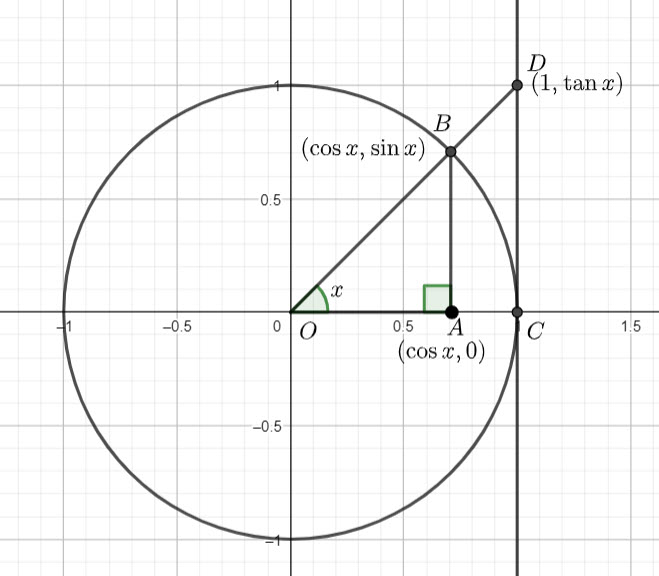
Remember  , hence
  and the co-ordinate of
  is
is  .
.
 , hence
  and the co-ordinate of
  is
is 
And from the definition of  we know
  is the point
Consider the areas of triangle  , sector
  , and triangle
  .
.
We know from inspection of the above diagram that
Area  Area
Area  Area
Area
Which means,

We can ignore all of the halves.

Remember

Divide everything by  (as we are in the first quadrant we know
  , so we don’t need to worry about the inequality)

Invert everything and change the direction of the inequalities)

I am going to rewrite it as follows

because I like to use less thans rather than greater thans.
Now what happens as  tends to
  ?
?

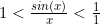
Hence by the squeeze theorem 
Now we know this limit, we are going to use it to find 
Multiply by 

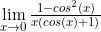
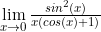


If we evaluate the limits,

Hence, 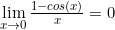
In the next post we are going to use these limits to differentiate sine and cosine functions.
, find
.
I came across this sum in An Imaginary Tale by Nahin and I was fascinated.
Let  and
and  .
.
Remember Hence,    Therefore,  and  and and   |
Which means,

Let’s try a few partial sums




Hence, 

What happens as  ?
?

Because we know  is undefined.
Filed under Identities, Interesting Mathematics, Puzzles, Sequences, Trigonometry
Remember
(1) 
We know that  for odd integer multiples of
  , i.e.
  , which is
  for
for 
Hence,

for 
We can factorise our  expansion
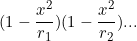
We know 

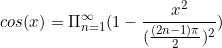

We are going to use De Moivre’s theorem to prove trigonometric identities.
Remember, De Moivre’s Theorem
If  , then
Or a shorter version  , then
Now, let  , find

Remember  and
and 


It is the same for 


Prove          |
We can do something similar with sine.




Hence 
Prove        |
Let’s find an identity for 








And  ?
?







Filed under Complex Numbers, Identities, Trig Identities, Trigonometry