Category Archives: Year 12 Mathematical Methods

Deriving the Chain Rule for Differentiation

How to differentiate something in the form y=[f(x)]^n

For example, y=(3x^2-2x+6)^5, we could expand the expression, but the Chain Rule provides a quick and easy method.

Differentiate y=[f(x)]^n

Let u=f(x), then y=u^n

We want to find \frac{dy}{dx}, but \frac{dy}{dx}=\frac{dy}{du}\times \frac{du}{dx}

They’re not fractions, but limits of fractions, but they work like fractions.

\frac{du}{dx}=f'(x) and \frac{dy}{du}=nu^{n-1}

Therefore, \frac{dy}{dx}=f'(x)\times nu^{n-1}

Replace u with f(x)

(1)   \begin{equation*}\frac{dy}{dx}=n[f(x)]^{n-1}f'(x)\end{equation*}

What about a function in the form y=f(g(x))?

We’re going to follow the same process.

Let u=g(x), then y=f(u)

\frac{du}{dx}=g'(x) and \frac{dy}{du}=f'(u)

Therefore \frac{dy}{dx}=f'(u)g'(x)

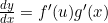
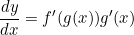
(2)   \begin{equation*}\frac{dy}{dx}=f'(g(x))g'(x) \end{equation*}

Equations 1 and 2 are versions of the Chain Rule.

Example

Find the derivative of y=(3x^2-2x+6)^5

    \begin{equation*}\frac{dy}{dx}=5(3x^2-2x+6)^4\times (6x-2)\end{equation}

    \begin{equation*}\frac{dy}{dx}=5(6x-2)(3x^2-2x+6)^4\end{equation}

    \begin{equation*}\frac{dy}{dx}=10(3x-1)(3x^2-2x+6)\end{equation}

Next time we are going to look at the Product Rule.

1 Comment

Filed under Calculus, Chain Rule, Differentiation, Year 12 Mathematical Methods

Effect of Function Transformations on Integration

My year 12 Mathematical Methods students have questions like this

Given that f(x) is continuous everywhere and that \int_{4}^{10} f(x) dx=-10, find:

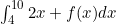
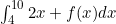
(a) \int_{4}^{10}2x +f(x) dx

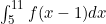
(b) \int_{5}^{11} f(x-1) dx

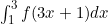
(c) \int_{1}^{3} f(3x+1) dx

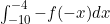
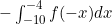
(d) \int_{-10}^{-4} -f(-x) dx

(e) \int{10}^{22} f(\frac{x-2}{2}) dx

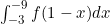
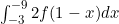
(f) \int_{-3}^{-9} f(1-x) dx

OT Lee Mathematics Methods Textbook Ex 8.3 question 6

For the most part these questions aren’t too difficult, but the horizontal dilations cause issues.

(a) \int_{4}^{10} 2x +f(x) dx
\int_{4}^{10} 2x  dx +\int_{2}^{10} f(x) dx
(x^2]_4^{10} + (-10)
10^2-4^2-10
=74

(b) \int_{5}^{11} f(x-1) dx
=-10


(c) \int_{1}^{3} f(3x+1) dx
Let u=3x+1
\frac{du}{dx}=3
dx=\frac{du}{3}

When x=1, u=4 and when x=3, u=10
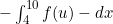
\int_{4}^10 f(u) \frac{du}{3}
=\frac{1}{3}\times (-10)
=\frac{-10}{3}

(d) \int_{-10}^{-4} -f(-x) dx
-\int_{-10}^{-4} f(-x) dx

Let u=-x
\frac{du}{dx}=-1
dx=-du

When x=-4, u=4 and when x=-10, u=10
-\int_{4}^{10} f(u) -dx
=-10

(e) \int_{10}^{22} f(\frac{x-2}{2} dx
Let u=f(\frac{x-2}{2})
\frac{du}{dx}=\frac{1}{2}
\du=2dx

When x=10, u=4 and when x=22, u=10
2\int_{4}^{10} f(u) du
=-20

(f) \int_{-3}^{-9} 2f(1-x) dx
Let u=1-x
\frac{du}{dx}=-1

When x=-3, u=4 and when x=-9, u=10
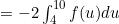
=-2\int_{4}^{10} f(u) du
=20


Split the integral
Integrate the first part.


This is a horizontal translation (one unit to the right) so the shape of the curve doesn’t change.
The integration bounds have also shifted one unit to the right.


This is a horizontal dilation and translation. The easiest method is to use a change of variable


Once you get the hang of it, you can skip the change of variable and multiply the value of the definite integral by the scale factor of the horizontal dilation (only if the integration bounds are also changed).

Leave a Comment

Filed under Definite, Integration, Uncategorized, Year 12 Mathematical Methods

Optimisation

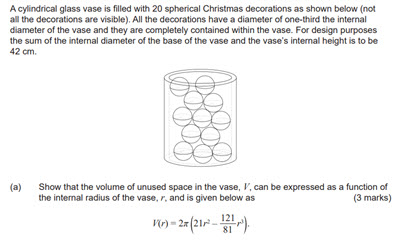
An optimisation question from the 2019 ATAR Mathematics Methods exam.

I always like optimisation questions. There is a nice process to follow:

  • Find the function to optimise (in terms of one variable).
  • Find the stationary points.
  • Find the nature of the stationary points.
  • Find the maximum or minimum.
(a) Volume of the cylinder V=\pi r^2h
42=2r+h
h=42-2r
\therefore V_C=\pi r^2(42-2r)
Volume of spherical decorations V_S=\frac{4}{3}\pi( r_s)^3 where r_s=\frac{r}{3}
V_S=\frac{4\pi r^3}{81}
Volume unused space V=\pi r^2(42-2r)-20(\frac{4\pi r^3}{81})
V=2\pi (21r^2-r^3-\frac{40r^3}{81})
V=2\pi (21r^2-\frac{81r^3}{81}-\frac{40r^3}{81})
V=2\pi (21r^2-\frac{121r^3}{81})

(b) V=2\pi (21r^2-\frac{121r^3}{81})
\frac{dV}{dr}=2\pi (42r-\frac{121r^2}{27})
\frac{dV}{dr}=0
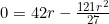
0=42r-\frac{121r^2}{27}
0=r(42-\frac{121r}{27})
r=0 or r=\frac{1134}{121}=9.372

\frac{d^2V}{dr^2}=2\pi (42-\frac{242r}{27})
(\frac{d^2V}{dr^2})_{|r=9.372}=-42
\therefore r=9.372 is a maximum.

Dimensions of the vase, internal diameter=18.7cm internal height=23.3cm

(c) Maximum volume of empty space =2\pi (21r^2-\frac{121r^3}{81})=3863.08cm^3
Volume of one sphere =\frac{4}{3}\pi r^3=3448.03cm^3

There is enough unused space for one extra decoration, but it would depend on how they are packed.

Leave a Comment

Filed under Differentiation, Optimisation, Year 12 Mathematical Methods