Category Archives: Complex Numbers

Complex Locus Question

My Year 12 Specialist students are working on complex loci again. The following type of question always creates confusion.

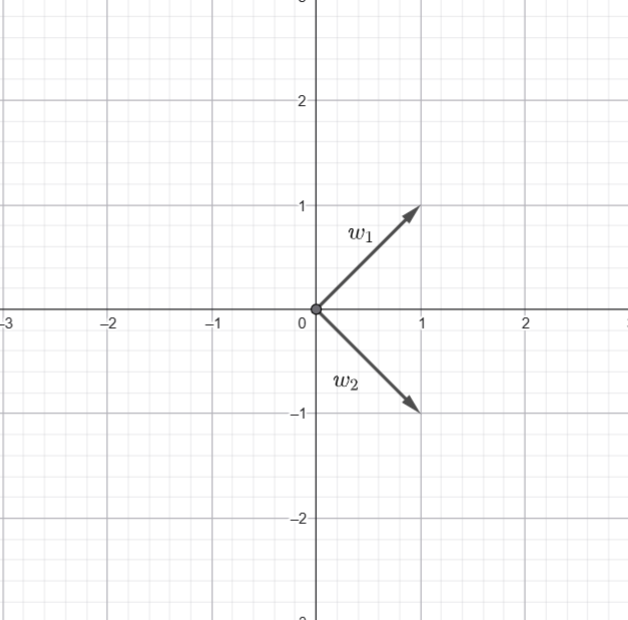
Let z \in \mathbb{C}, w_1=1+i, and w_2=1-i

(a) Show that the locus of points satisfying

    \begin{equation*}arg(z-w_1)-arg(z-w_2)=\frac{\pi}{6}\end{equation}

is the arc of a circle.
(b) Find the centre and radius of the circle, expressing your answers in exact form.

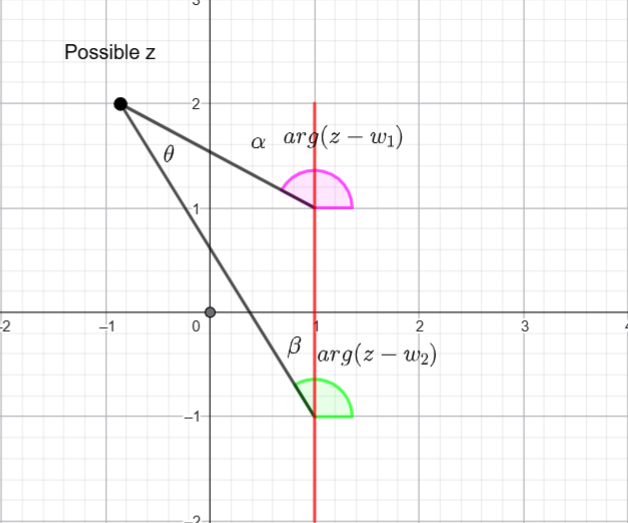
arg(z-w_1) is the angle the vector from w_1 to z makes with the positive x- axis, likewise for arg(z-w_2).

I am going to plot a possible z and try to see the geometry that works.
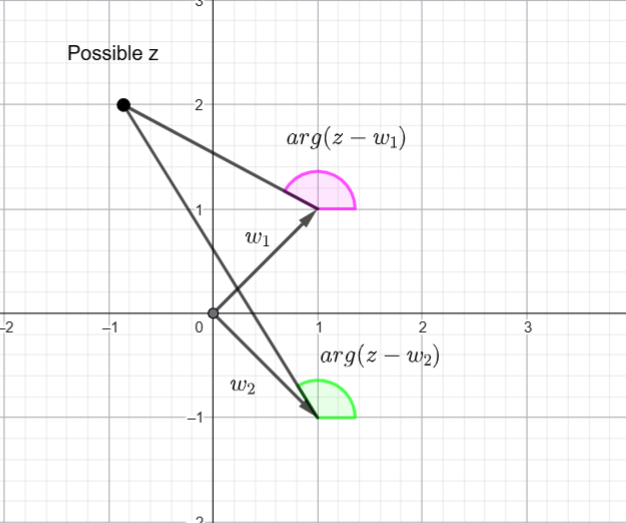
We want arg(z-w_1)-arg(z-w_2)=\frac{\pi}{6}

I am going to take advantage of some triangle geometry
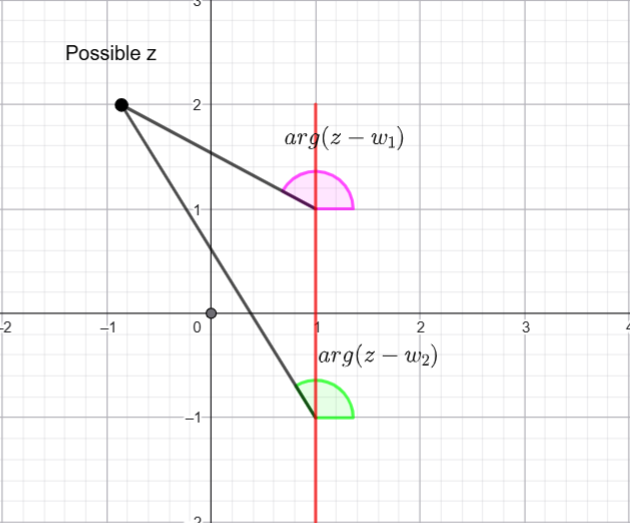
Using the External Angle Theorem, we know \alpha=\beta+\theta

    \begin{equation*}arg(z-w_1)-arg(z-w_2)=(\alpha+\frac{\pi}{2})-(\beta+\frac{\pi}{2}0=\alpha-\beta=\theta\end{equation}

Therefore \theta=\frac{\pi}{6}

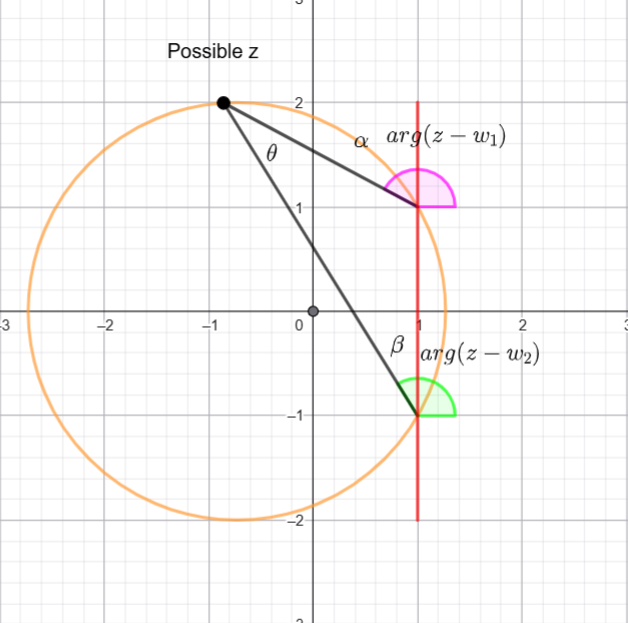
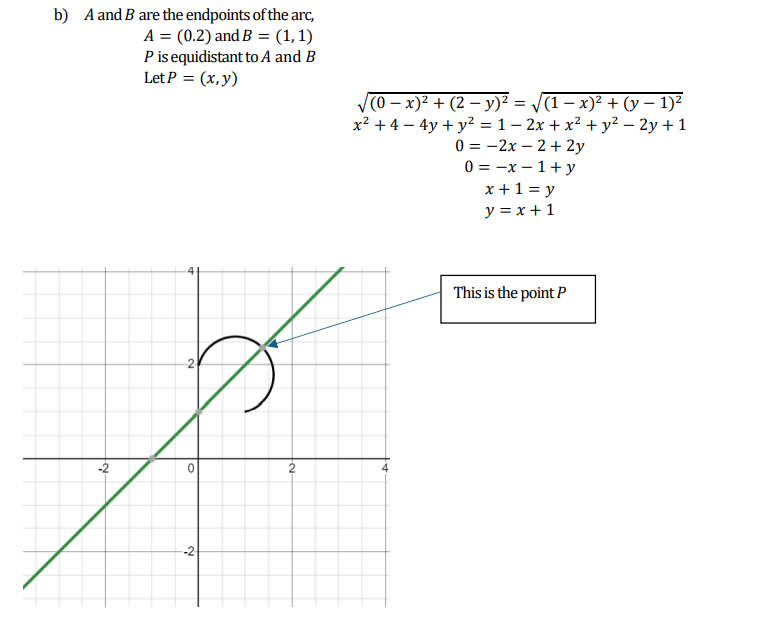
So we want all of the z values that have an angle of \frac{\pi}{6}

Now we are going to use some circle geometry -The angle at the circumference subtended by the same arc are congruent. So we need to find a circle that has those three points (z, w_1 and w_2) on the circumference.

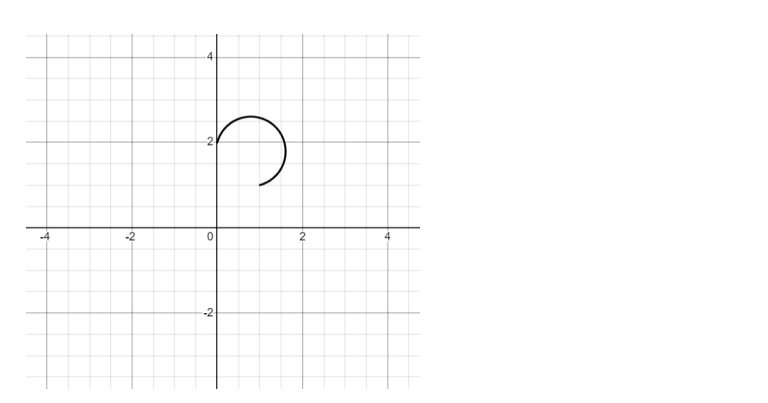
Hence the locus is

Now we need to find the radius and centre of the circle.
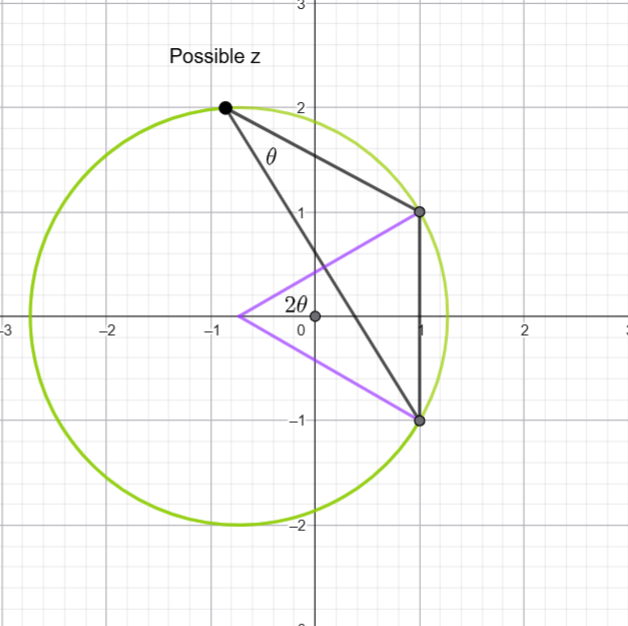
Using another circle theorem, the angle at the centre is twice the angle at the circumference.

The triangle must be equilateral (it is isosceles with a vertex angle of \frac{\pi}{3})

Hence the radius is 2.

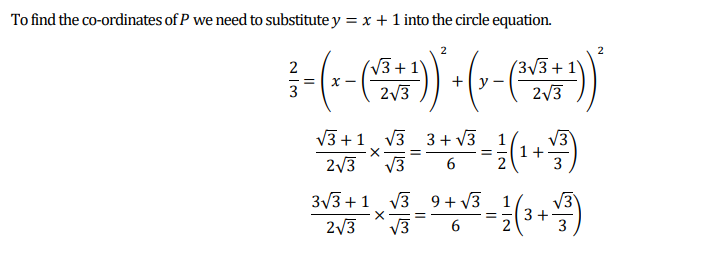
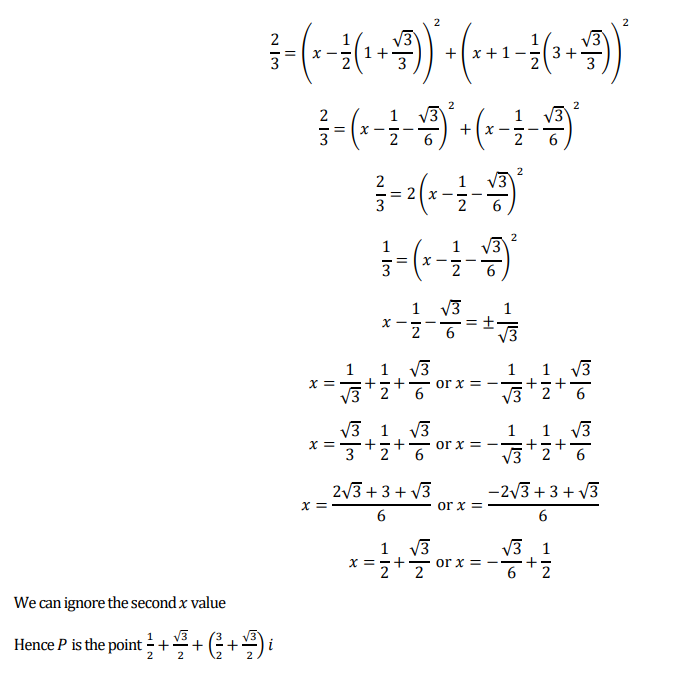
h=\sqrt{2^2-1^2}=\sqrt{3}

Hence the centre is (-\sqrt{3}+1, 0)

Leave a Comment

Filed under Circle Theorems, Complex Numbers, Geometry, Interesting Mathematics, Pythagoras, Sketching Complex Regions, Year 12 Specialist Mathematics

Complex Numbers and Trig Idenities

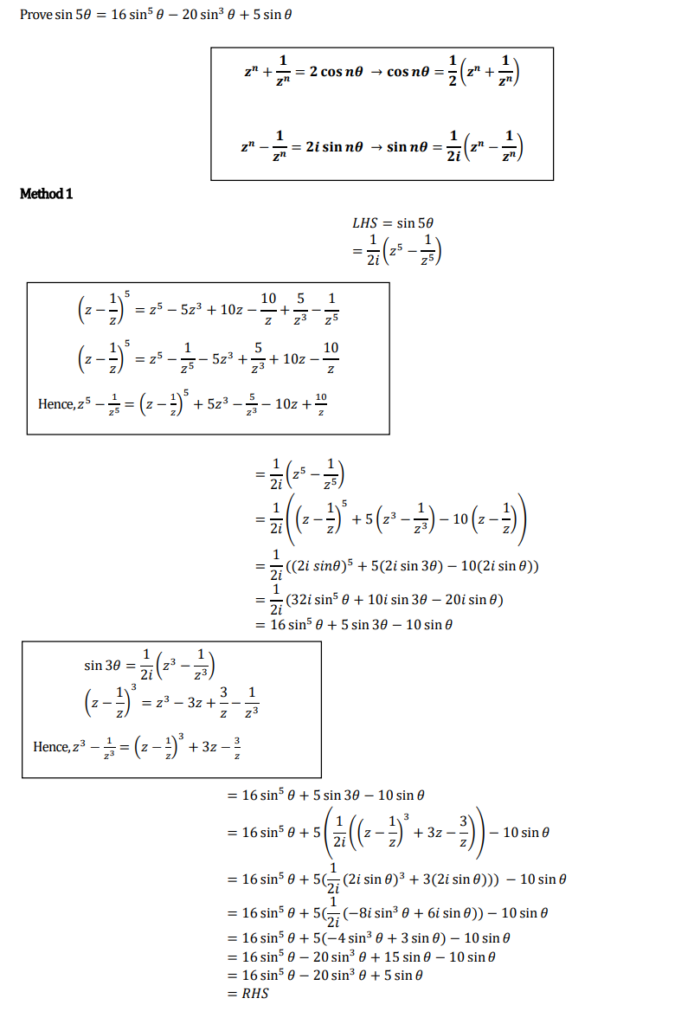
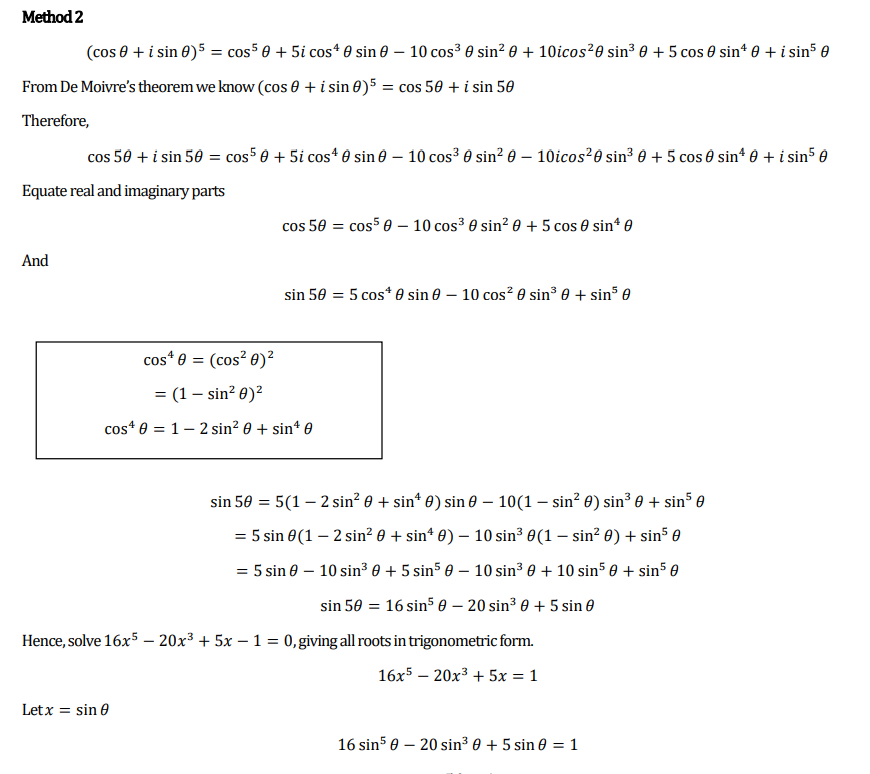
My Year 12 Specialist Students are using complex numbers to prove trigonometric identities.

Things like

    \begin{equation*}sin(5\theta)=16sin^5(\theta) -20sin^3(\theta)+5sin(\theta) \end{equation}

Method 2 might be a little bit easier depending upon how your brain works.

Leave a Comment

Filed under Algebra, Binomial Expansion Theorem, Complex Numbers, Identities, Trig Identities, Trigonometry, Year 12 Specialist Mathematics

Complex Loci Question

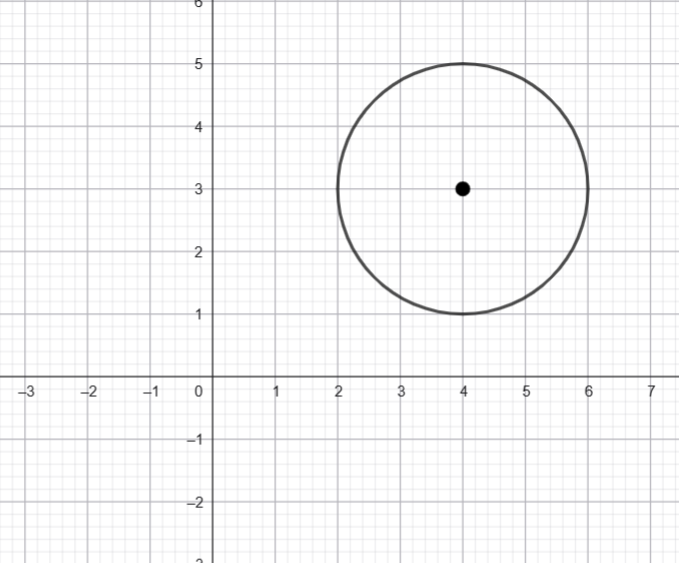
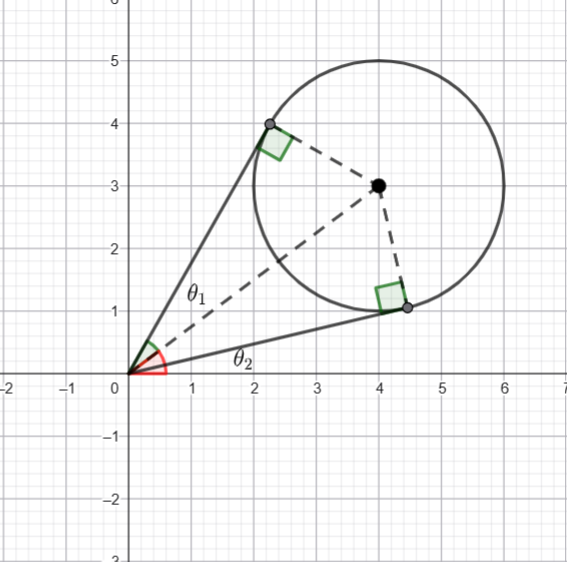
A sketch of the locus of a complex number z is shown above, determine the maximum value of arg(z) correct to two decimal places where 0\le z \le 2\pi
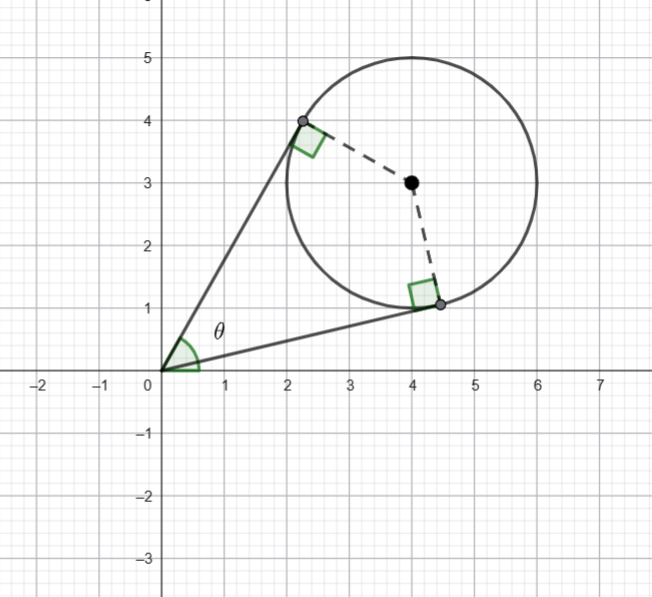
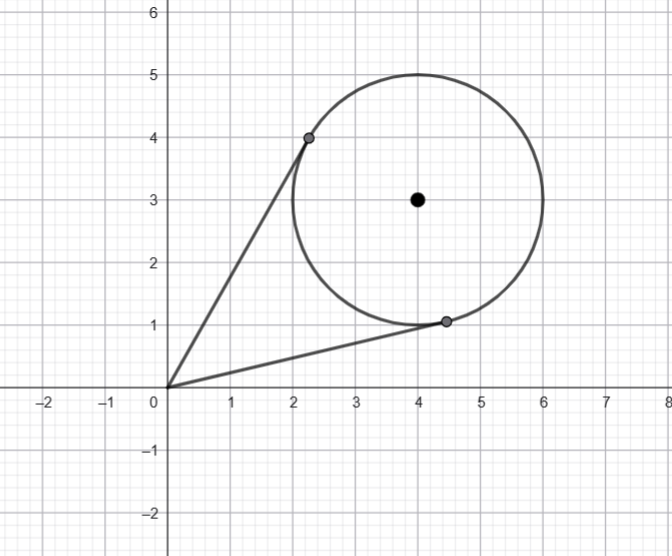
Draw tangent lines from the origin to the circle.

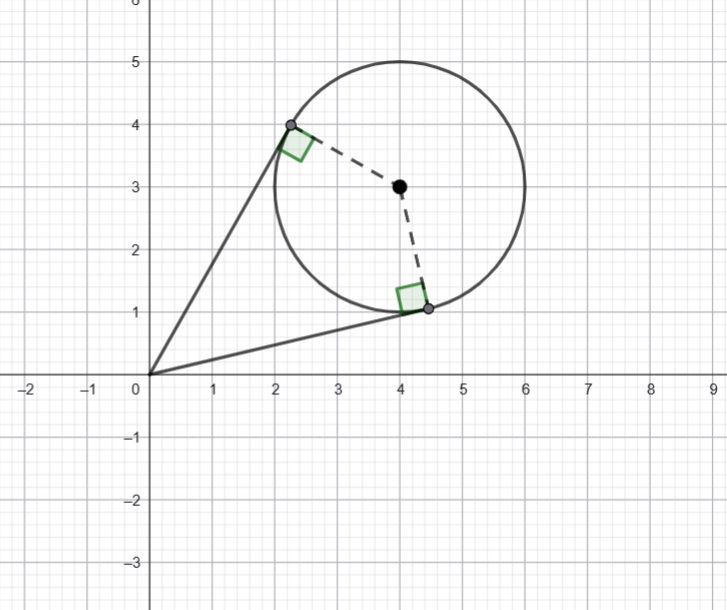
Remember tangent lines are perpendicular to the radii

The maximum argument is this angle

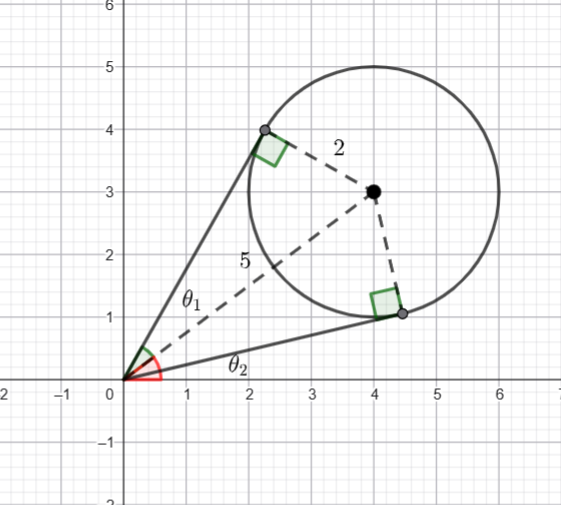
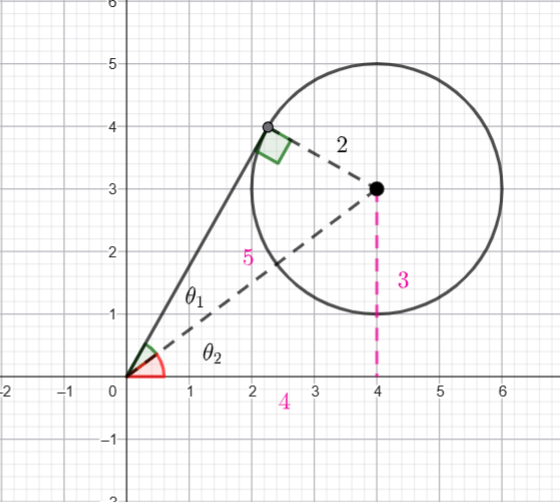
I am going to find the angle in two sections

From the diagram the radius of the circle is 2 and the centre is (4, 3). Hence the distance from the origin to the centre is 5.

    \begin{equation*}sin(\theta_1)=\frac{2}{5}\end{equation}

    \begin{equation*}\theta_1=0.412\end{equation}

    \begin{equation*}sin(\theta_2)=\frac{3}{5}\end{equation}

    \begin{equation*}\theta_2=0.644\end{equation}

Hence maximum arg(z)=1.06

Leave a Comment

Filed under Complex Numbers, Right Trigonometry, Sketching Complex Regions, Trigonometry, Year 12 Specialist Mathematics

Fibonacci Sequence – Finding the Closed Form

I have been reading An Imaginary Tale – The Story of \sqrt{-1} by Paul J Nahin, which is fabulous. There was a bit in chapter 4 where he found the closed form of the generalised Fibonacci sequence. I thought it would be a good exercise to find the closed from of the Fibonacci sequence.

Just to remind you, the Fibonacci sequence is

1, 1, 2, 3, 5, 8, 13, 21, ...

and it is defined recursively

    \begin{equation*}T_{n+2}=T_{n+1}+T_n, T_0=1, T_1=1\end{equation}

That is, the next term is the sum of the two previous terms, i.e.

    \begin{equation*}T_3=T_2+T_1=1+1=2\end{equation}

Now the starting off point is slightly dodgy as it involves and educated guess as Paul Nahin writes,

How do I know that works? Because I have seen it before, that’s how! […] There is nothing dishonourable about guessing correct solutions – indeed, great mathematicians and scientists, are invariable great guessers – just as long as eventually the guess is verified to work. The next time you encounter a recurrence formula, you can guess the answer too because then you will have already seen how it works.

We start with T_n=kz^n

This means T_{n+2}=T_{n+1}+T_n is kz^{n+2}=kz^{n+1}+kz^n

    \begin{equation*}kz^{n+2}=kz^{n+1}+kz^n\end{equation}

    \begin{equation*}kz^n(z^2-z-1)=0\end{equation}

    \begin{equation*}z^2-z-1=0\end{equation}

    \begin{equation*}z=\frac{1\pm\sqrt{(-1)^2-4(1)(-1)}}{2}\end{equation}

\therefore z=\frac{1+\sqrt{5}}{2} or z=\frac{1-\sqrt{5}}{2}

Hence T_n=k_1(\frac{1+\sqrt{5}}{2})^n+k_2(\frac{1-\sqrt{5}}{2})^n and we can use the initial conditions T_0=1 and T_1=1 to find k_1 and k_2

When n=0, T_0=1

(1)   \begin{equation*}1=k_1+k_2\end{equation*}

When n=1, T_1=1

(2)   \begin{equation*}1=k_1(\frac{1+\sqrt{5}}{2})+k_2(\frac{1-\sqrt{5}}{2})\end{equation*}

From equation 1, k_2=(1-k_1), substitute into equation 2

    \begin{equation*}1=k_1(\frac{1+\sqrt{5}}{2})+(1-k_1)(\frac{1-\sqrt{5}}{2})\end{equation}

    \begin{equation*}1=k_1(\frac{1+\sqrt{5}}{2})+\frac{1-\sqrt{5}}{2}-k_1(\frac{1-\sqrt{5}}{2})\end{equation}

    \begin{equation*}1=k_1\sqrt{5}+\frac{1-\sqrt{5}}{2}\end{equation}

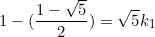
    \begin{equation*}1-(\frac{1-\sqrt{5}}{2})=\sqrt{5}k_1\end{equation}

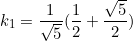
    \begin{equation*}k_1=\frac{1}{\sqrt{5}}(\frac{1}{2}+\frac{\sqrt{5}}{2})\end{equation}

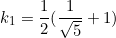
    \begin{equation*}k_1=\frac{1}{2}(\frac{1}{\sqrt{5}}+1)\end{equation}

    \begin{equation*}k_1=\frac{1+\sqrt{5}}{2\sqrt{5}}\end{equation}

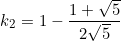
    \begin{equation*}k_2=1-\frac{1+\sqrt{5}}{2\sqrt{5}}\end{equation}

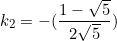
    \begin{equation*}k_2=-(\frac{1-\sqrt{5}}{2\sqrt{5}})\end{equation}

\therefore T_n=(\frac{1+\sqrt{5}}{2\sqrt{5}})(\frac{1+\sqrt{5}}{2})^n-(\frac{1-\sqrt{5}}{2\sqrt{5}})(\frac{1-\sqrt{5}}{2})^n

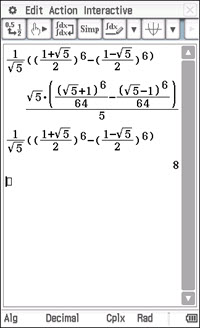
T_n=\frac{1}{\sqrt{5}}((\frac{1+\sqrt{5}}{2})^{n+1}-(\frac{1-\sqrt{5}}{2})^{n+1})

Does it work?

Remember the sequence is 1, 1, 2, 3, 5, 8, 13, 21, 34, 55, ...

If n=5, T_n=8

    \begin{equation*}T_5=\frac{1}{\sqrt{5}}(\frac{1+\sqrt{5}}{2})^6-\frac{1-\sqrt{5}}{2})^6)\end{equation}

As you can see it works!

Leave a Comment

Filed under Complex Numbers, Fibonacci, Fibonacci Sequence, Interesting Mathematics, Sequences

Using De Moivre’s Theorem for Trigonometric Identities

We are going to use De Moivre’s theorem to prove trigonometric identities.

Remember, De Moivre’s Theorem

If z=r(cos(\theta)+isin(\theta)), then z^n=r^n(cos(n\theta)+isin(n\theta))

Or a shorter version z=rcis(\theta), then z^n=r^ncis(n\theta)

Now, let z=cos(\theta)+isin(\theta), find z+\frac{1}{z}

z+z^{-1}=cos(\theta)+isin(\theta)+cos(-\theta)+isin(-\theta)

Remember cos(\theta)=cos(\theta) and sin(-\theta)=-sin(\theta)

z+\frac{1}{z}=cos(\theta)+isin(\theta)+cos(\theta)-isin(\theta)

z+\frac{1}{z}=2cos(\theta)

It is the same for z^n+\frac{1}{z^n}

z^n+z^{-n}=cos(n\theta)+isin(n\theta)+cos(-n\theta)+isin(-n\theta)

z^n+\frac{1}{z^n}=2cos(n\theta)

Prove cos(2\theta)=2cos^2(\theta)-1
LHS=\frac{1}{2}(z^2+\frac{1}{z^2})
LHS=\frac{1}{2}(z^2+\frac{1}{z^2})+z\times\frac{1}{z}-z\times\frac{1}{z}
LHS=\frac{1}{2}(z^2+2z\times\frac{1}{z}+\frac{1}{z^2})-z\times\frac{1}{z}
LHS=\frac{1}{2}(z+\frac{1}{z})^2-1
LHS=\frac{1}{2}(2cos(\theta))^2-1
LHS=\frac{1}{2}(4cos^2(\theta))-1
LHS=2cos^2(\theta)-1
LHS=RHS

We can do something similar with sine.

z-\frac{1}{z}=cos(\theta)+isin(\theta)-(cos(-\theta)+isin(-\theta))

z-\frac{1}{z}=cos(\theta)+isin(\theta)-(cos(-\theta)+isin(-\theta))

z-\frac{1}{z}=cos(\theta)+isin(\theta)-(cos(\theta)-isin(\theta))

z-\frac{1}{z}=cos(\theta)+isin(\theta)-cos(\theta)+isin(\theta)

z-\frac{1}{z}=2isin(\theta)

Hence z^n-\frac{1}{z^n}=2isin(n\theta)

Prove sin(2\theta)=2sin(\theta)cos(\theta)
LHS=sin(2\theta)
LHS=\frac{1}{2i}(z^2-\frac{1}{z^2})
LHS=\frac{1}{2i}(z-\frac{1}{z})(z+\frac{1}{z})
LHS=\frac{1}{2i}(2isin(\theta)(2cos(\theta))
LHS=sin(\theta)2cos(\theta)
LHS=2sin(\theta)cos(\theta)
LHS=RHS

Let’s find an identity for cos(3\theta)

cos(3\theta)=\frac{1}{2}(z^3+\frac{1}{z^3})

=\frac{1}{2}(z^3+\frac{1}{z^3}+3z^2\times\frac{1}{z}+3z\times\frac{1}{z^2}-3z^2\times\frac{1}{z}-3z\times\frac{1}{z^2})

=\frac{1}{2}((z+\frac{1}{z})^3-3z-\frac{3}{z})

=\frac{1}{2}((z+\frac{1}{z})^3-3(z+\frac{1}{z}))

=\frac{1}{2}(2cos(\theta))^3-3(2cos(\theta)))

=\frac{1}{2}(8cos^3(\theta)-6cos(\theta))

=4cos^3(\theta)-3cos(\theta)

\therefore cos(3\theta)=4cos^3(\theta)-3cos(\theta)

And sin(3\theta)?

sin(3\theta)=\frac{1}{2i}(z^3-\frac{1}{z^3})

=\frac{1}{2i}(z^3-\frac{1}{z^3}-3z^2\times\frac{1}{z}+3z\times\frac{1}{z^2}+3z^2\times\frac{1}{z}-3z\times\frac{1}{z^2}

=\frac{1}{2i}((z-\frac{1}{z})^3+3z-\frac{3}{z})

=\frac{1}{2i}(2isin(\theta))^3+3(z-\frac{1}{z}))

=\frac{1}{2i}(-8isin^3(\theta)+6isin(\theta))

=-4sin^3(\theta)+3sin(\theta)

\therefore sin(3\theta)=3sin(\theta)-4sin^3(\theta)

Leave a Comment

Filed under Complex Numbers, Identities, Trig Identities, Trigonometry

Sketching in the Complex Plane Using a TI-nspire CX 11

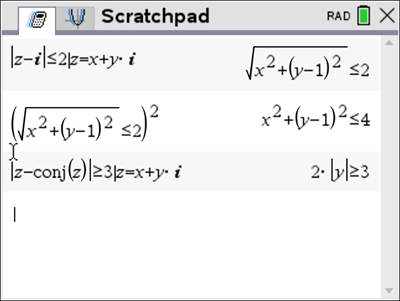
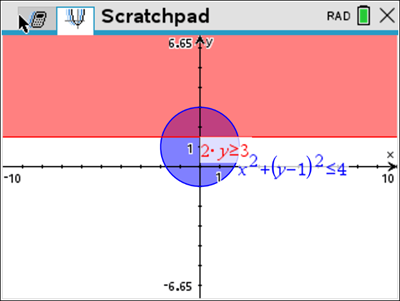
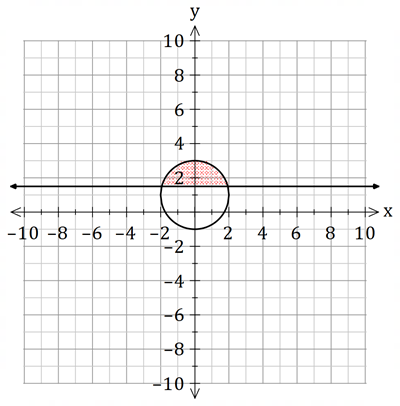
Let R be the region of the complex plane where the inequalities |z-i|\le2 and |z-\bar{z}|\ge3 hold simultaneously.

First find the Cartesian equations.

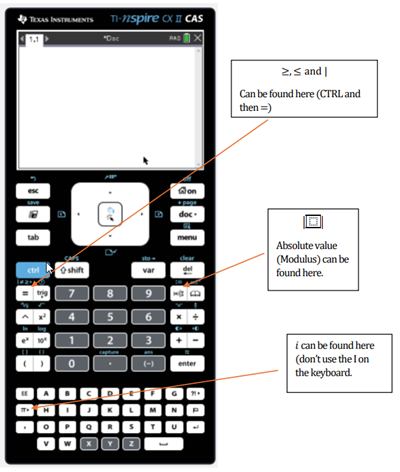
Finding the symbols


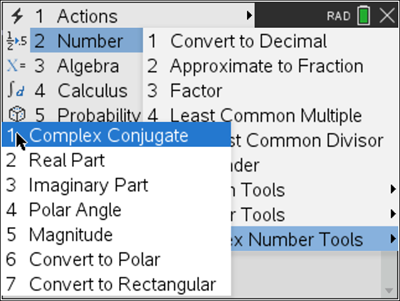
The conj(z) is found under
Menu – Number – Complex Number Tools – Complex Conjugate

Second, sketch each of the functions.

The section that is shaded twice is our region.

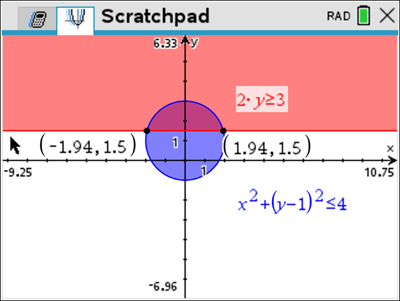
Determine the minimum value of Re(z) in R.

We can find the point of intersection between the circle and the line.

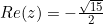
Re(z)=-1.94

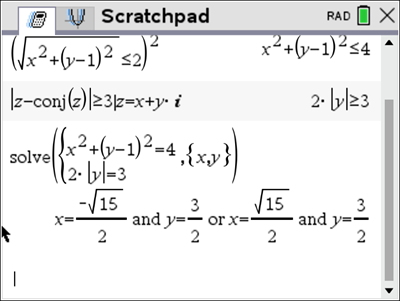
Or if you want exact values

Use the Solve Systems of Equations tool – Menu – Algebra – Solve Systems of Equations – Solve Systems of Equations.

Re(z)=-\frac{\sqrt{15}}{2}

Leave a Comment

Filed under Complex Numbers, Sketching Complex Regions, TI nspire CX 11

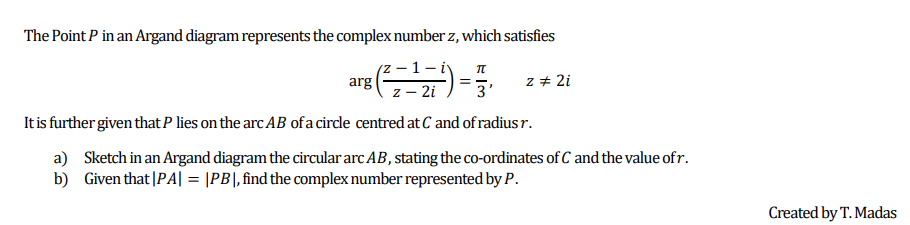
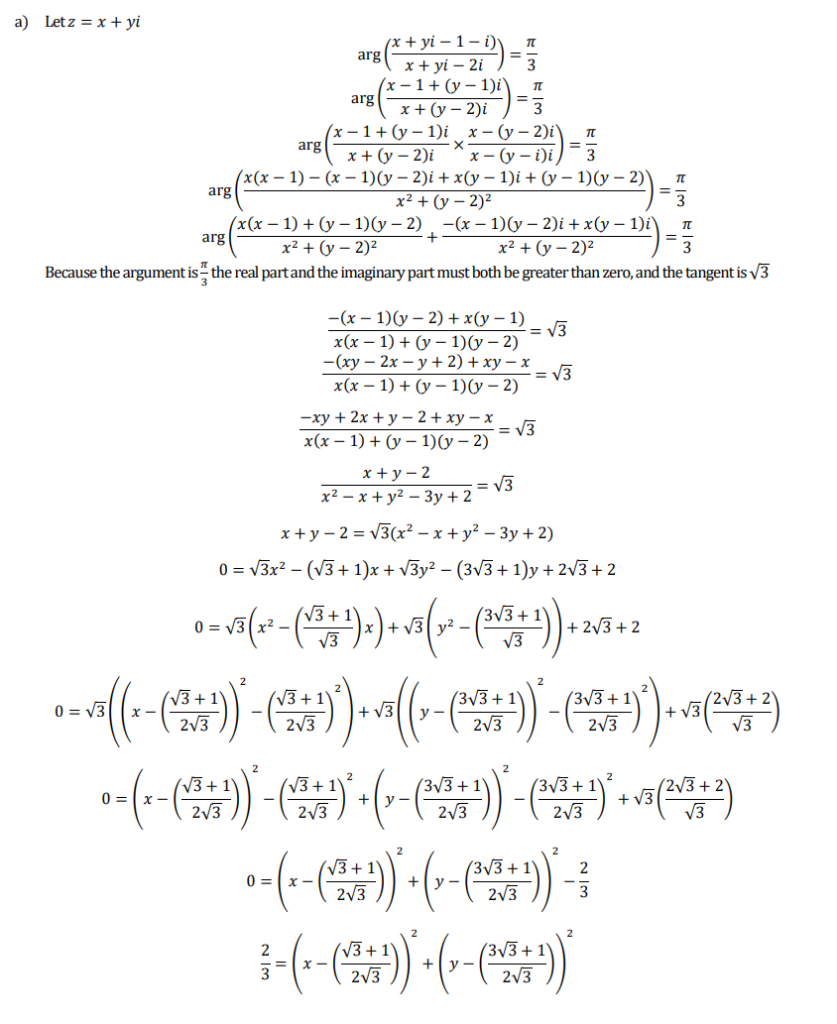
Sketching Subsets of the Complex Plane – Problem 2

I found this question on the madasmaths site – his resources are fabulous.

I am not sure I would have been able to do this in an exam.

I have split my solution into 6 images and there is a pdf version at the bottom

PDF version of my solution

Leave a Comment

Filed under Complex Numbers, Sketching Complex Regions