Monthly Archives: February 2026

Complex Locus Question

My Year 12 Specialist students are working on complex loci again. The following type of question always creates confusion.

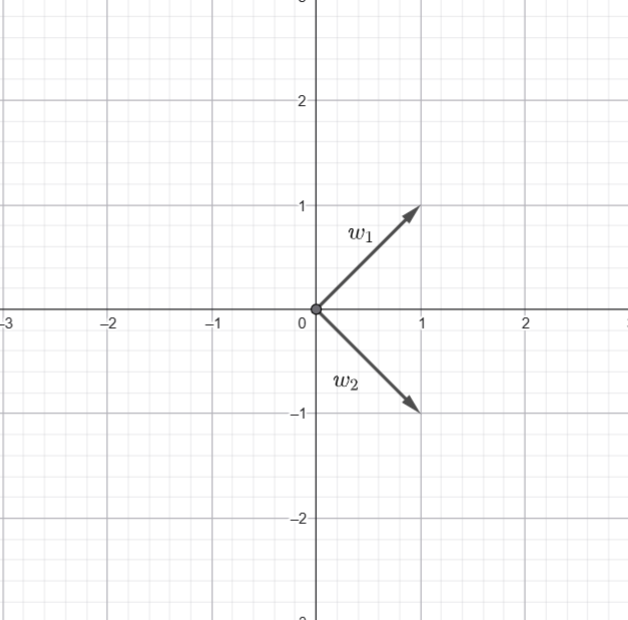
Let z \in \mathbb{C}, w_1=1+i, and w_2=1-i

(a) Show that the locus of points satisfying

    \begin{equation*}arg(z-w_1)-arg(z-w_2)=\frac{\pi}{6}\end{equation}

is the arc of a circle.
(b) Find the centre and radius of the circle, expressing your answers in exact form.

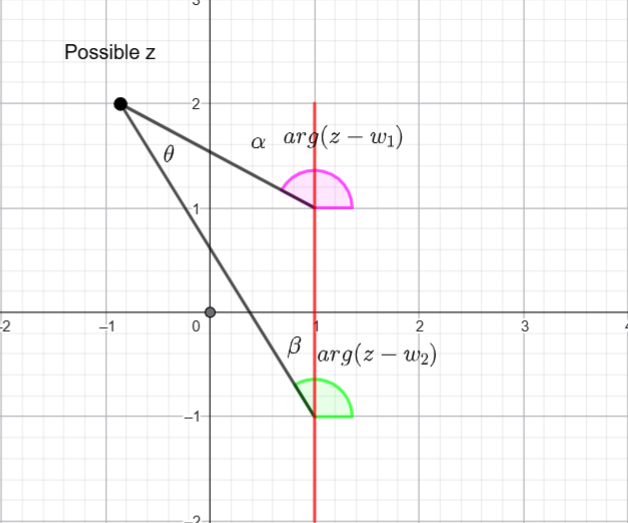
arg(z-w_1) is the angle the vector from w_1 to z makes with the positive x- axis, likewise for arg(z-w_2).

I am going to plot a possible z and try to see the geometry that works.
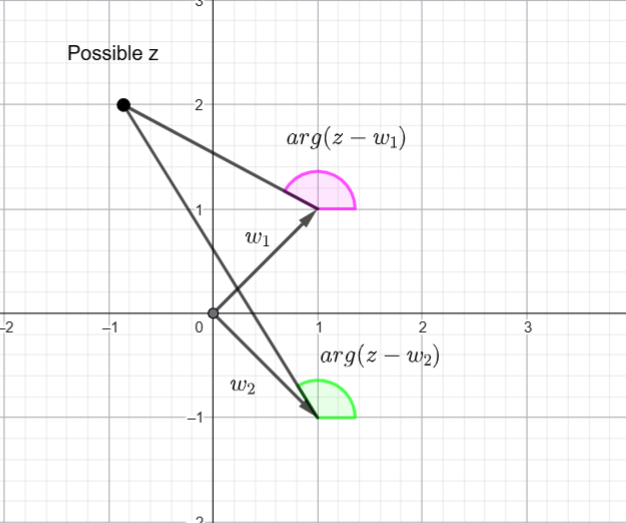
We want arg(z-w_1)-arg(z-w_2)=\frac{\pi}{6}

I am going to take advantage of some triangle geometry
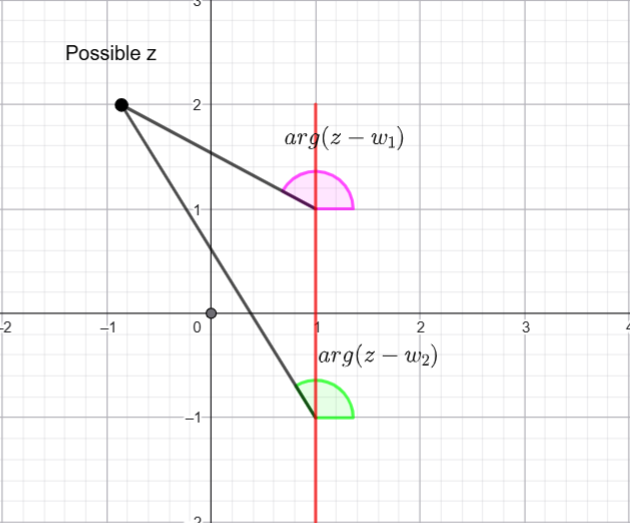
Using the External Angle Theorem, we know \alpha=\beta+\theta

    \begin{equation*}arg(z-w_1)-arg(z-w_2)=(\alpha+\frac{\pi}{2})-(\beta+\frac{\pi}{2}0=\alpha-\beta=\theta\end{equation}

Therefore \theta=\frac{\pi}{6}

So we want all of the z values that have an angle of \frac{\pi}{6}

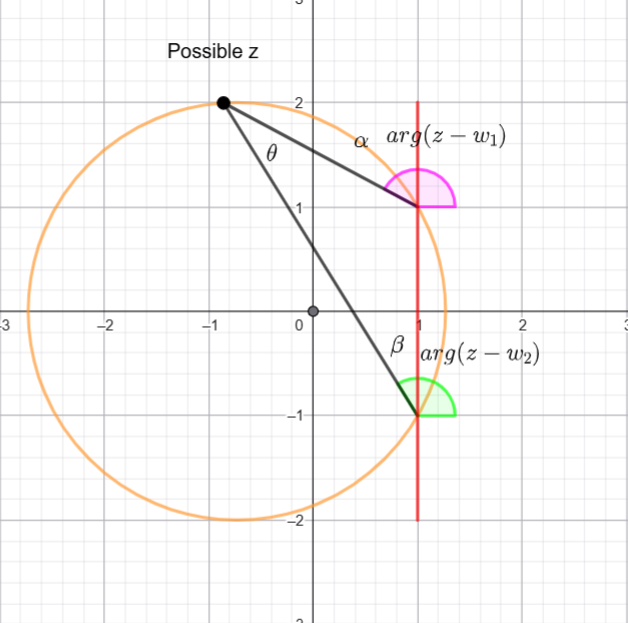
Now we are going to use some circle geometry -The angle at the circumference subtended by the same arc are congruent. So we need to find a circle that has those three points (z, w_1 and w_2) on the circumference.

Hence the locus is

Now we need to find the radius and centre of the circle.
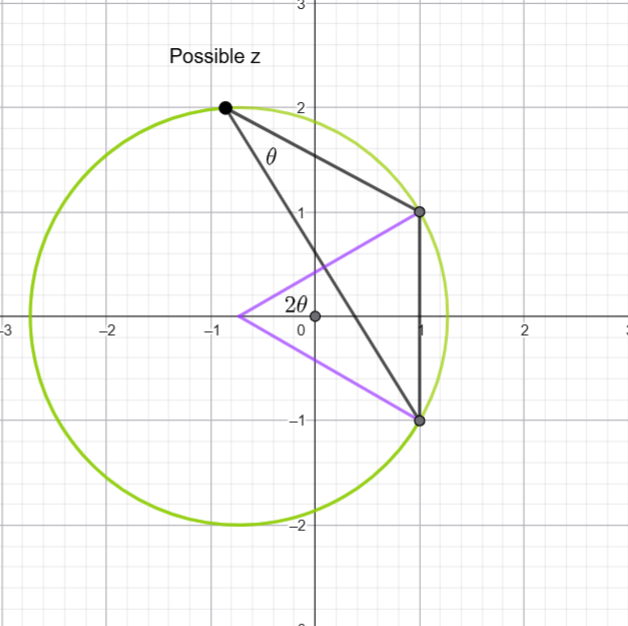
Using another circle theorem, the angle at the centre is twice the angle at the circumference.

The triangle must be equilateral (it is isosceles with a vertex angle of \frac{\pi}{3})

Hence the radius is 2.

h=\sqrt{2^2-1^2}=\sqrt{3}

Hence the centre is (-\sqrt{3}+1, 0)

Leave a Comment

Filed under Circle Theorems, Complex Numbers, Geometry, Interesting Mathematics, Pythagoras, Sketching Complex Regions, Year 12 Specialist Mathematics

Complex Numbers and Trig Idenities

My Year 12 Specialist Students are using complex numbers to prove trigonometric identities.

Things like

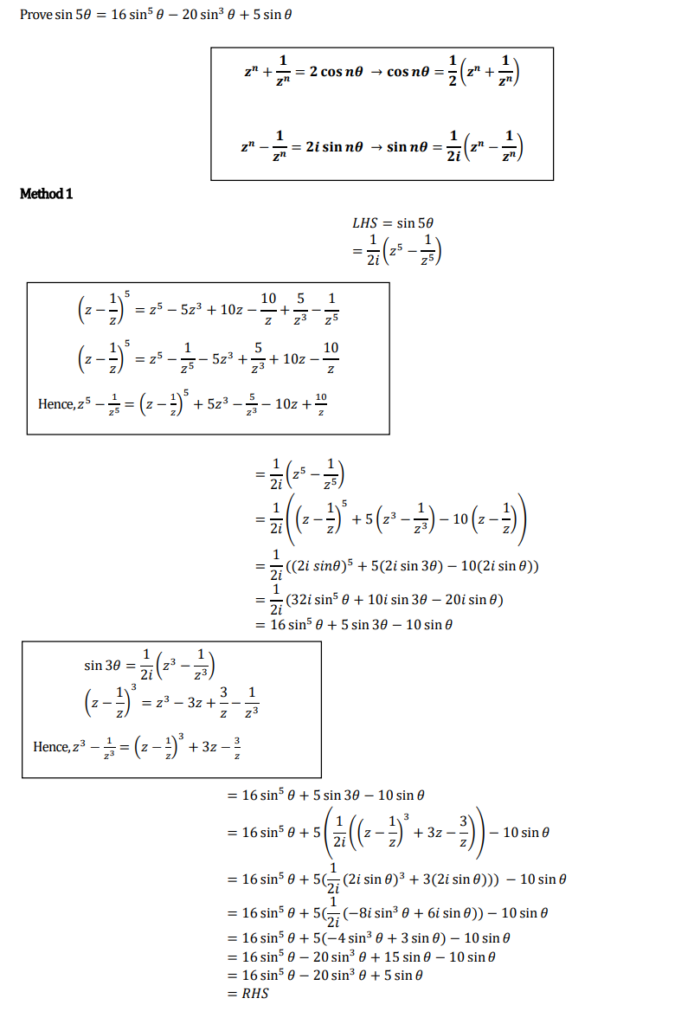
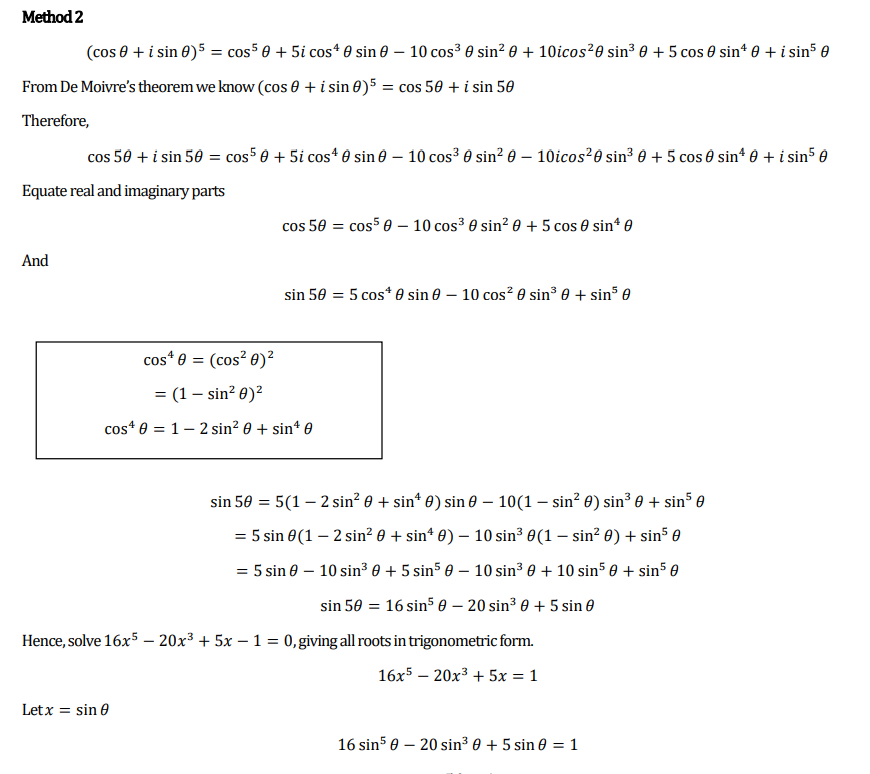
    \begin{equation*}sin(5\theta)=16sin^5(\theta) -20sin^3(\theta)+5sin(\theta) \end{equation}

Method 2 might be a little bit easier depending upon how your brain works.

Leave a Comment

Filed under Algebra, Binomial Expansion Theorem, Complex Numbers, Identities, Trig Identities, Trigonometry, Year 12 Specialist Mathematics

Drawing Threefold Symmetry with Geogebra

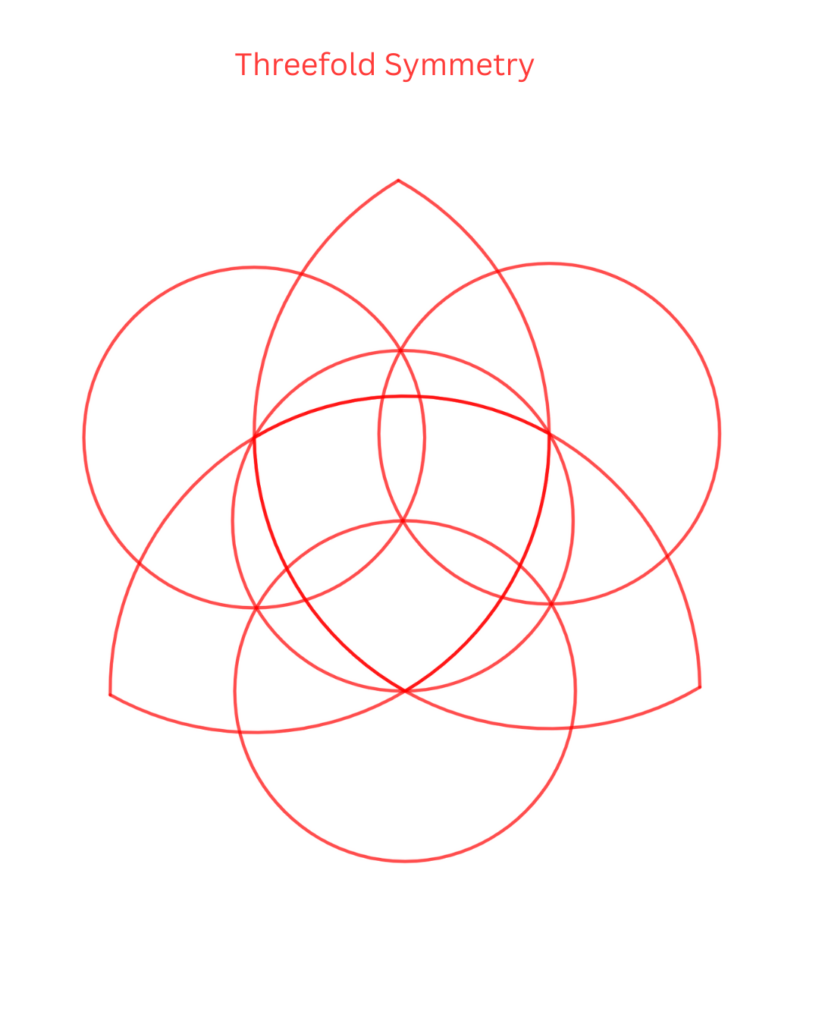
I am an embroiderer and I have been experimenting with geometric drawings. Like the diagram below.

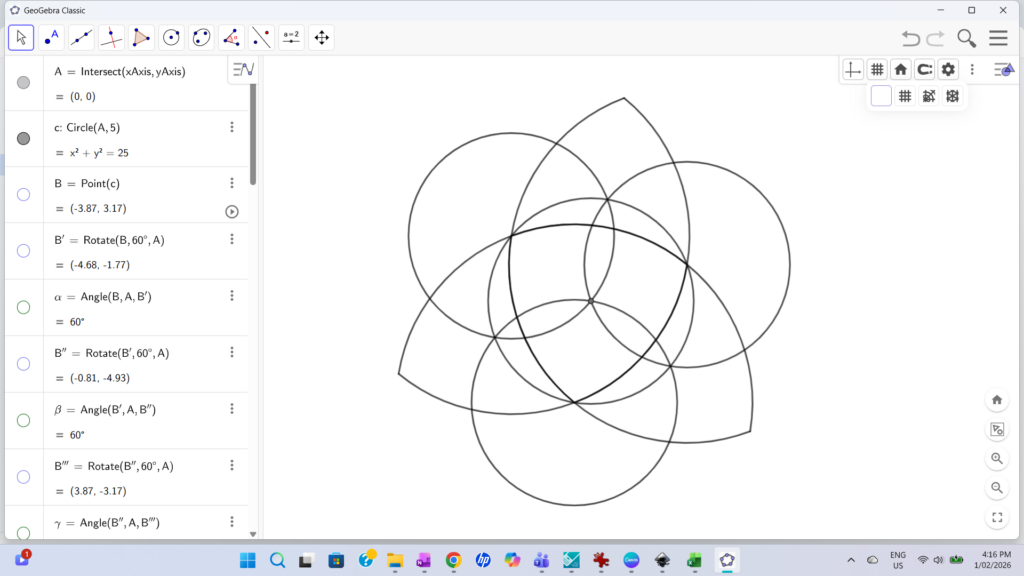
I have been using Geogebra – I use the desktop app.

(1) Start with a circle (mine has a radius of 5)

(2) Place 6 points equidistant around the circle (I placed a point on the circle and then used the angle of a given size tool – 60 degrees)

I have hidden the angle markers to make everything a bit easier to see.

(3) Draw circles (with the same radius as the original) on every second point.

(4) Find the distance between two centre points of the new circles

(5) Using the centres of the three new circles, draw circles where the radius is the distance you found in (4).

(6) Mark the points of intersection.

(7) Hide the big circles

(8) Draw arcs

Finished – change the colour (if you want) and remove labels, etc.

Leave a Comment

Filed under Drawing, Geometry, Interesting Mathematics