I usually choose to use synthetic division when factorising polynomials, but I know some teachers are unhappy when their students do this. So for completeness, here is my PDF for Polynomial Long Division.
Category Archives: Factorising
Synthetic Division (for factorising and/or solving polynomials)
I use synthetic division to factorise polynomials with a degree greater than 2. For example, 
It works best with monic polynomials but can be adapted to non-monic ones (see example below).
The only problem is that you need to find a root to start.
Try the factors of  i.e.
i.e. 

Hence,  is a root and
  is a factor of the polynomial.
Set up as follows

Bring the first number down

Multiply by the root and place under the second co-efficient

Add down

Repeat the process


The numbers at the bottom  are the coefficients of the polynomial factor.
We now know  .
.
We can factorise the quadratic in the usual way.

Hence  .
.
Let’s try a non-monic example
Factorise 
I know  is a root. Otherwise I would try the factors of 30.
Use synthetic division

Because this was non-monic we need to divide our new co-efficients  by 6 (the co-efficient of the
  term)
term)

We now need to go again. I know that  is a root and
  is a factor.

Our quadratic factor is  , which is
  .
.
The quadratic factor doesn’t have integer factors so,

I think this is much quicker than polynomial long division.
Filed under Algebra, Factorising, Factorising, Fractions, Polynomials, Quadratic, Simplifying fractions, Solving Equations
Factorising Non-Monic Quadratics
The general equation of a quadratic is 
Let’s explore different methods of factorising a non-monic quadratic (the  term is not
  )
)
Factorise 
We need to find two numbers that add to and multiply to  (i.e. add to
  and multiply to
The two numbers are  and
and 
Method 1 – Splitting the middle term
This is the method I teach the most often

Split the middle term (the term) into the two numbers

The order doesn’t matter.
Find a common factor for the first term terms, and then for the last two terms.

There is a common factor of  , factor it out.

Method two – Fraction
Put  into both factors and divide by
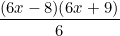
Factorise
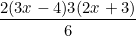
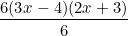
Method 3 – Monic to non-monic

Multiply both sides of the equation by



Let 

Factorise

Replace the  with
with




Method 4 – Cross Method
Place the two numbers in the cross
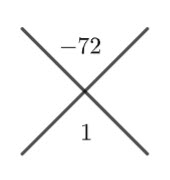
Place the two numbers that add to and multiply to in the other parts of the cross.
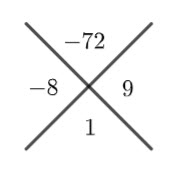
Divide these two numbers by (i.e )
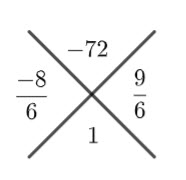
Simplify
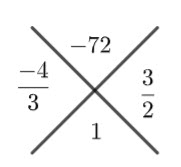
Hence,
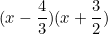
Which is
Method 5 – By Inspection
This is my least favourite method – although students get better with practice
The factors of are  and and the factors of
  are
are 
We know one number is positive and one number negative.
Which give us all of these possibilities
| Possible factorisations | term of expansion | |
 |  | No |
 |  | No |
 |  | No |
 |  | No |
 | | No |
 |  | Almost, switch the signs |
 |  | Yes |

With a bit of practice you don’t need to check all of the possibilties, but I find students struggle with this method.
Method 6 – Grid
Create a grid like the one below
 | ||
 |
Find the two numbers that multiply to and add to and place them in the other grid spots (see below)
|  | |
 | |
Find the HCF (highest common factor) of each row and put in the first column.
Row HCF= , Row
, Row  HCF=
HCF=
| | |
| | |
For the columns, calculate what is required to multiple the HCF to get the table entry.
For example, what do you need to multiple and by to get and ? In this case it is  . It’s always going to be the same thing, so just use one value to calculate it,
|  | |
| | |
| | |
The factors are column and row

The two methods I use the most are splitting the middle term, and the cross method, but I can see value in the grid method.
Filed under Algebra, Factorising, Factorising, Polynomials, Quadratic, Quadratics
Factorising Non-Monic Trinomials
I factorise trinomials by using the grouping method, I will show you what I mean
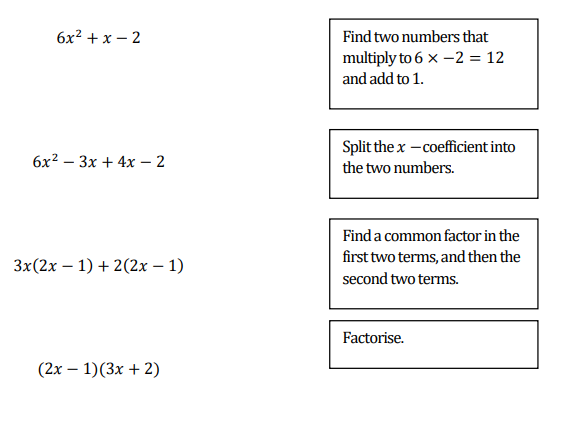
But one of my students showed me a different way
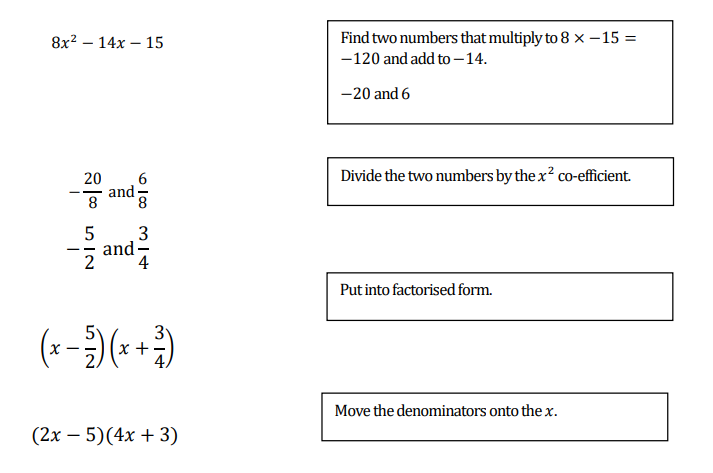
I have put in more steps than is necessary. I think this might be a quicker method.
Filed under Factorising, Quadratics