Category Archives: Pythagoras

Complex Locus Question

My Year 12 Specialist students are working on complex loci again. The following type of question always creates confusion.

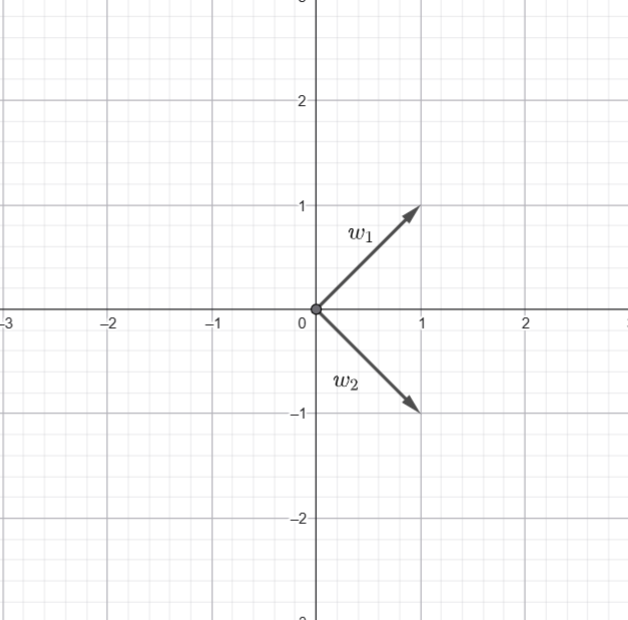
Let z \in \mathbb{C}, w_1=1+i, and w_2=1-i

(a) Show that the locus of points satisfying

    \begin{equation*}arg(z-w_1)-arg(z-w_2)=\frac{\pi}{6}\end{equation}

is the arc of a circle.
(b) Find the centre and radius of the circle, expressing your answers in exact form.

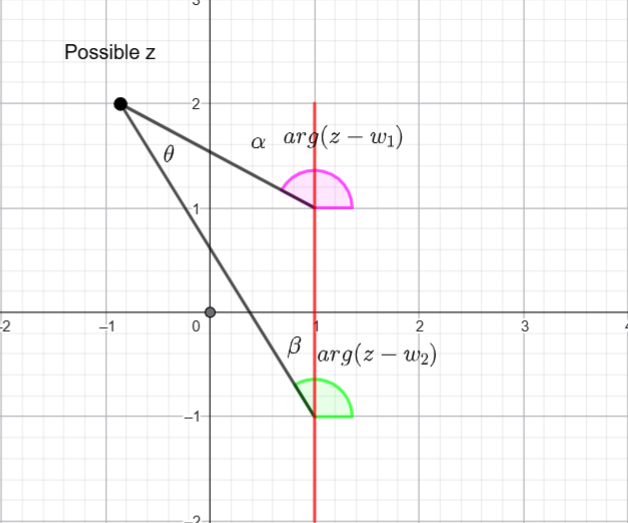
arg(z-w_1) is the angle the vector from w_1 to z makes with the positive x- axis, likewise for arg(z-w_2).

I am going to plot a possible z and try to see the geometry that works.
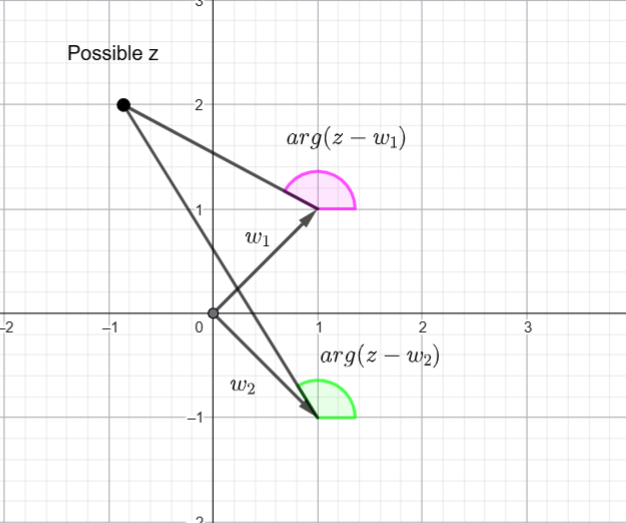
We want arg(z-w_1)-arg(z-w_2)=\frac{\pi}{6}

I am going to take advantage of some triangle geometry
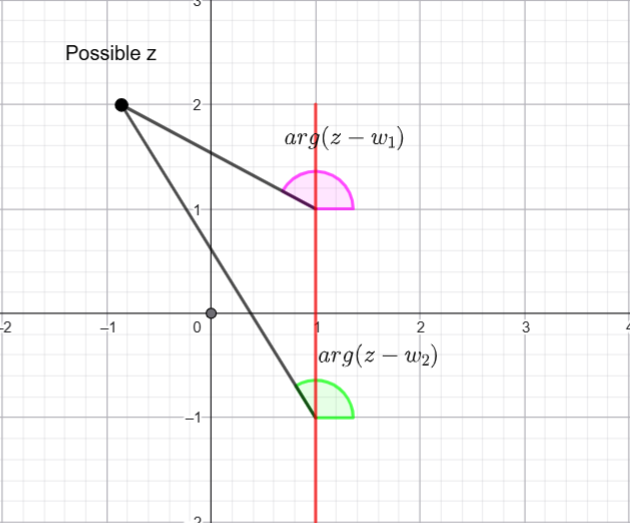
Using the External Angle Theorem, we know \alpha=\beta+\theta

    \begin{equation*}arg(z-w_1)-arg(z-w_2)=(\alpha+\frac{\pi}{2})-(\beta+\frac{\pi}{2}0=\alpha-\beta=\theta\end{equation}

Therefore \theta=\frac{\pi}{6}

So we want all of the z values that have an angle of \frac{\pi}{6}

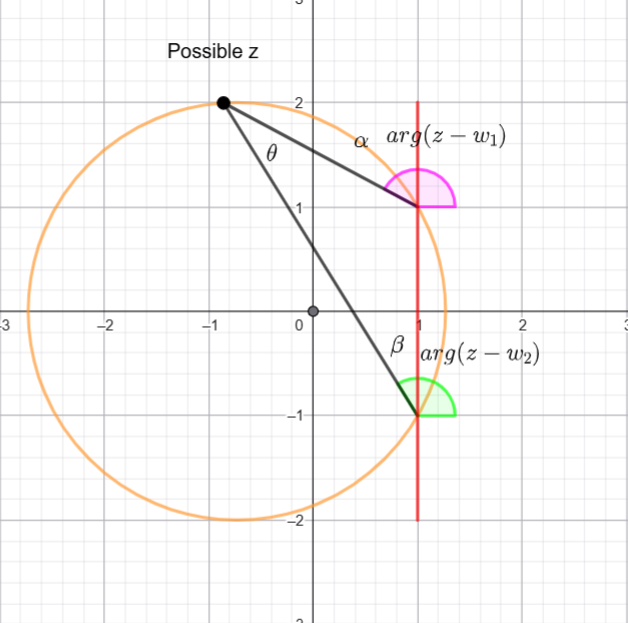
Now we are going to use some circle geometry -The angle at the circumference subtended by the same arc are congruent. So we need to find a circle that has those three points (z, w_1 and w_2) on the circumference.

Hence the locus is

Now we need to find the radius and centre of the circle.
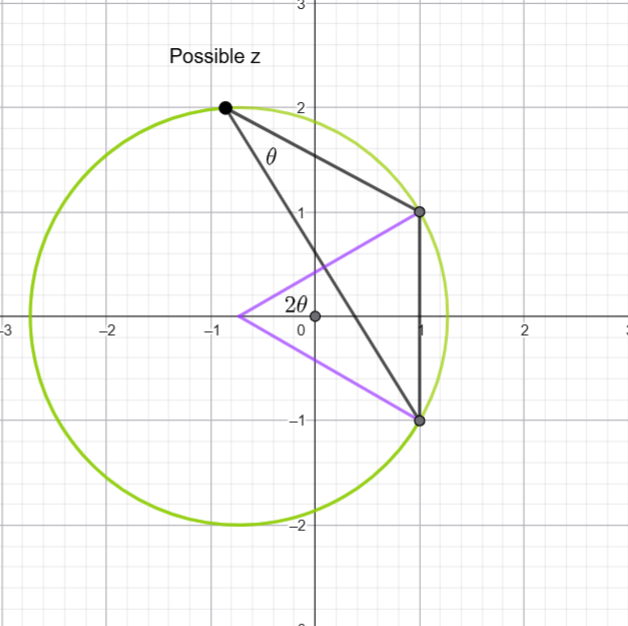
Using another circle theorem, the angle at the centre is twice the angle at the circumference.

The triangle must be equilateral (it is isosceles with a vertex angle of \frac{\pi}{3})

Hence the radius is 2.

h=\sqrt{2^2-1^2}=\sqrt{3}

Hence the centre is (-\sqrt{3}+1, 0)

Leave a Comment

Filed under Circle Theorems, Complex Numbers, Geometry, Interesting Mathematics, Pythagoras, Sketching Complex Regions, Year 12 Specialist Mathematics

Equation of a Circle and Geometry Question

A circle has equation x^2+y^2+4x-6y=36
(a) Find the centre and radius of the circle.
Points S and T lie on the circle such that the origin is the midpoint of ST.
(b) Show that ST has a length of 12.

(a)We need to put the circle equation into completed square form

    \begin{equation*}(x+2)^2-4+(y-3)^2-9=36\end{equation}

    \begin{equation*}(x+2)^2+(y-3)^2=49\end{equation}

The centre is (-2, 3) and the radius is 7.

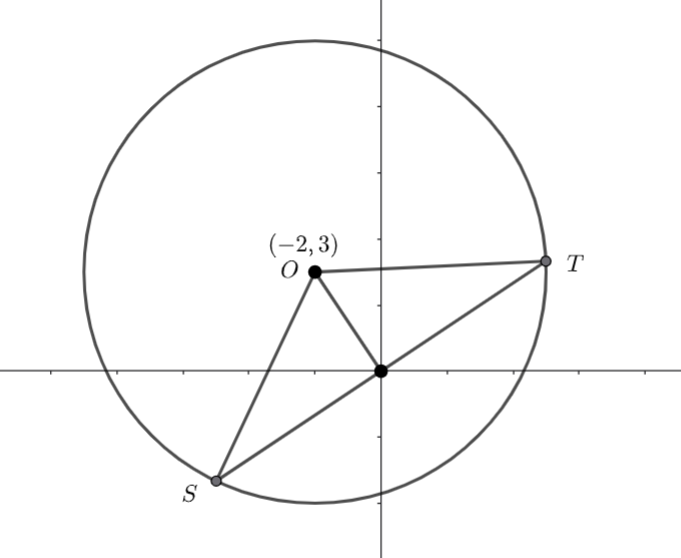
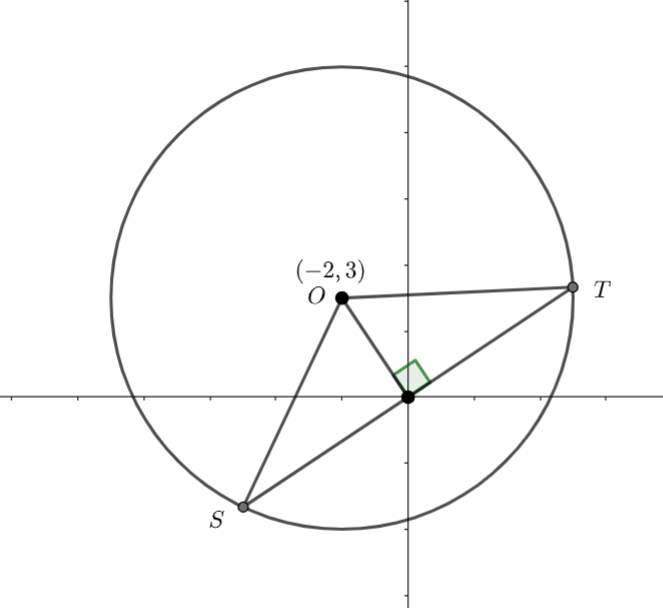
(b)Draw a diagram

We know SO and TO are radii of the circle. Hence \Delta{SOT} is isosceles and the line segment from O to the origin is perpendicular to ST.

OT=7 and the distance from O to the origin is

    \begin{equation*}\sqrt{(-2-0)^2+(3-0)^2}=\sqrt{13}\end{equation}

We can use Pythagoras to find the distance from the origin to T.

    \begin{equation*}x=\sqrt{7^2-(\sqrt{13})^2}=\sqrt{49-13}=\sqrt{36}=6\end{equation}

Hence ST=2\times6=12


Leave a Comment

Filed under Co-ordinate Geometry, Geometry, Pythagoras, Year 11 Mathematical Methods

Trigonometry Question

I don’t know where I found this question, but it does require algebra and problem solving (as well as right trig and Pythagoras)

From a point A, a lighthouse is on a bearing of 026^\circT and the top of the light house is at an angle of elevation of 20.25^\circ. From a point B, the lighthouse is on a bearing of 296^\cricT and the top of the lighthouse is at angle of elevation of 10.2^\circ. If A and B are 500 metres apart, find the height of the lighthouse.

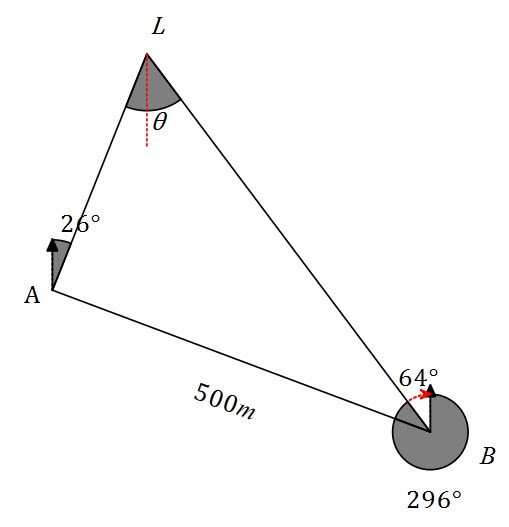
Let’s draw a diagram.

Let the height of the lighthouse be h

We can find the angle between A, the lighthouse, and B by using the base triangle

The red line from L is parallel to the two north lines. Hence \theta=26^\circ+64^\circ=90^\circ (Alternate angles in parallel lines are congruent)


It’s a right triangle so we know

(1)   \begin{equation*}500^2=(AL)^2+(BL)^2\end{equation*}

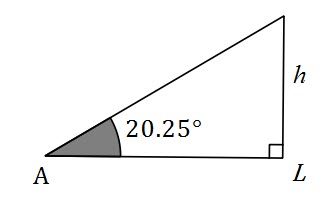
We are going to use the other two triangles to find AL and BL


tan(20.25)=\frac{h}{AL}
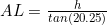
AL=\frac{h}{tan(20.25)}

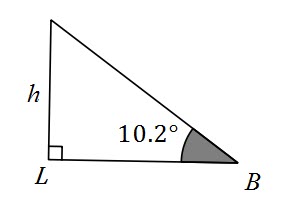
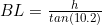
tan(10.2)=\frac{h}{BL}
BL=\frac{h}{tan(10.2)}

Substitute AL and BL into equation 1

    \begin{equation*}500^2=(\frac{h}{tan(20.25)})^2+(\frac{h}{tan(10.2)})^2\end{equation}

Solve for h.

    \begin{equation*}500^2=7.35h^2+30.89h^2=38.24h^2\end{equation}

    \begin{equation*}h^2=6538.3\end{equation}

    \begin{equation*}h=80.9m\end{equation}

Leave a Comment

Filed under Algebra, Bearings, Pythagoras, Right Trigonometry, Solving Equations, Trigonometry

Area/Geometry Problem

This problem is from The Geometry Forum Problem of the Week June 1996

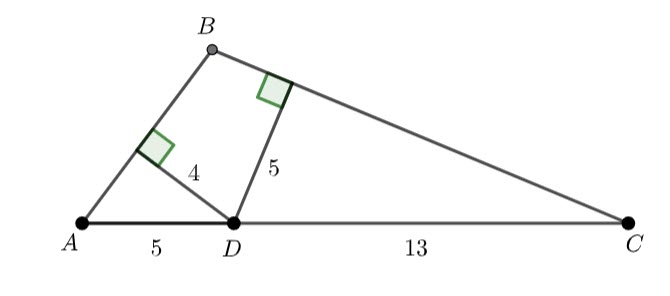
In triangle ABC, AC=18 and D is the point on AC for which AD=5. Perpendiculars drawn from D to AB and CB have lengths of 4 and 5 respectively. What is the area of triangle ABC?

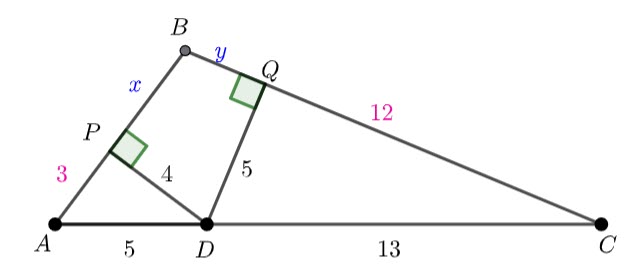
I put together a diagram (in Geogebra)

Add points P and Q

Triangle APD and triangle DQC are right angled. Using pythagoras, AP=3 and QC=12

BQDP is a cyclic quadrilateral and BD is the diameter. I am not sure if this is useful, but it is good to notice.

    \begin{equation*}sin(A+B+C)=sin(180)=0\end{equation}

    \begin{equation*}sin((A+C)+B)=sin(A+C)cosB+sinBcos(A+C)=0\end{equation}

    \begin{equation*}cosB(sinAcosC+sinCcosA)+sinB(cosAcosC-sinAsinC)=0\end{equation}

    \begin{equation*}cosB(\frac{4}{5}\times\frac{12}{13}+\frac{5}{13}\times\frac{3}{5})+sinB(\frac{3}{5}\times\frac{12}{13}-\frac{4}{5}\times\frac{5}{13})=0\end{equation}

    \begin{equation*}cosB(\frac{48}{65}+\frac{15}{65})+sinB(\frac{36}{65}-\frac{20}{65})=0\end{equation}

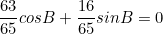
    \begin{equation*}\frac{63}{65}cosB+\frac{16}{65}sinB=0\end{equation}

    \begin{equation*}63cosB+16sinB=0\end{equation}

    \begin{equation*}63+16tanB=0\end{equation}

    \begin{equation*}tanB=\frac{-63}{16}\end{equation}

If tanB=\frac{-63}{16} then sinB=\frac{63}{65}

Now,

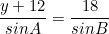
    \begin{equation*}\frac{y+12}{sinA}=\frac{18}{sinB}\end{equation}

    \begin{equation*}y+12=\frac{4}{5}(18)\frac{65}{63}\end{equation}

    \begin{equation*}y+12=\frac{104}{7}\end{equation}

Hence the Area is

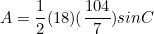
    \begin{equation*}A=\frac{1}{2}(18)(\frac{104}{7})sinC\end{equation}

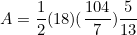
    \begin{equation*}A=\frac{1}{2}(18)(\frac{104}{7})\frac{5}{13}\end{equation}

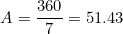
    \begin{equation*}A=\frac{360}{7}=51.43\end{equation}

Leave a Comment

Filed under Area, Finding an area, Geometry, Identities, Non-Right Trigonometry, Pythagoras, Trigonometry

Circle Geometry Question 2

One of my Year 11 Specialist students had this question

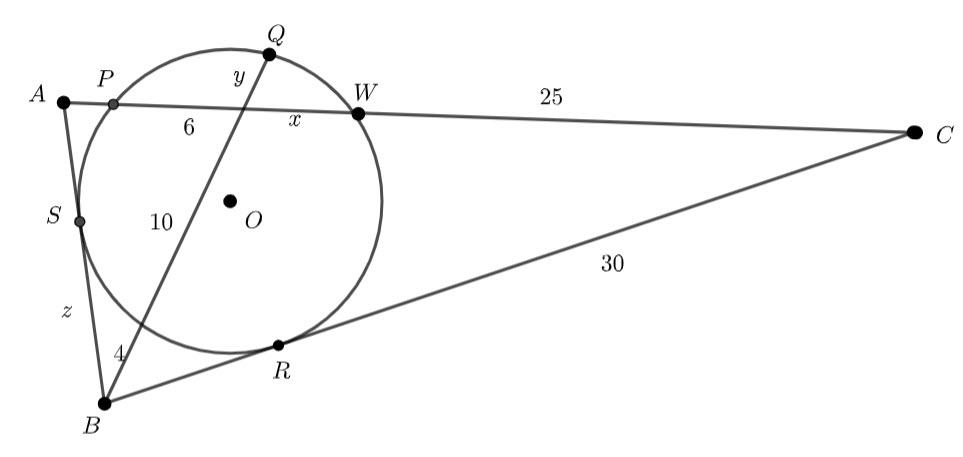
Triangle ABC touches the given circle at Points P, Q, R and S only. The secant BW touches the circle at V and W.

Diagram not drawn to scale

(a) Determine the lengths of the line segments marked x, y and z, leaving your answers as exact values.

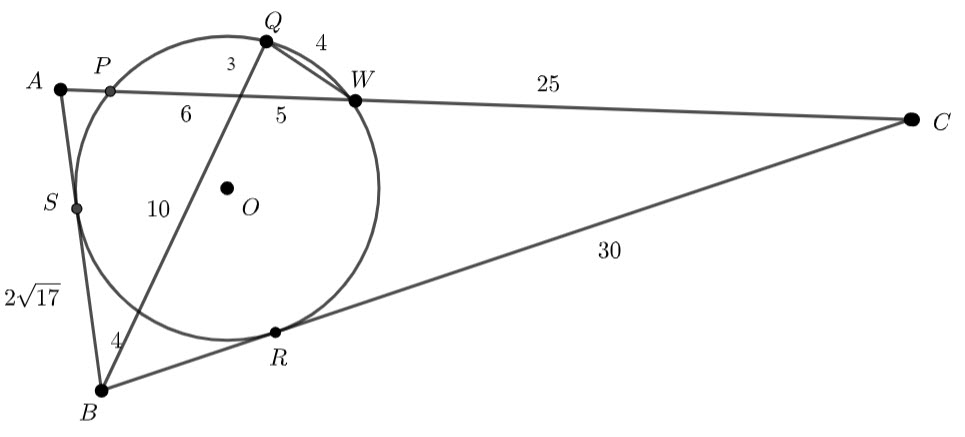
(b) If the length of the line segment QW is 4 units, determine the exact radius of the circle.
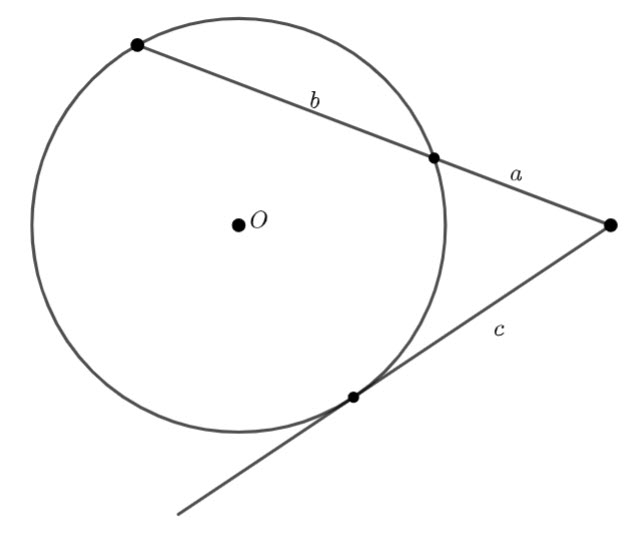

(a) We are going to use the Intersecting Secant Theorem – the tangent version

c^2=a\times(a+b)

Hence, we have

    \begin{equation*}30^2=25(25+x+6)\end{equation}

    \begin{equation*}900=25(31+x)\end{equation}

    \begin{equation*}x=5\end{equation}

Then we can use the intersecting chord theorem to find y.

    \begin{equation*}10\times y=6 \times x\end{equation}

    \begin{equation*}10y=30\end{equation}

    \begin{equation*}y=3\end{equation}

Back to the Intersecting Secant Theorem to find z

    \begin{equation*}z^2=4\times 17\end{equation}

    \begin{equation*}z=2\sqrt{17}\end{equation}

(b)


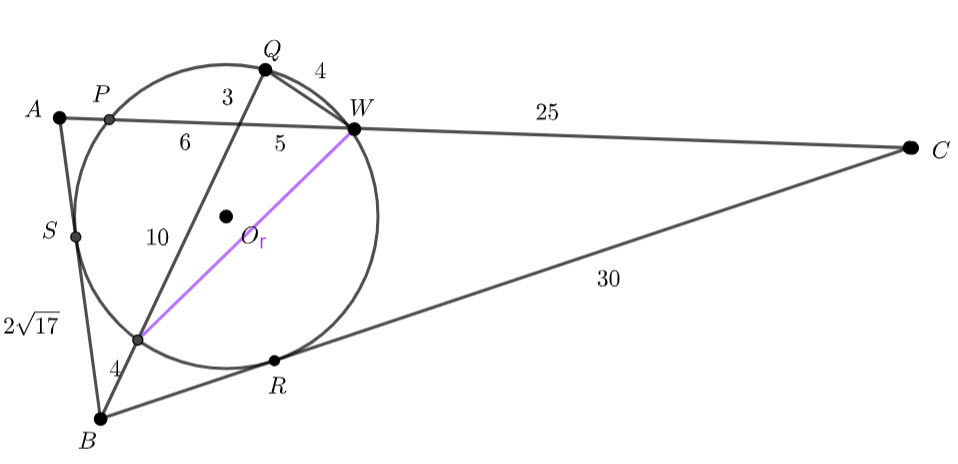
QW is part of a 3-4-5 triangle, therefore \angle{Q}=90^\circ

This is definitely the case of the diagram not being drawn to scale. If \angle{Q}=90^\circ, then the purple line must be the diameter.

We can use pythagoras to find the length of the diameter

    \begin{equation*}(2r)^2=13^2+4^2\end{equation}

    \begin{equation*}4r^2=185\end{equation}

    \begin{equation*}r=\frac{\sqrt{285}}{2}\end{equation}

The radius of the circle is \frac{\sqrt{285}}{2}

Leave a Comment

Filed under Circle Theorems, Geometry, Pythagoras, Year 11 Specialist Mathematics

Related Rates Question

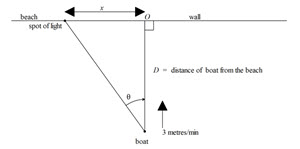
A boat is moving towards the beach line at 3 metres/minute. On the boat is a rotating light, revolving at 4 revolutions/minute clockwise, as observed from the beach. There is a long straight wall on the beach line, as the boat approaches the beach, the light moves along the wall. Let x equal the displacement of the light from the point O on the wall, which faces the boat directly. See the diagram below.
Determine the velocity, in metres/minute, of the light when x=5 metres, and the distance of the boat from the beach D is 12 metres.

Mathematics Specialist Semester 2 Exam 2018


The light is rotating at 4 revolutions/minute, which means

    \begin{equation*}\frac{d\theta}{dt}=4\times\pi\end{equation}

We want to find \frac{dx}{dt} and we know \frac{d\theta}{dt} and \frac{dD}{dt}.

We need to find an equation connecting x, \theta, and D.

    \begin{equation*}tan (\theta)=\frac{x}{D}\end{equation}

Differentiate (implicitly) with respect to time.

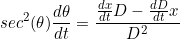
    \begin{equation*}sec^2(\theta)\frac{d\theta}{dt}=\frac{\frac{dx}{dt}D-\frac{dD}{dt}x}{D^2}\end{equation}

Now we know x=5, and D=12, using pythagoras we can calulate the hypotenuse.
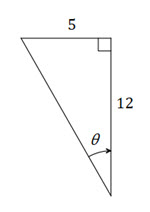


h=\sqrt{12^2+3^2}=13
sec(\theta)=\frac{13}{12}

    \begin{equation*}sec^2(\theta)\frac{d\theta}{dt}=\frac{\frac{dx}{dt}D-\frac{dD}{dt}x}{D^2}\end{equation}

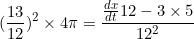
    \begin{equation*}(\frac{13}{12})^2\times 4\pi=\frac{\frac{dx}{dt}12-3\times 5}{12^2}\end{equation}

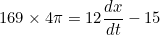
    \begin{equation*}169\times4\pi=12\frac{dx}{dt}-15\end{equation}

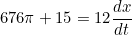
    \begin{equation*}676\pi+15=12\frac{dx}{dt}\end{equation}

    \begin{equation*}\frac{dx}{dt}=178.2\end{equation}

The velocity of the light is 178.2 m/minute.

Leave a Comment

Filed under Differentiation, Implicit, Pythagoras, Right Trigonometry, Trigonometry, Uncategorized

Tricky Area Ratio Question

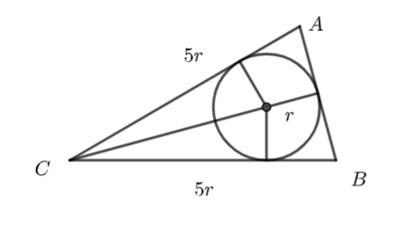
A circle of radius r, is inscribed within an isosceles triangle ABC. CA=CB=5r. Given that \angle{ACB} is acute, find the ratio of the area of the circle to that of triangle ABC.

Mathematics Specialist 3AB Question15 page 55

I came across this question while searching for an area of sectors and segments question.

Here’s a diagram

We know AC, AB and BC are tangents to the circle. Because the triangle is isosceles, the distance from A to the circle is the same as the distance from B to the circle.
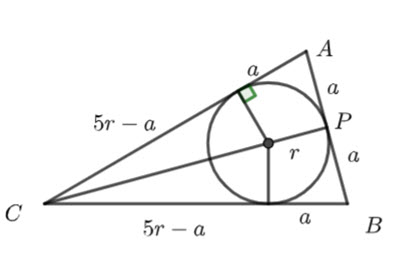
CP is perpendicular to AB (because the triangle is isosceles).

Because it is proportional, i.e. r and 5r, we can let r=1

Let h=CP

(1)   \begin{equation*}h=\sqrt{25-a^2}\end{equation*}

but h also equals

(2)   \begin{equation*}h=1+\sqrt{(5-a)^2+1}\end{equation*}

Set equation 1 equal to equation 2

    \begin{equation*}\sqrt{25-a^2}={1+\sqrt{(5-a)^2+1}\end{equation}

Square both sides

    \begin{equation*}25-a^2=1+(5-a)^2+1+2\sqrt{(5-a)^2+1}\end{equation}

Expand and simplify

    \begin{equation*}25-a^2=2+25-10a+a^2+2\sqrt{(5-a)^2+1}\end{equation}

    \begin{equation*}0=2-10a+2a^2+2\sqrt{(5-a)^2+1}\end{equation}

Divide by 2

    \begin{equation*}0=1-5a+a^2+\sqrt{(5-a)^2+1}\end{equation}

    \begin{equation*}-\sqrt{(5-a)^2+1}=a^2-5a+1\end{equation}

Square both sides

    \begin{equation*}(5-a)^2+1=a^4-5a^3+a^2-5a^3+25a^2-5a+a^2-5a+1\end{equation}

    \begin{equation*}25-10a+a^2+1=a^4-10a^3+27a^2-10a+1\end{equation}

    \begin{equation*}0=a^4-10a^3+26a^2-25 \end{equation}

I solved this using a graphics calculator

a=-0.8434, a=1.3068, a=4.5367, a=5

We can reject a=-0.8434, a=4.5367, and a=5. If a=5, there isn’t a triangle, and if a=4.5367 \angle{ACB} is not acute.

Hence the area of triangle ABC=a\times h

    \begin{equation*}A_{\Delta}=1.3068\times\sqrt{25-1.3068^2}\end{equation}

(3)   \begin{equation*}A_{\Delta}=6.3069\end{equation*}

(4)   \begin{equation*}A_{\circ}=\pi\end{equation*}

Hence, equation 4 divided by equation 3 is

    \begin{equation*}\frac{\pi}{6.3069}\approx 0.5\end{equation}

Perhaps I approached this question in the wrong way. Is there an easier process?

Leave a Comment

Filed under Area, Geometry, Pythagoras

Pythagoras Question

This was a question one of my year 9s had to tackle:

A hemisphere of radius length 5cm is partially filled with water. The top of the hemisphere is horizontal and the surface of the water is a circle of radius 4cm. Find the depth of the water.

ICE-EM Mathematics 9, page 70, question 2

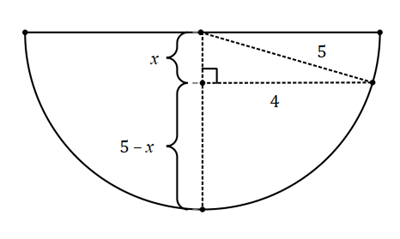
Below is a cross section of the hemisphere

The depth of the water is 5-x

We can find x using the Pythagorean theorem

x^2=5^2-4^2

x=3 (it’s the classic 3-4-5 triangle)

Hence the depth of the water is 2cm.

Leave a Comment

Filed under Pythagoras