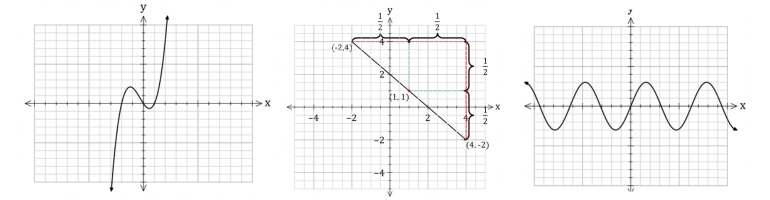
I usually choose to use synthetic division when factorising polynomials, but I know some teachers are unhappy when their students do this. So for completeness, here is my PDF for Polynomial Long Division.
Category Archives: Solving
Hard Equation Solving Question
Find the value(s) of  such that the equation below has two numerically equal but opposite sign solutions (e.g.
  and
and  ).
).
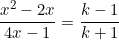




For there to be two numerically equal but opposite sign solutions, the  term of the quadratic equation must be
  .
.

Hence  .
.
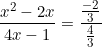
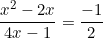
When the equation becomes



Filed under Algebra, Polynomials, Quadratic, Quadratics, Solving, Solving, Solving Equations
Simultaneous Equation (or is it?)
Solve simultaneously



We could attempt to solve this simultaneously, but I think the algebra would be tricky.
The three equations are related to the roots of a cubic polynomial.
If the general equation of the polynomial is  , then we know
The sum of the roots

The product of the roots

and

So from our three equations we have
(1) 
(2) 
(3) 
Let  , then
  , and
, and 
Our cubic is  and we can try to solve it.
The roots will be factors of  , so
, so 
Try 

Hence is a root.
Use synthetic division to find the quadratic factor
 |  |  |  | |
|  |  | ||
|  |  | |
The quadratic factor is  , which factorises to
Hence the solutions are  , and
, and 
We could assume the solutions are natural numbers, then we can look at factors of 30.
| Factors of Thirty |  |  |
 |  |  |
 |  |  |
 |  |  |
 |  |  |
Hence the solutions are  and
and
But with this approach we might not be able to find the solutions.
Deriving the Quadratic Equation formula
My year 10 students have been learning how to complete the square with the idea of then deriving the quadratic equation formula.
The general equation for a quadratic is 
Completing the square,

Factorise out the leading coefficient (i.e.  )
)
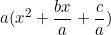
Half the second term (i.e  ) and subtract the square of the second term.

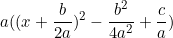
Simplify
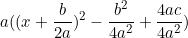
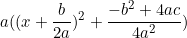
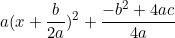
Now let’s solve

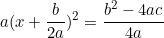
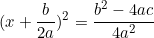
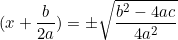
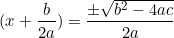
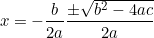
Which is the quadratic equation formula.
Filed under Algebra, Quadratic, Quadratics, Solving, Solving, Solving Equations
Solving Cubic Functions
I have been thinking about cubics a bit lately because some of my students are solving and then sketching cubics. Plus I am reading An Imaginary Tale by Paul Nahin, which talks about solving cubics and complex numbers.
Cubics must have at least one real root. If one of the roots is a rational number, then we can use the Factor and Remainder Theorem.
For example,
Solve 
We know the root(s) must be a factor of  . .I always start with or   Try  and and  is a factor. is a factor.Then we can do polynomial long division.  Now we know that  And we can factorise the quadratic (or using the quadratic equation formula)    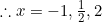 |
But what if it is not factorisable?
For example,
Solve 
How many roots does this equation have?
We could find the derivative and find out how many stationary points the function has.

This is a quadratic function. Find the discriminant to determine the number of roots.

As  , there are two stationary points, which means we could have 1, 2 (one root is repeated) or three roots, depending on if the function crosses the
  axis between stationary points. So not much use.
We could try the discriminant of a cubic.


The discriminant is negative so there is one real root.
From my reading, we need to turn the cubic into a depressed cubic (cubics of the form  ).
).
We can do this by using a change of variable.
Let    Substitute  into the cubic. into the cubic.    |
We can then use Cardano’s formula
![x=\sqrt[3]{-\frac{q}{2}+\sqrt{(-\frac{q}{2})^2+(\frac{p}{3})^3}}+\sqrt[3]{-\frac{q}{2}-\sqrt{(-\frac{q}{2})^2+(\frac{p}{3})^3}}](https://www.racquelsanderson.com/wp-content/ql-cache/quicklatex.com-d37c6b14e19cd65d434db272d800e8ee_l3.png "Rendered by QuickLaTeX.com")
 and and     ![t=\sqrt[3]{\frac{-431}{216}+\sqrt{\frac{139}{48}}}+\sqrt[3]{\frac{-431}{216}-\sqrt{\frac{139}{48}}}](https://www.racquelsanderson.com/wp-content/ql-cache/quicklatex.com-23a6a5411221f9c43bab67055718abb1_l3.png "Rendered by QuickLaTeX.com")   |
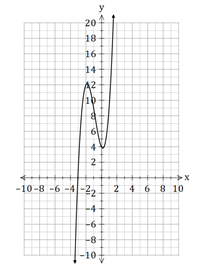
We can see from the sketch below that there is only one solution and it is about  .
.
Filed under Cubics, Factorising, Polynomials, Solving