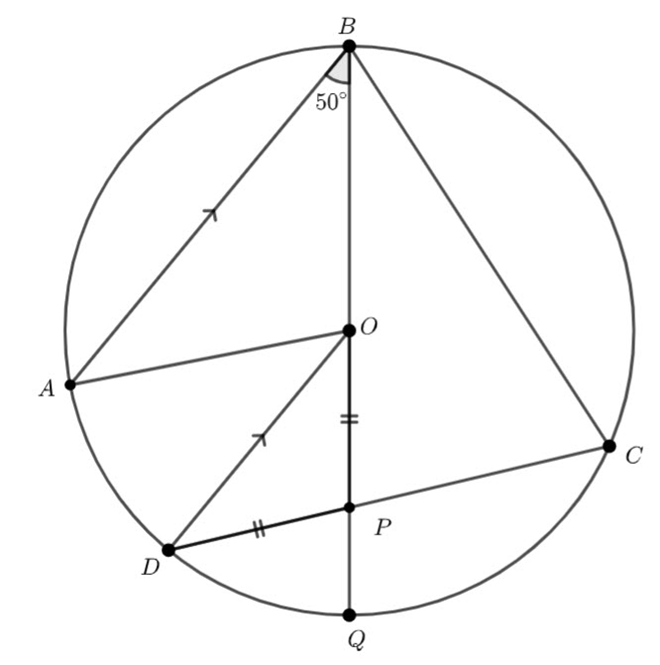
In the diagram below,  and
and  lie on the circle with centre
  . If
. If  and
and  , determine with reasoning
  and
and 

We know  – radii of the circle.
Which means,  is isosceles and
  – equal angles isosceles triangle.
 – angle at the centre twice the angle at the circumference.


This means  – angles on a straight line are supplementary
 – equal angles isosceles triangle and the angle sum of a triangle.
 – angle at the circumference subtended by the same arc are congruent.

 – angles at the circumference subtended by the same arc are congruent.
 – equal angle isosceles triangle
Hence 
 and
and  lie on a circle centre
  cm and diameter
  is parallel to
  and point
  lies on diameter
  such that
  cm.
cm.
 .
.
 (Co-interior angles in parallel lines are supplementary.)
 (Angles subtended by the same arc. The angle at the centre is twice the angle at the circumference.)




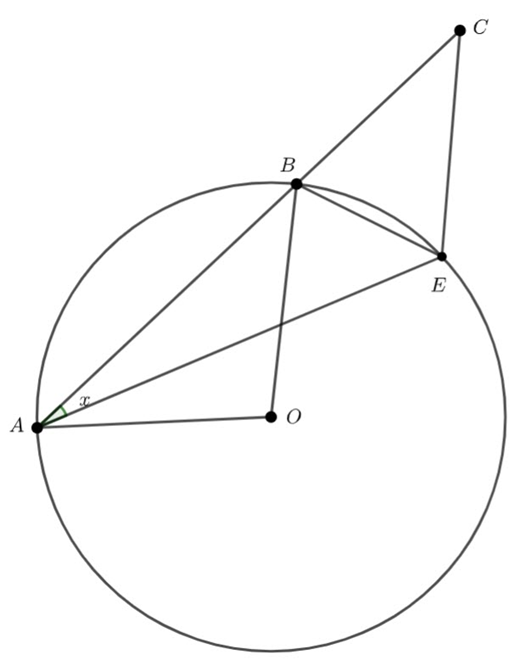
 of a circle
  . The straight line bisecting
  meets the circle at
  . Let
. Let  . Prove that
  bisects
  .
.
 (
( bisects
  )
) is isosceles (
 radii of the circle)
 (Equal angles in isosceles triangle)
 (angle sum of a triangle)
 (angle at the circumference is half angle at the centre)
 (angle sum of a triangle)
 (angles on a straight line)

 bisects