, find
.
I came across this sum in An Imaginary Tale by Nahin and I was fascinated.
Let  and
and  .
.
Remember Hence,    Therefore,  and  and and   |
Which means,

Let’s try a few partial sums




Hence, 

What happens as  ?
?

Because we know  is undefined.
I came across this sum in An Imaginary Tale by Nahin and I was fascinated.
Let and .
| Remember Hence, Therefore, and and |
Which means,
Let’s try a few partial sums
Hence,
What happens as ?
Because we know is undefined.
Filed under Identities, Interesting Mathematics, Puzzles, Sequences, Trigonometry
If
, then find
.
My first thought was to solve for  , but it doesn’t factorise easily, and I didn’t want to find the fifth power of an expression involving surds
  , there must be an easier way.
Because  , we can divide by
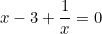
Hence
(1) 
What is the expansion of  ?
?
Using the binomial expansion theorem


Therefore
(2) 
Let’s do it again for 

(3) 
Substitute  into
into 

Remember 
Therefore


This would be a good extension question for students learning the binomial expansion theorem. We also use this technique for trigonometric identities using complex numbers.
Filed under Algebra, Binomial Expansion Theorem, Puzzles
If
, what does
equal?




Two positive numbers are such that their difference, their sum, and their product are in the ratio
. What is the smaller of the two numbers?
Let and  be the two numbers. Then
(1) 
(2) 
(3) 
Add equation  and together to eliminate the

(4) 
From  , substitute for into equation .
(5) 
Substitute  into equation
  .
.
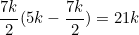
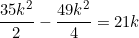
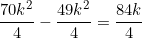


Hence,  or
or  .
.
When ,  and
and 
Therefore the smaller number is  .
.
Filed under Algebra, Puzzles, Ratio, Solving Equations