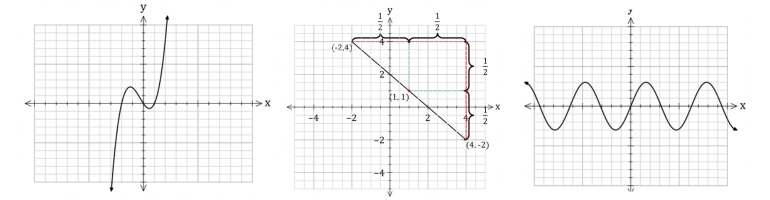
, find
.
I came across this sum in An Imaginary Tale by Nahin and I was fascinated.
Let  and
and  .
.
Remember Hence,    Therefore,  and  and and   |
Which means,

Let’s try a few partial sums




Hence, 

What happens as  ?
?

Because we know  is undefined.
I came across this sum in An Imaginary Tale by Nahin and I was fascinated.
Let and .
| Remember Hence, Therefore, and and |
Which means,
Let’s try a few partial sums
Hence,
What happens as ?
Because we know is undefined.
Filed under Identities, Interesting Mathematics, Puzzles, Sequences, Trigonometry
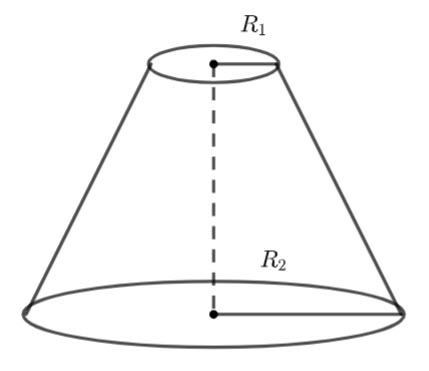
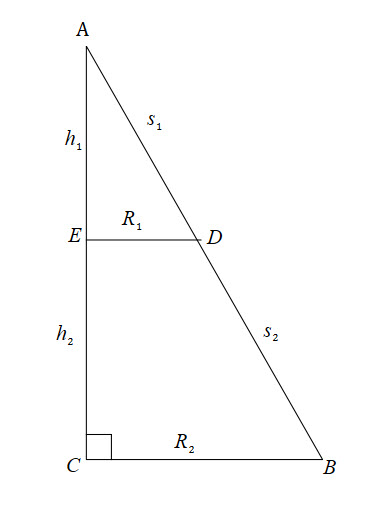
We have a truncated cone,
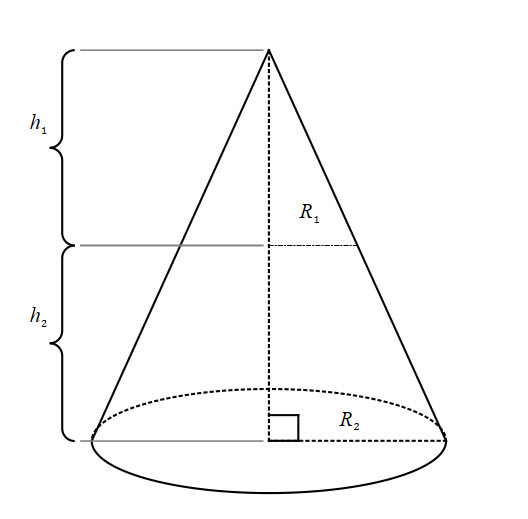
(1) 
We are unlikely to know  . Can we get in terms that we do know (i.e.
  )?
)?
Think of similar triangles
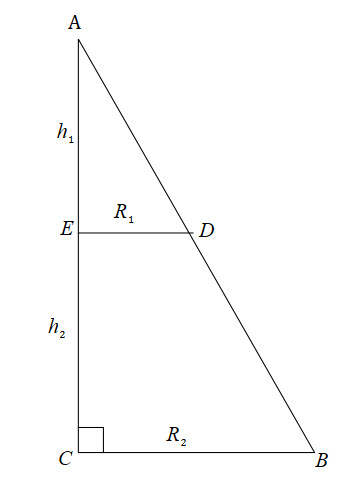


 (Corresponding Angles in Parallel Lines)
 (Corresponding Angles in Parallel Lines)
Therefore
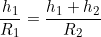
Rearrange to make the subject.
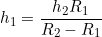
Substitute into equation 







Now let’s think about the surface area.
The surface area of a cone is  where
where  is the slant height of the cone.
Once again, we need to subtract the ‘missing’ part of the cone.
(2) 
We don’t need to subtract the circle of the top cone because it is the top of the frustrum, but we do need to add it on.
Using similar triangles again

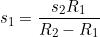
Substitute into equation 




And hence the curved surface area is  .
.
I think this one is doing the rounds, I first saw it here.

 is the obvious answer,
  , but are there more answers?
This was my approach




A quadratic equation.
Hence,

I then used my calculator
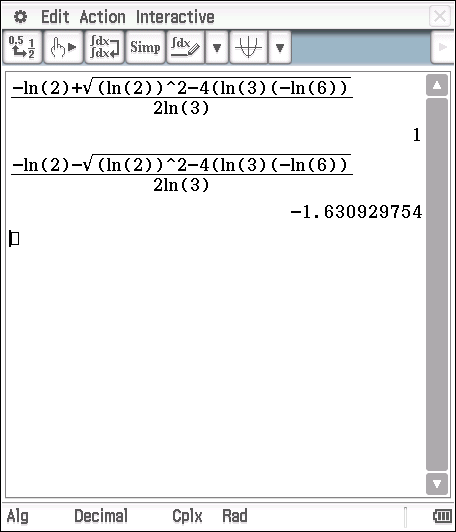
Hence 0r 
Filed under Algebra, Index Laws, Interesting Mathematics, Quadratics, Solving
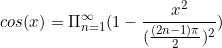
Remember
(1) 
We know that  for odd integer multiples of
  , i.e.
  , which is
  for
for 
Hence,

for 
We can factorise our  expansion
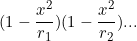
We know 


I have been reading An Imaginary Tale – The Story of  by Paul J Nahin, which is fabulous. There was a bit in chapter 4 where he found the closed form of the generalised Fibonacci sequence. I thought it would be a good exercise to find the closed from of the Fibonacci sequence.
Just to remind you, the Fibonacci sequence is

and it is defined recursively

That is, the next term is the sum of the two previous terms, i.e.

Now the starting off point is slightly dodgy as it involves and educated guess as Paul Nahin writes,
How do I know that works? Because I have seen it before, that’s how! […] There is nothing dishonourable about guessing correct solutions – indeed, great mathematicians and scientists, are invariable great guessers – just as long as eventually the guess is verified to work. The next time you encounter a recurrence formula, you can guess the answer too because then you will have already seen how it works.
We start with 
This means  is
is 




 or
or 
Hence  and we can use the initial conditions
  and
and  to find
  and
and 
When 
(1) 
When 
(2) 
From equation  ,
,  , substitute into equation



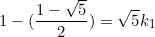
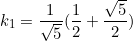
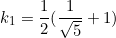

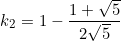
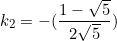


Does it work?
Remember the sequence is 
If 

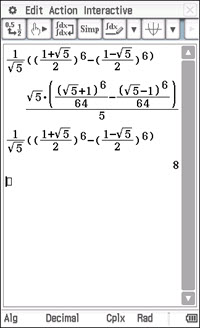
As you can see it works!
This is one of those theorems, where the name is probably not the person who discovered it. Check out the Wikipedia entry for more information on the history.
Napoleon’s theorem states that if equilateral triangles are constructed on the sides of any triangle, either all outward or all inward, the lines connecting the centres of those equilateral triangles themselves form an equilateral triangle.
I am just going to look at the outward triangles.
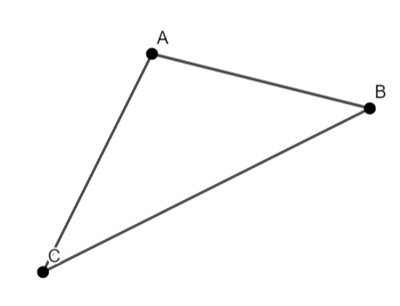
Construct equilateral triangles on the edges AB, BC and AC.
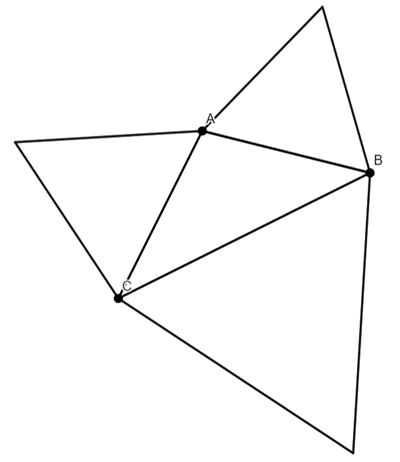
Find the centre (Centroid) of these triangles.
Note: The centroid is the point of intersections of the medians.
A median is the line from a vertex to the midpoint of the opposite side.
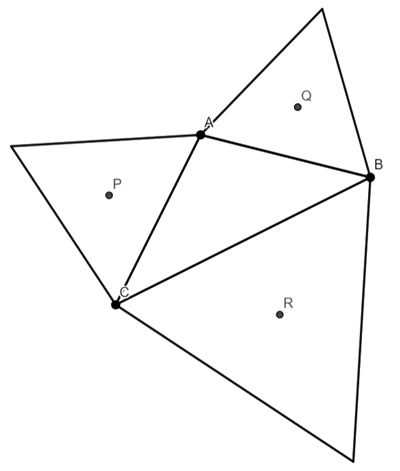
We are going to prove that triangle PQR is equilateral
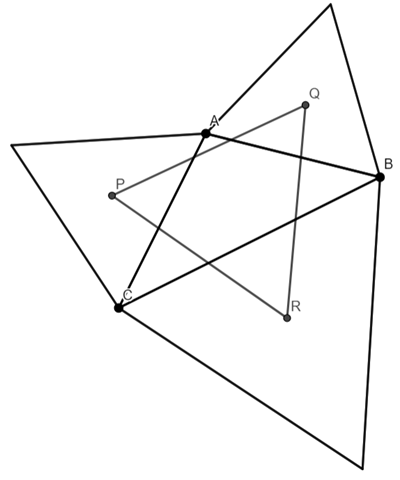
I am going to add AP, AQ, QB, BR, RC and CP
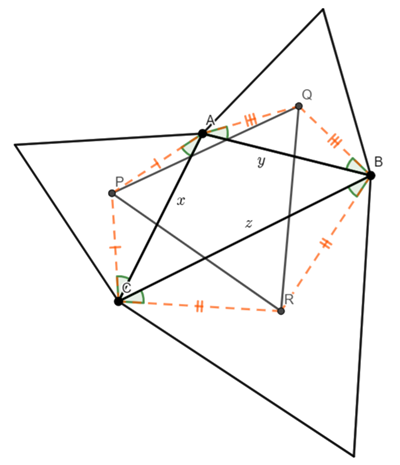
As P, Q and R are the centroids, PA=PC, QA=QB, and RB=RC.
Therefore triangles AQB, BRC, and CPA are isosceles.
The angles QAB, QBA, RBC, RCB, PCA, PAC (the shaded angles in the above diagram) are 30 degrees, because the line bisects the angle (and the angle is 60 degrees because the triangles are equilateral).
Now for the maths.
![\[\textnormal {Let}\ AB=y,\ AC=x,\ BC=z\]](https://www.racquelsanderson.com/wp-content/ql-cache/quicklatex.com-0a202b0f006432d8dd90e8b609d70fc8_l3.png "Rendered by QuickLaTeX.com")
![\[\textnormal {Let}\ \angle{CAB}=\theta,\ \angle{ABC}=\alpha,\ \angle{BCA}=\gamma\]](https://www.racquelsanderson.com/wp-content/ql-cache/quicklatex.com-0b06510049efb29f6cd00c6d1ce5111e_l3.png "Rendered by QuickLaTeX.com")
![\[\therefore\angle{PAQ}=(60+\theta),\ \angle{QBR}=(60+\alpha),\]](https://www.racquelsanderson.com/wp-content/ql-cache/quicklatex.com-8ea08beb2a901e6510a4a7cdb218921e_l3.png "Rendered by QuickLaTeX.com")
![\[ \angle{RCP}=(60+\gamma)\]](https://www.racquelsanderson.com/wp-content/ql-cache/quicklatex.com-6e000b656e4509c8368ea5bfed8a0c22_l3.png "Rendered by QuickLaTeX.com")
PA is 2/3 the length of the median.
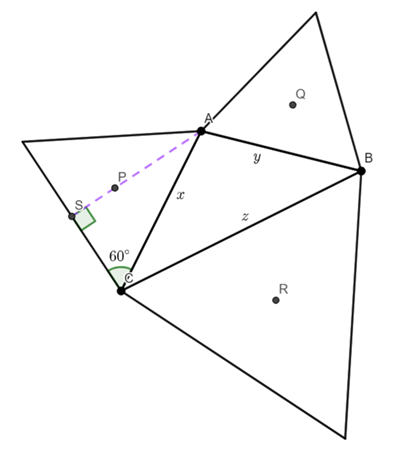
AS is the median
![\[sin(60)=\frac{AS}{x}\]](https://www.racquelsanderson.com/wp-content/ql-cache/quicklatex.com-7939e7d93aab91f09474b42a7aed1ee9_l3.png "Rendered by QuickLaTeX.com")
![\[AS=xsin(60)\]](https://www.racquelsanderson.com/wp-content/ql-cache/quicklatex.com-e85717e7c3d20af7dd6048f71216a8a4_l3.png "Rendered by QuickLaTeX.com")
![\[AS=\frac{\sqrt{3}}{2}x\]](https://www.racquelsanderson.com/wp-content/ql-cache/quicklatex.com-9f21b71acd4008d18c10cb0480e37254_l3.png "Rendered by QuickLaTeX.com")
Hence,
![\[PA=\frac{2}{3}\frac{\sqrt3}{2}x\]](https://www.racquelsanderson.com/wp-content/ql-cache/quicklatex.com-9ebc3c9e56fcc11bf885e0a21af9c910_l3.png "Rendered by QuickLaTeX.com")
![\[PA=\frac{\sqrt{3}}{3}x\]](https://www.racquelsanderson.com/wp-content/ql-cache/quicklatex.com-d5532ce0c0c81b58b0a919049888e378_l3.png "Rendered by QuickLaTeX.com")
![\[PA=\frac{x}{\sqrt{3}}\]](https://www.racquelsanderson.com/wp-content/ql-cache/quicklatex.com-eaed84f2daf0fd839648666b7125b545_l3.png "Rendered by QuickLaTeX.com")
In the same manner,
![\[QA=\frac{y}{\sqrt{3}}\ \textnormal {and} \ BR=\frac{z}{\sqrt{3}}\]](https://www.racquelsanderson.com/wp-content/ql-cache/quicklatex.com-ddbfca3228d890b08fa79314d2d68795_l3.png "Rendered by QuickLaTeX.com")
Using the cosine rule
![\[(PQ)^2=(\frac{x}{\sqrt{3}})^2+(\frac{y}{\sqrt{3}})^2-2\frac{x}{\sqrt{3}}\frac{y}{\sqrt{3}}cos(60+\theta)\]](https://www.racquelsanderson.com/wp-content/ql-cache/quicklatex.com-f30149da2a40f25ac976c813aa11c68f_l3.png "Rendered by QuickLaTeX.com")
![\[(PQ)^2=\frac{x^2}{3}+\frac{y^2}{3}-\frac{2xy}{3}cos(60+\theta)\]](https://www.racquelsanderson.com/wp-content/ql-cache/quicklatex.com-4091c96b5c5f84a12d6cc264c15695f9_l3.png "Rendered by QuickLaTeX.com")
![\[\textnormal{Use a trigonometric identity to expand}\ cos(60+\theta)\]](https://www.racquelsanderson.com/wp-content/ql-cache/quicklatex.com-d755c54e37c7a3a26ac1788348b97742_l3.png "Rendered by QuickLaTeX.com")
![\[(PQ)^2=\frac{x^2}{3}+\frac{y^2}{3}-\frac{2xy}{3}(cos60cos\theta-sin60sin\theta)\]](https://www.racquelsanderson.com/wp-content/ql-cache/quicklatex.com-82401ff7593bb721159a4c87c1b1e0eb_l3.png "Rendered by QuickLaTeX.com")
![\[(PQ)^2=\frac{x^2}{3}+\frac{y^2}{3}-\frac{2xy}{3}(\frac{1}{2}cos\theta-\frac{\sqrt{3}}{2}sin\theta)\]](https://www.racquelsanderson.com/wp-content/ql-cache/quicklatex.com-eebbbc1c30a6f1b8de7ebd29efef2478_l3.png "Rendered by QuickLaTeX.com")
Now from the original triangle ABC
![\[cos\theta=\frac{x^2+y^2-z^2}{2xy}\ \textnormal {and}\ A=\frac{1}{2}xysin\theta\ \textnormal {where} A\ \textnormal {is the area.}\]](https://www.racquelsanderson.com/wp-content/ql-cache/quicklatex.com-0dca65a1cffba41ee639db3e7939c760_l3.png "Rendered by QuickLaTeX.com")
![\[\textnormal{Substitute into}\ (PQ)^2 \]](https://www.racquelsanderson.com/wp-content/ql-cache/quicklatex.com-899e9e8d0156b7cc097208db341d92a9_l3.png "Rendered by QuickLaTeX.com")
![\[(PQ)^2=\frac{x^2}{3}+\frac{y^2}{3}-\frac{2xy}{3}(\frac{x^2+y^2-z^2}{4xy}-\frac{\sqrt{3}A}{xy})\]](https://www.racquelsanderson.com/wp-content/ql-cache/quicklatex.com-9ec10ee252942c31b363a6b22a0af68e_l3.png "Rendered by QuickLaTeX.com")
Multiply both sides by 3 and expand and simplify
![\[3(PQ)^2=x^2+y^2-2xy(\frac{x^2+y^2-z^2}{4xy}-\frac{\sqrt{3}A}{xy})\]](https://www.racquelsanderson.com/wp-content/ql-cache/quicklatex.com-3163ed2ffe449e6026a29ba65c43d931_l3.png "Rendered by QuickLaTeX.com")
![\[3(PQ)^2=x^2+y^2-(\frac{x^2}{2}+\frac{y^2}{2}-\frac{z^2}{2}-2\sqrt{3}A)\]](https://www.racquelsanderson.com/wp-content/ql-cache/quicklatex.com-2673582b21222e561491591220bbcef2_l3.png "Rendered by QuickLaTeX.com")
![\[3(PQ)^2=\frac{x^2}{2}+\frac{y^2}{2}+\frac{z^2}{2}+2\sqrt{3}A\]](https://www.racquelsanderson.com/wp-content/ql-cache/quicklatex.com-c61f620ffa9bf574dd3b8fd721ea238d_l3.png "Rendered by QuickLaTeX.com")
We are going to do the same for QR
![\[(QR)^2=\frac{y^2}{3}+\frac{z^2}{3}-\frac{2yz}{3}(cos(60+\alpha)\]](https://www.racquelsanderson.com/wp-content/ql-cache/quicklatex.com-980d3939635271aa1be3e1e48d26a4c5_l3.png "Rendered by QuickLaTeX.com")
![\[(QR)^2=\frac{y^2}{3}+\frac{z^2}{3}-\frac{2xy}{3}(cos60cos\alpha-sin60sin\alpha)\]](https://www.racquelsanderson.com/wp-content/ql-cache/quicklatex.com-22accfd85f62082d882a189f2698e0a1_l3.png "Rendered by QuickLaTeX.com")
![\[(QR)^2=\frac{y^2}{3}+\frac{z^2}{3}-\frac{2xy}{3}(\frac{1}{2}cos\alpha-\frac{\sqrt{3}}{2}sin\alpha)\]](https://www.racquelsanderson.com/wp-content/ql-cache/quicklatex.com-a3b50d9361acd0cb739c35bf8876a2f8_l3.png "Rendered by QuickLaTeX.com")
Once again, from triangle ABC
![\[cos\alpha=\frac{y^2+z^2-x^2}{2yz}\ \textnormal {and}\ A=\frac{1}{2}zysin\alpha\ \textnormal {where} A\ \textnormal {is the area.}\]](https://www.racquelsanderson.com/wp-content/ql-cache/quicklatex.com-cdb8478ab8c4542a9f35306c3dfaaae9_l3.png "Rendered by QuickLaTeX.com")
![\[\textnormal{Substitute into}\ (QR)^2 \]](https://www.racquelsanderson.com/wp-content/ql-cache/quicklatex.com-ae91f673de38b6758bf68e0ba73020cd_l3.png "Rendered by QuickLaTeX.com")
![\[(QR)^2=\frac{y^2}{3}+\frac{z^2}{3}-\frac{2yz}{3}(\frac{y^2+z^2-x^2}{4yz}-\frac{\sqrt{3}A}{yz})\]](https://www.racquelsanderson.com/wp-content/ql-cache/quicklatex.com-b9c434214e372e86b08ca08595604154_l3.png "Rendered by QuickLaTeX.com")
Multiply both sides by three and expand and simplify
![\[3(QR)^2=y^2+z^2-2yz(\frac{y^2+z^2-x^2}{4yz}-\frac{\sqrt{3}A}{yz})\]](https://www.racquelsanderson.com/wp-content/ql-cache/quicklatex.com-371a3e0e0eb364d0feeebca906eba8b5_l3.png "Rendered by QuickLaTeX.com")
![\[3(QR)^2=y^2+z^2-(\frac{y^2}{2}+\frac{z^2}{2}-\frac{x^2}{2}-2\sqrt{3}A)\]](https://www.racquelsanderson.com/wp-content/ql-cache/quicklatex.com-eb418d45e98aa8e35ca003ad5d29c2c4_l3.png "Rendered by QuickLaTeX.com")
![\[3(QR)^2=\frac{x^2}{2}+\frac{y^2}{2}+\frac{z^2}{2}+2\sqrt{3}A\]](https://www.racquelsanderson.com/wp-content/ql-cache/quicklatex.com-980d6b131deb8abcdef31da91592d680_l3.png "Rendered by QuickLaTeX.com")
We can do the same for PR
![\[(PR)^2=\frac{x^2}{3}+\frac{z^2}{3}-\frac{2xz}{3}cos(60+\gamma)\]](https://www.racquelsanderson.com/wp-content/ql-cache/quicklatex.com-557df3c5b17eb8e3854b869f5ac21bab_l3.png "Rendered by QuickLaTeX.com")
![\[(PR)^2=\frac{x^2}{3}+\frac{z^2}{3}-\frac{2xz}{3}(cos60cos\gamma-sin60sin\gamma)\]](https://www.racquelsanderson.com/wp-content/ql-cache/quicklatex.com-3c8d581836622a0abe2a9146ffac9447_l3.png "Rendered by QuickLaTeX.com")
![\[(PR)^2=\frac{x^2}{3}+\frac{z^2}{3}-\frac{2xz}{3}(\frac{1}{2}cos\gamma-\frac{\sqrt{3}}{2}sin\gamma)\]](https://www.racquelsanderson.com/wp-content/ql-cache/quicklatex.com-ee3adc1751d812f92148bdecd94f983b_l3.png "Rendered by QuickLaTeX.com")
And from triangle ABC
![\[cos\gamma=\frac{x^2+z^2-y^2}{2xz}\ \textnormal{and}\ A=\frac{1}{2}sin\gamma\ \textnormal{where A is the area.}\]](https://www.racquelsanderson.com/wp-content/ql-cache/quicklatex.com-f1d0db90cef404a4d5ec60fd96cea271_l3.png "Rendered by QuickLaTeX.com")
![\[\textnormal{substitute into}\ (PR)^2\]](https://www.racquelsanderson.com/wp-content/ql-cache/quicklatex.com-e86755940ae797e2599d1679c8228e7f_l3.png "Rendered by QuickLaTeX.com")
![\[(PR)^2=\frac{x^2}{3}+\frac{y^2}{3}-\frac{2xz}{3}(\frac{x^2+z^2-y^2}{4xz}-\frac{\sqrt{3}A}{xz})\]](https://www.racquelsanderson.com/wp-content/ql-cache/quicklatex.com-0bb74378afd08d5d3b10b89e11937be4_l3.png "Rendered by QuickLaTeX.com")
Multiply both sides by three and expand and simplify
![\[3(PR)^2=\frac{x^2}{2}+\frac{y^2}{2}+\frac{z^2}{2}+2\sqrt{3}A\]](https://www.racquelsanderson.com/wp-content/ql-cache/quicklatex.com-08d35dcf1e79e5fda1cd6289af5df4d4_l3.png "Rendered by QuickLaTeX.com")
Hence, PQ=PR=RQ and triangle PQR is equilateral.
Filed under Interesting Mathematics, Napoleon's Triangle