Category Archives: Book Review

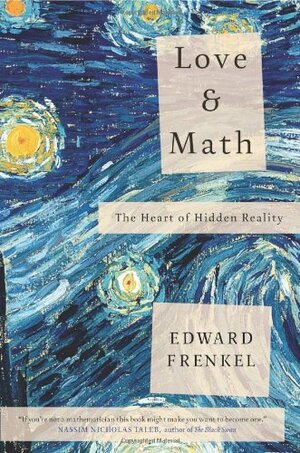
Love & Math – Edward Frenkel

Love & Math – Edward Frenkel

A friend left this behind when they moved countries (knowing that I liked maths). This was my second attempt at reading it.

Here’s the blurb …

What if you had to take an art class in which you were only taught how to paint a fence? What if you were never shown the paintings of van Gogh and Picasso, weren’t even told they existed? Alas, this is how math is taught, and so for most of us it becomes the intellectual equivalent of watching paint dry.

In Love and Math , renowned mathematician Edward Frenkel reveals a side of math we’ve never seen, suffused with all the beauty and elegance of a work of art. In this heartfelt and passionate book, Frenkel shows that mathematics, far from occupying a specialist niche, goes to the heart of all matter, uniting us across cultures, time, and space.

Love and Math tells two intertwined stories: of the wonders of mathematics and of one young man’s journey learning and living it. Having braved a discriminatory educational system to become one of the twenty-first century’s leading mathematicians, Frenkel now works on one of the biggest ideas to come out of math in the last 50 years: the Langlands Program. Considered by many to be a Grand Unified Theory of mathematics, the Langlands Program enables researchers to translate findings from one field to another so that they can solve problems, such as Fermat’s last theorem, that had seemed intractable before.

At its core, Love and Math is a story about accessing a new way of thinking, which can enrich our lives and empower us to better understand the world and our place in it. It is an invitation to discover the magic hidden universe of mathematics.

I believe the aim of this book was to show non-maths people the beauty and joy of mathematics. However, I think it would be hard going if you didn’t have a mathematics background. This is high level mathematics (at one stage he mentions that there are probably about 12 people in the world who understand what he is discussing). Having said that, I liked it. I particularly liked the personal aspects of the narrative – his life experiences, and the people he met and with whom he worked.

A review
Leave a Comment

Filed under Book Review

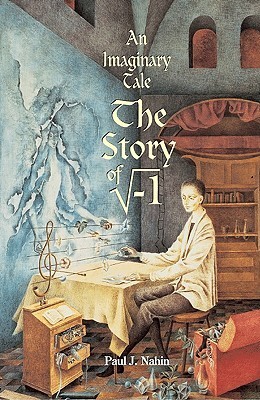
An Imaginary Tale – The story of i

An Imaginary Tale – The Story of \sqrt{-1}

I bought a second hand copy of this book from Abe Books (it’s possible to find cheap maths books this way).

Here’s the blurb …

Today complex numbers have such widespread practical use–from electrical engineering to aeronautics–that few people would expect the story behind their derivation to be filled with adventure and enigma. In An Imaginary Tale , Paul Nahin tells the 2000-year-old history of one of mathematics’ most elusive numbers, the square root of minus one, also known as i . He recreates the baffling mathematical problems that conjured it up, and the colorful characters who tried to solve them. In 1878, when two brothers stole a mathematical papyrus from the ancient Egyptian burial site in the Valley of Kings, they led scholars to the earliest known occurrence of the square root of a negative number. The papyrus offered a specific numerical example of how to calculate the volume of a truncated square pyramid, which implied the need for i . In the first century, the mathematician-engineer Heron of Alexandria encountered I in a separate project, but fudged the arithmetic; medieval mathematicians stumbled upon the concept while grappling with the meaning of negative numbers, but dismissed their square roots as nonsense. By the time of Descartes, a theoretical use for these elusive square roots–now called “imaginary numbers”–was suspected, but efforts to solve them led to intense, bitter debates. The notorious i finally won acceptance and was put to use in complex analysis and theoretical physics in Napoleonic times. Addressing readers with both a general and scholarly interest in mathematics, Nahin weaves into this narrative entertaining historical facts and mathematical discussions, including the application of complex numbers and functions to important problems, such as Kepler’s laws of planetary motion and ac electrical circuits. This book can be read as an engaging history, almost a biography, of one of the most evasive and pervasive “numbers” in all of mathematics.

It took me a long time to read this book – according to storygraph I started it in August (12th to be exact). I really enjoyed this book, but I do think you need to understand maths. I enjoyed working through all of the different formulae and examples. I have put some on this blog

I found the historical aspects very interesting.

Minus times minus is plus

The reason for this we need not discuss

W. H. Auden

Maybe I should use the above quote with my Year 8s who are just starting on their negative number journey.

This book covers quite complex (pun intended) ideas – particularly in Chapter 6 Wizard Mathematics and Chapter 7 The Nineteenth Century, Cauchy, and the Beginning of Complex Function Theory.

If you can do algebra and a bit of calculus and complex numbers interest you, then I think this book is for you.

A review

Leave a Comment

Filed under Book Review