Category Archives: Solving Equations

Trigonometry Question

I don’t know where I found this question, but it does require algebra and problem solving (as well as right trig and Pythagoras)

From a point A, a lighthouse is on a bearing of 026^\circT and the top of the light house is at an angle of elevation of 20.25^\circ. From a point B, the lighthouse is on a bearing of 296^\cricT and the top of the lighthouse is at angle of elevation of 10.2^\circ. If A and B are 500 metres apart, find the height of the lighthouse.

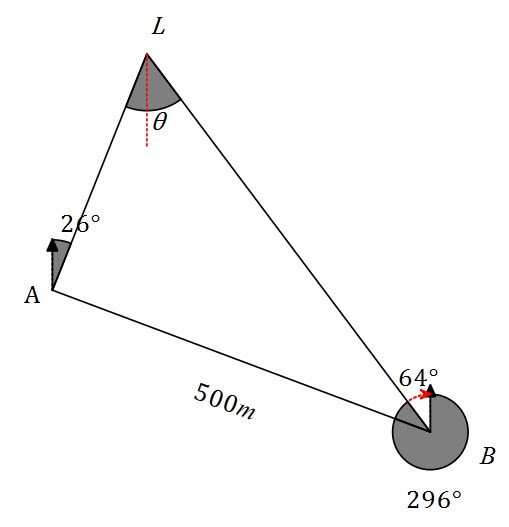
Let’s draw a diagram.

Let the height of the lighthouse be h

We can find the angle between A, the lighthouse, and B by using the base triangle

The red line from L is parallel to the two north lines. Hence \theta=26^\circ+64^\circ=90^\circ (Alternate angles in parallel lines are congruent)

It’s a right triangle so we know

(1)   \begin{equation*}500^2=(AL)^2+(BL)^2\end{equation*}

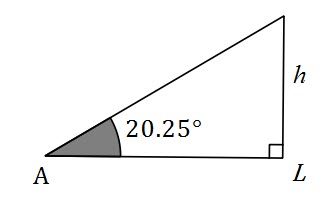
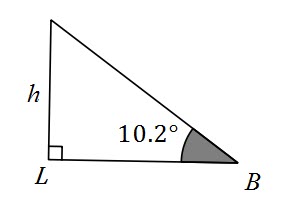
We are going to use the other two triangles to find AL and BL


tan(20.25)=\frac{h}{AL}
AL=\frac{h}{tan(20.25)}

tan(10.2)=\frac{h}{BL}
BL=\frac{h}{tan(10.2)}

Substitute AL and BL into equation 1

    \begin{equation*}500^2=(\frac{h}{tan(20.25)})^2+(\frac{h}{tan(10.2)})^2\end{equation}

Solve for h.

    \begin{equation*}500^2=7.35h^2+30.89h^2=38.24h^2\end{equation}

    \begin{equation*}h^2=6538.3\end{equation}

    \begin{equation*}h=80.9m\end{equation}

Leave a Comment

Filed under Algebra, Bearings, Pythagoras, Right Trigonometry, Solving Equations, Trigonometry

Perfect Squares

Find all of the positive integers that make the following expression a perfect square.

(1)   \begin{equation*}(x-10)(x+14)\end{equation*}

Let

    \begin{equation*}(x-10)(x+14)=n^2\end{equation}

where n is an integer.

Expand and simplify

    \begin{equation*}x^2+4x-140=n^2\end{equation}

    \begin{equation*}x^2-4x-n^2=140\end{equation}

Complete the square

    \begin{equation*}(x+2)^2-4-n^2=140\end{equation}

    \begin{equation*}(x+2)^2-n^2=144\end{equation}

Factorise (using difference of perfect squares)

    \begin{equation*}(x+2-n)(x+2+n)=144\end{equation}

Find all of the factors of 144

(1,144), (2, 72), (3, 48), (4, 36), (6, 24), (8, 18), (9, 16), (12, 12)

First pair,

    \begin{equation*}x+2-n=1 \tag {1} \end{equation}

    \begin{equation*}x+2+n=144 \tag {2} \end{equation}

2x=141

x must be an integer.

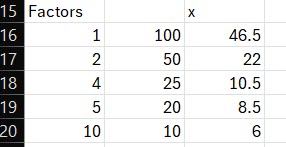
I then used a spreadsheet

Solved for the x values.

Hence the integers that make (x-10)(x+14) are perfect square are, 10, 11, 13, 18, and 35.

Let’s try another one,

(x-6)(x+14)

(2)   \begin{equation*}(x-6)(x+14)=n^2\end{equation*}

    \begin{equation*}(x^2+8x-84=n^2\end{equation}

    \begin{equation*}(x+4)^2-n^2=100\end{equation}

    \begin{equation*}(x+4-n)(x+4+n)=100\end{equation}

Factors of 100,

(1, 100), (2, 50), (4, 25), (5, 20), (10, 10)

So the possible integers are 6 and 22.

Leave a Comment

Filed under Algebra, Arithmetic, Divisibility, Interesting Mathematics, Puzzles, Quadratic, Solving Equations

Geometry Puzzle

Another puzzle from this book

Two ladders are propped up vertically in a narrow passageway between two vertical buildings. The ends of the ladders are 8 metres and 4 metres above the pavement.
Find the height above the ground, T,

\Delta ABC \sim \Delta TEC and \Delta DCB \sim  \Delta TEB (Angle Angle Similarity)

Hence,

(1)   \begin{equation*}\frac{h}{8}=\frac{x}{x+y}\end{equation*}

(2)   \begin{equation*}\frac{h}{4}=\frac{y}{x+y}\end{equation*}

From equation 1 h=\frac{8x}{x+y} and from 2 h=\frac{4y}{x+y}

Hence, \frac{8x}{x+y}=\frac{4y}{x+y}

Therefore, 8x=4y and y=2x

From equation 1

    \begin{equation*}h=\frac{8x}{3x}=\frac{8}{3}\end{equation}

Hence T is 2 \frac{2}{3}m above the ground.

Leave a Comment

Filed under Geometry, Puzzles, Similarity, Simplifying fractions, Solving Equations

Deriving the Quadratic Equation formula

My year 10 students have been learning how to complete the square with the idea of then deriving the quadratic equation formula.

The general equation for a quadratic is y=ax^2+bx+c

Completing the square,

    \begin{equation*}ax^2+bx+c\end{equation}

Factorise out the leading coefficient (i.e. a)

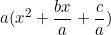
    \begin{equation*}a(x^2+\frac{bx}{a}+\frac{c}{a})\end{equation}

Half the second term (i.e \frac{b}{a}) and subtract the square of the second term.

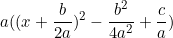
    \begin{equation*}a((x+\frac{b}{2a})^2-(\frac{b}{2a})^2+\frac{c}{a})\end{equation}

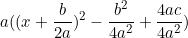
    \begin{equation*}a((x+\frac{b}{2a})^2-\frac{b^2}{4a^2}+\frac{c}{a})\end{equation}

Simplify

    \begin{equation*}a((x+\frac{b}{2a})^2-\frac{b^2}{4a^2}+\frac{4ac}{4a^2})\end{equation}

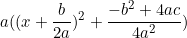
    \begin{equation*}a((x+\frac{b}{2a})^2+\frac{-b^2+4ac}{4a^2})\end{equation}

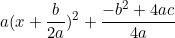
    \begin{equation*}a(x+\frac{b}{2a})^2+\frac{-b^2+4ac}{4a}\end{equation}

Now let’s solve

    \begin{equation*}a(x+\frac{b}{2a})^2+\frac{-b^2+4ac}{4a}=0\end{equation}

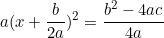
    \begin{equation*}a(x+\frac{b}{2a})^2=\frac{b^2-4ac}{4a}\end{equation}

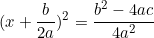
    \begin{equation*}(x+\frac{b}{2a})^2=\frac{b^2-4ac}{4a^2}\end{equation}

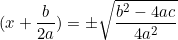
    \begin{equation*}(x+\frac{b}{2a})=\pm \sqrt{\frac{b^2-4ac}{4a^2}}\end{equation}

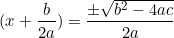
    \begin{equation*}(x+\frac{b}{2a})=\frac{\pm \sqrt{b^2-4ac}}{2a}\end{equation}

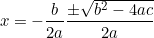
    \begin{equation*}x=-\frac{b}{2a}\frac{\pm \sqrt{b^2-4ac}}{2a}\end{equation}

Which is the quadratic equation formula.

1 Comment

Filed under Algebra, Quadratic, Quadratics, Solving, Solving, Solving Equations

Puzzle Page 1

If \frac{a+b+2c}{a+b-c}=\frac{31}{15}, what does \frac{a+b}{c} equal?

    \begin{equation*}15(a+n+2c)=31(a+b-c)\end{equation}

    \begin{equation*}15a+15b+30c=31a+31b-31c)\end{equation}

    \begin{equation*}61c=16a+16b)\end{equation}

    \begin{equation*}\frac{61}{16}=\frac{a+b}{c}\end{equation}

Two positive numbers are such that their difference, their sum, and their product are in the ratio 2:5:21. What is the smaller of the two numbers?

Let x and y be the two numbers. Then

(1)   \begin{equation*}x-y=2k\end{equation*}

(2)   \begin{equation*}x+y=5k\end{equation*}

(3)   \begin{equation*}xy=21k\end{equation*}

Add equation 1 and 2 together to eliminate the y

    \begin{equation*}2x=7k\end{equation}

(4)   \begin{equation*}x=\frac{7k}{2}\end{equation*}

From 2 =5k-x, substitute for y into equation 3.

(5)   \begin{equation*}x(5k-x)=21k\end{equation*}

Substitute x=\frac{7k}{2} into equation 5.

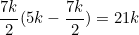
    \begin{equation*}\frac{7k}{2}(5k-\frac{7k}{2})=21k\end{equation}

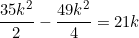
    \begin{equation*}\frac{35k^2}{2}-\frac{49k^2}{4}=21k\end{equation}

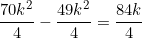
    \begin{equation*}\frac{70k^2}{4}-\frac{49k^2}{4}=\frac{84k}{4}\end{equation}

    \begin{equation*}21k^2-84k=0\end{equation}

    \begin{equation*}21k(k-4)=0\end{equation}

Hence, k=0 or k=4.

When k=4, x=\frac{7\times 4}{2}=14 and y=5\times 4-14=6

Therefore the smaller number is 6.

Leave a Comment

Filed under Algebra, Puzzles, Ratio, Solving Equations