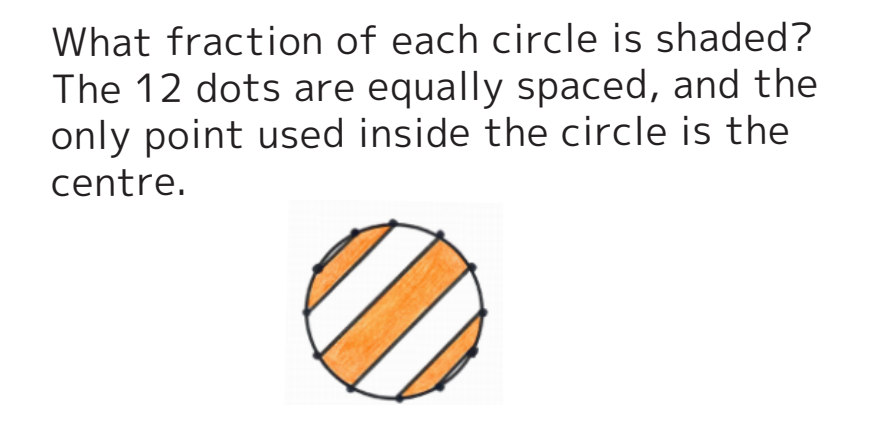
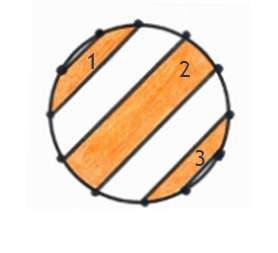
Band  and
and  have the same area.
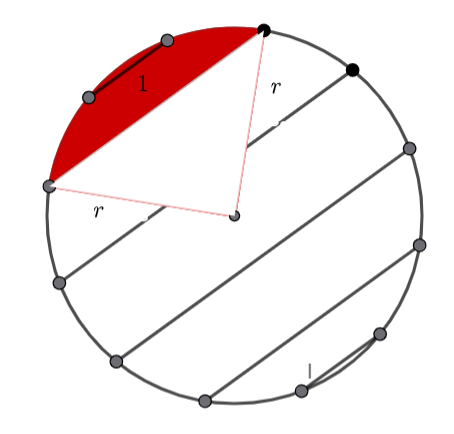
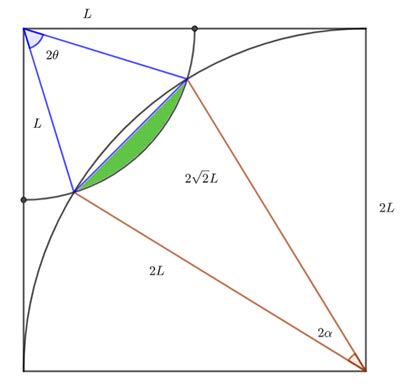
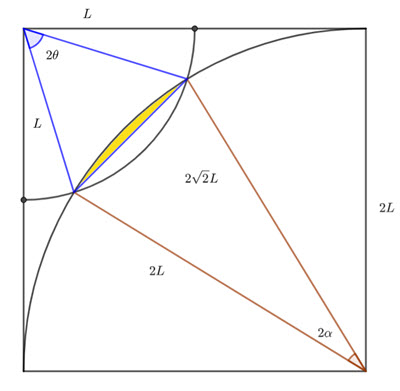
We want to find the area of the shaded segment.
As the dots are equally spaced, the sector’s angle is 
Remember the area of a segment is  where the angle measurement is in radians.
(1) 
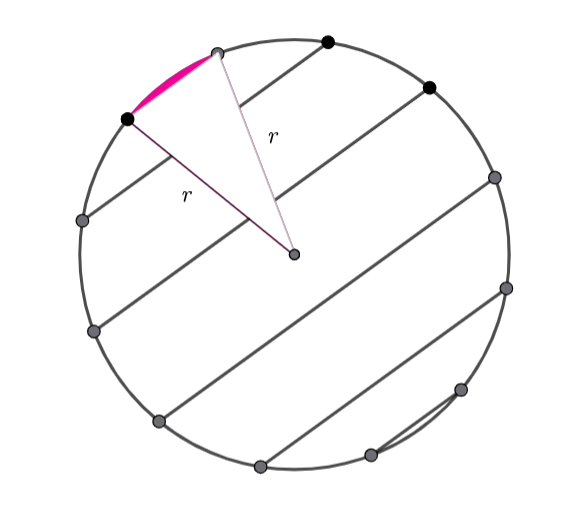
We want to find the area of the shaded segment.
As the dots are equally spaced, the sector’s angle is 
(2) 
The area of band is equation  equation
  .
.
(3) 
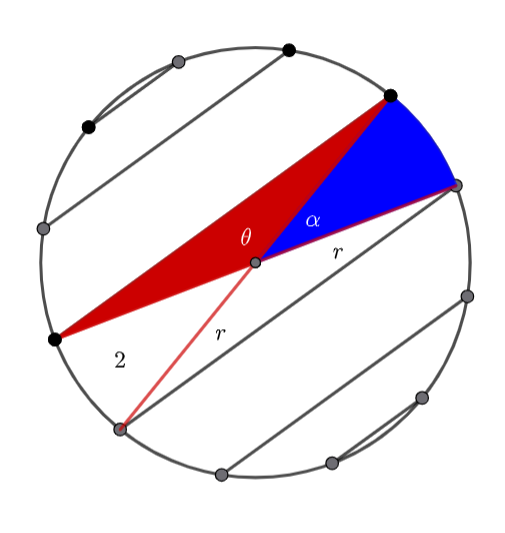
Band 2 consists of two congruent triangles and two congruent sectors.

(4) 
Hence the shaded area is 
The area of the circle is 
Hence the fraction of the shaded area is 
 and
and  lie on the circle with centre
  . If
. If  and
and  , determine with reasoning
  and
and 

 – radii of the circle.
 is isosceles and
  – equal angles isosceles triangle.
 – angle at the centre twice the angle at the circumference.

 – angles on a straight line are supplementary
 – equal angles isosceles triangle and the angle sum of a triangle.
 – angle at the circumference subtended by the same arc are congruent.
 – angles at the circumference subtended by the same arc are congruent.
 – equal angle isosceles triangle
 and
and  intersect as shown. What is the area of the shaded region?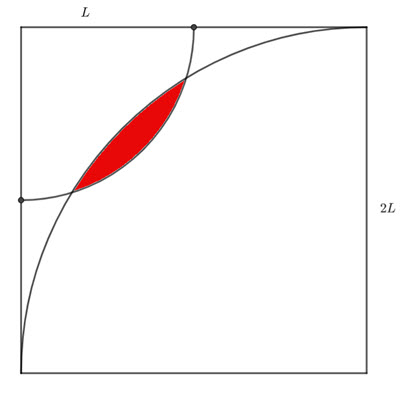
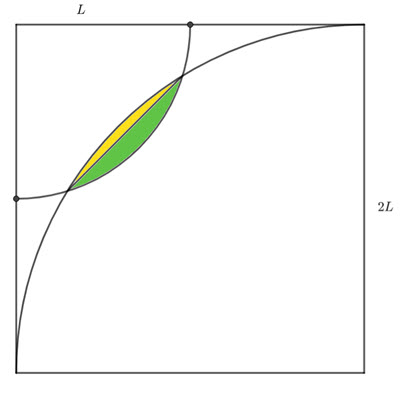
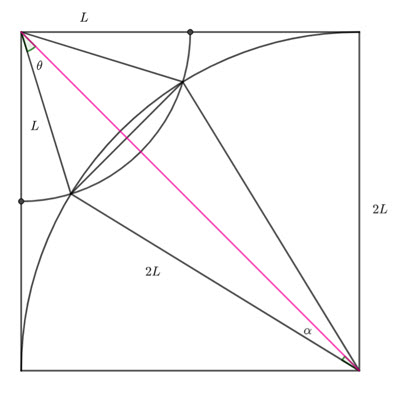

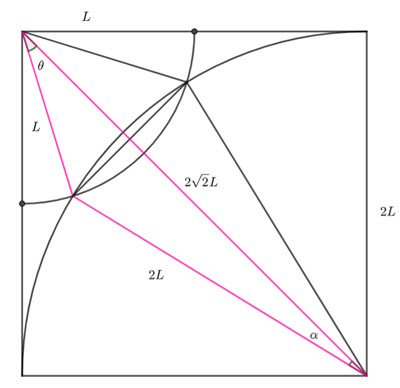






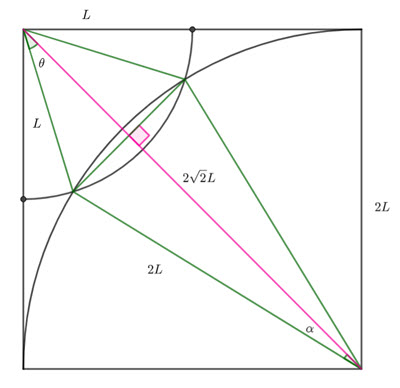
 and
and  (because the triangles are isosceles and the diagonal is perpendicular to the base of the triangles).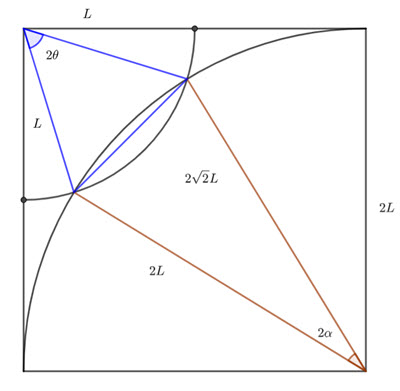




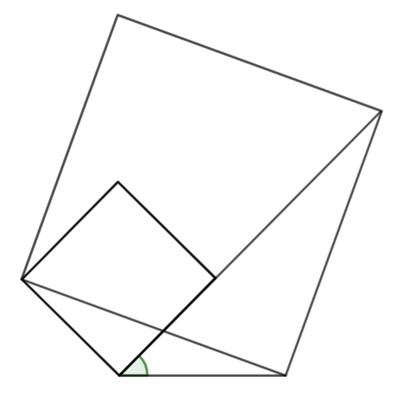
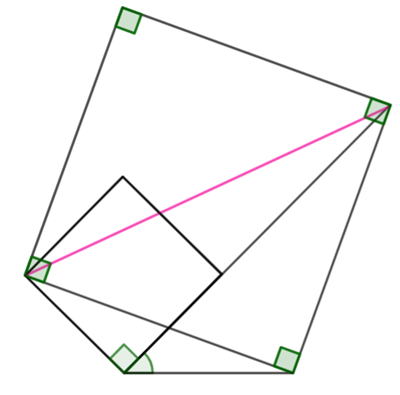
 , we know there is a circle, which has the diagonal of the square as its diameter (see second image below).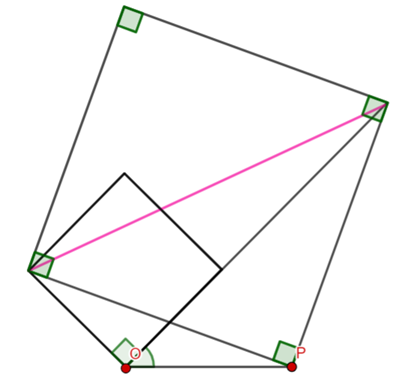
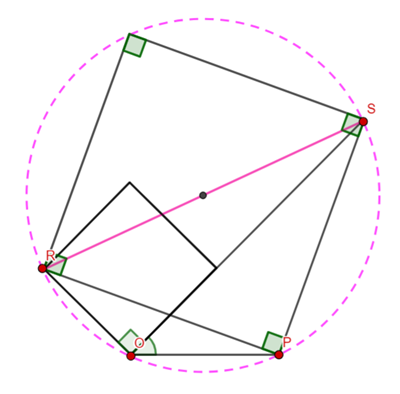
 is
is  (Angle between the diagonal and side of a square)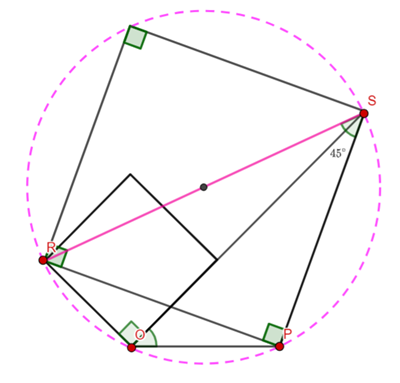
 is a
is a 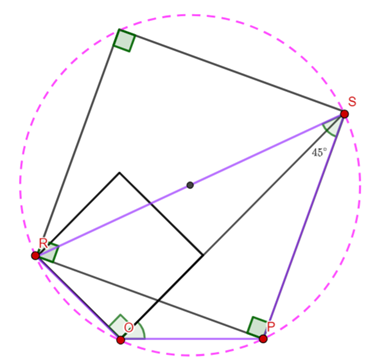

 ,
,  must be