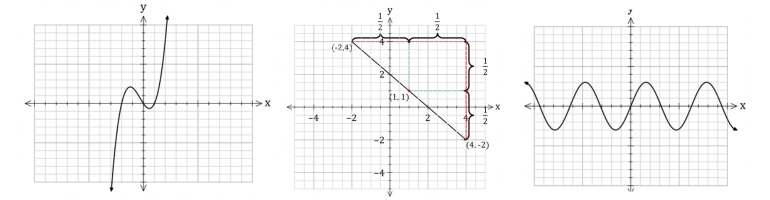

Completing the square is useful to
- sketch parabolas.
- solve quadratics.
- factorising quadratics
- finding the centre and radius version of the equation of a circle.
When completing the square we take advantage of perfect squares. For example, 
 and
and 
Example 1
Put  into completed square form.
What perfect square has an  term?
term?

We don’t want  , we want
  , so subtract


What about a non-monic quadratic? For example,

Factorise the 

And continue as before
![2[(x+3)^2-9+\frac{11}{2}]=2[(x+3)^2-\frac{18}{2}+\frac{11}{2}]=2[(x+3)^2-\frac{7}{2}]=2(x+3)^2-7](https://www.racquelsanderson.com/wp-content/ql-cache/quicklatex.com-75a4ad924f4dac2900b0825b3dbc5eb1_l3.png "Rendered by QuickLaTeX.com")
Example 2

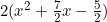
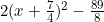
![2[(x+\frac{7}{4})^2-(\frac{7}{4})^2-\frac{5}{2}]](https://www.racquelsanderson.com/wp-content/ql-cache/quicklatex.com-86decb178d67f6e763e3418b68dd4609_l3.png "Rendered by QuickLaTeX.com")
![2[(x+\frac{7}{4})^2-\frac{49}{16}-\frac{40}{16}]](https://www.racquelsanderson.com/wp-content/ql-cache/quicklatex.com-46cc98a61881eb23836f41e52a308e56_l3.png "Rendered by QuickLaTeX.com")
![2[(x+\frac{7}{4})^2-\frac{89}{16}]](https://www.racquelsanderson.com/wp-content/ql-cache/quicklatex.com-9c430d81a00ab51437da9037c1141aac_l3.png "Rendered by QuickLaTeX.com")