Category Archives: Trigonometry

General Solutions to Trigonometric Equations

Solve sinx=\frac{1}{2} for 0\le x \le 2\pi

Sine is positive in the first and second quadrants.

    \begin{equation*}sinx=\frac{1}{2}\end{equation}

    \begin{equation*}x=\frac{\pi}{6} \text{ and } x=\pi-\frac{\pi}{6}=\frac{5\pi}{6}\end{equation}

But what if we aren’t given a domain for the x values?

Then we need to give general solutions.

For example,

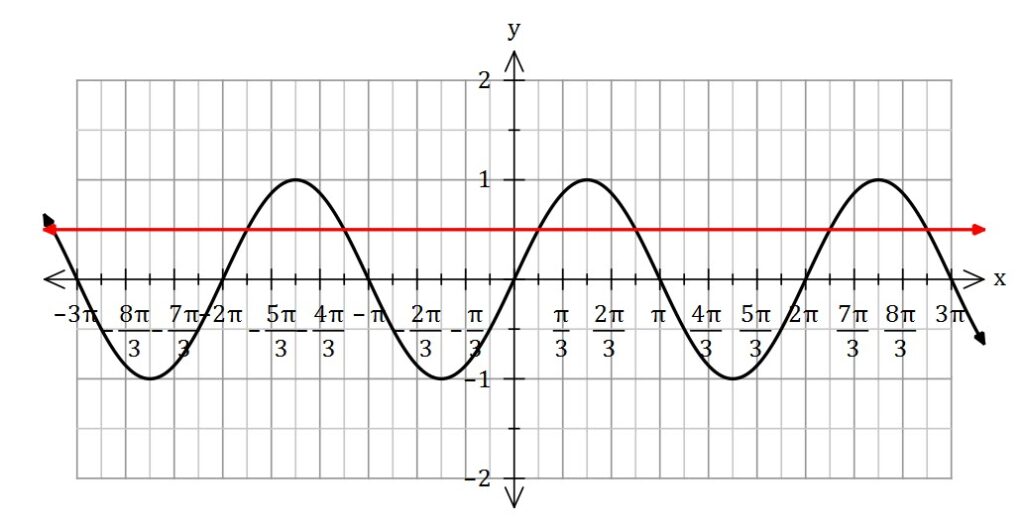
Solve sinx=\frac{1}{2}

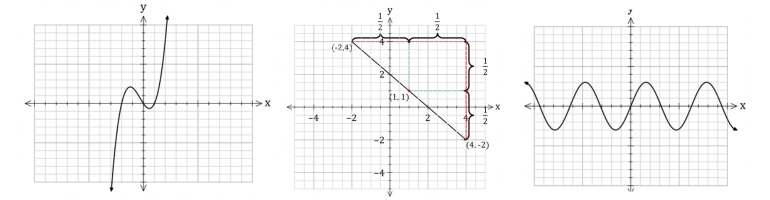
As you can see from the sketch above, there are infinite solutions.

The sine function has a period of 360^\circ, and so if \frac{\pi}{6} is a solution then \2pi+\frac{\pi}{6} is also a solution. This means \frac{\pi}{6}+2\pi n, n\in\mathbb{Z} is a general solution. And we can do the same for the second solution \frac{5\pi}{6}+2\pi n.

In general

    \begin{equation*}sinx=y\end{equation}


    \begin{equation*}x=arcsin(y)+2\pi n \text { and } x=\pi-arcsin(y)+2\pi n \end{equation}


    \begin{equation*}x=arcsin(y)+2\pi n \text { and } x=\pi(2n+1)-arcsin(y), n \in \mathbb{Z}\end{equation}


We can turn this into one equation

    \begin{equation*}x=(-1)^n arcsin(y)+n\pi, n \in \mathbb{Z}\end{equation}

What about cosine?

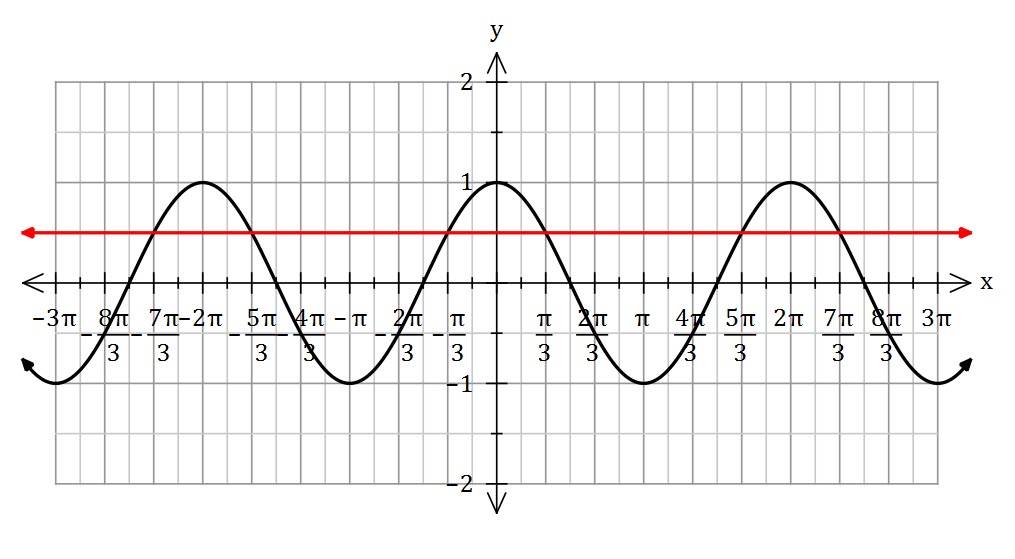
Solve cosx=\frac{1}{2}

Cosine is positive in the first and fourth quadrants (it also has a period of 2\pi. The first two (positive) solutions are \frac{\pi}{3} and 2\pi-\frac{\pi}{3}.

To generalise, x=2\pi n+\frac{\pi}{3} \text { and }x=2\pi n -\frac{\pi}{3}, which we can make into one equation x=2\pi n \pm \frac{pi}{3}

In general

    \begin{equation*}cosx=y\end{equation}

    \begin{equation*}x=2\pi n \pm arccos(y), n\in\mathbb{Z}\end{equation}

What about the tangent function? Remember tan has a period of \pi.

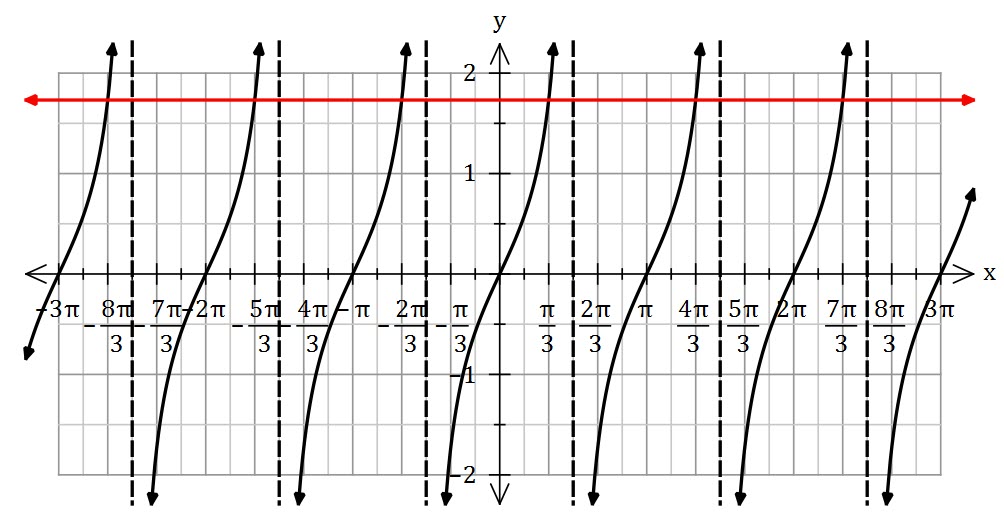
Solve tanx=\sqrt{3}

First, note that the solutions are all a common distance (\pi) apart.

Tan is positive in the first and the third quadrant

    \begin{equation*}tanx=\sqrt{3}\end{equation}

    \begin{equation*}x=\frac{\pi}{3} \text { and } x=\pi+\frac{\pi}{3}\end{equation}

Because all of the solutions are \pi radians apart, the general solution is x=\frac{\pi}{3} \pm \pi

In general

    \begin{equation*}tanx=y\end{equation}

    \begin{equation*}x=arctan(y) + n\pi, n\in \mathbb{Z}\end{equation}

Examples

Solve for all values of x, tan^2(x)+tan(x)-6=0

    \begin{equation*}tan^2(x)+tan(x)-6=0\end{equation}

This is a quadratic equation – we need two numbers that add to 1 and multiple to -6, +3 \text { and } -2

    \begin{equation*}(tan(x)+3)(tan(x)-2))=0\end{equation}

    \begin{equation*}tan(x)=-3 \text { or } tan(x)=2\end{equation}

    \begin{equation*}x=arctan(-3)+n\pi \text { or } x=arctan(2)+n\pi, n\in\mathbb{Z}\end{equation}


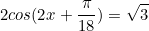
Solve 2cos(2x+\frac{\pi}{18})=\sqrt{3}

    \begin{equation*}2cos(2x+\frac{\pi}{18})=\sqrt{3}\end{equation}

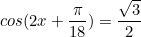
    \begin{equation*}cos(2x+\frac{\pi}{18})=\frac{\sqrt{3}}{2}\end{equation}

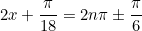
    \begin{equation*}2x+\frac{\pi}{18}=2n\pi \pm \frac{\pi}{6}\end{equation}

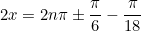
    \begin{equation*}2x=2n\pi \pm \frac{\pi}{6}-\frac{\pi}{18}\end{equation}

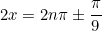
    \begin{equation*}2x=2n\pi \pm \frac{\pi}{9}\end{equation}

    \begin{equation*}x=n\pi \pm \frac{\pi}{18}\end{equation}

Leave a Comment

Filed under Algebra, Quadratic, Solving Equations, Solving Trig Equations, Trigonometry, Year 11 Specialist Mathematics

Trigonometry Question

I don’t know where I found this question, but it does require algebra and problem solving (as well as right trig and Pythagoras)

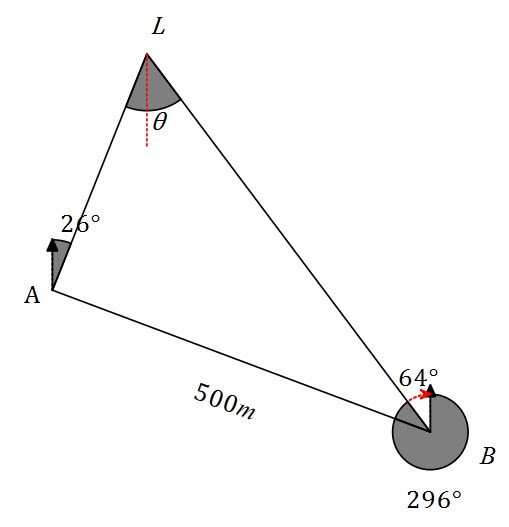
From a point A, a lighthouse is on a bearing of 026^\circT and the top of the light house is at an angle of elevation of 20.25^\circ. From a point B, the lighthouse is on a bearing of 296^\cricT and the top of the lighthouse is at angle of elevation of 10.2^\circ. If A and B are 500 metres apart, find the height of the lighthouse.

Let’s draw a diagram.

Let the height of the lighthouse be h

We can find the angle between A, the lighthouse, and B by using the base triangle

The red line from L is parallel to the two north lines. Hence \theta=26^\circ+64^\circ=90^\circ (Alternate angles in parallel lines are congruent)


It’s a right triangle so we know

(1)   \begin{equation*}500^2=(AL)^2+(BL)^2\end{equation*}

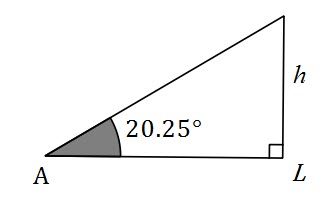
We are going to use the other two triangles to find AL and BL


tan(20.25)=\frac{h}{AL}
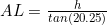
AL=\frac{h}{tan(20.25)}

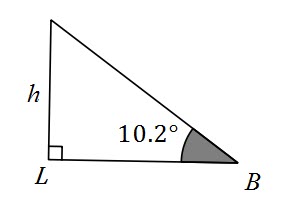
tan(10.2)=\frac{h}{BL}
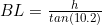
BL=\frac{h}{tan(10.2)}

Substitute AL and BL into equation 1

    \begin{equation*}500^2=(\frac{h}{tan(20.25)})^2+(\frac{h}{tan(10.2)})^2\end{equation}

Solve for h.

    \begin{equation*}500^2=7.35h^2+30.89h^2=38.24h^2\end{equation}

    \begin{equation*}h^2=6538.3\end{equation}

    \begin{equation*}h=80.9m\end{equation}

Leave a Comment

Filed under Algebra, Bearings, Pythagoras, Right Trigonometry, Solving Equations, Trigonometry

Area/Geometry Problem

This problem is from The Geometry Forum Problem of the Week June 1996

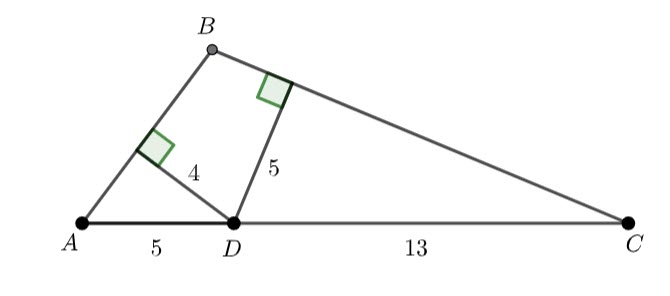
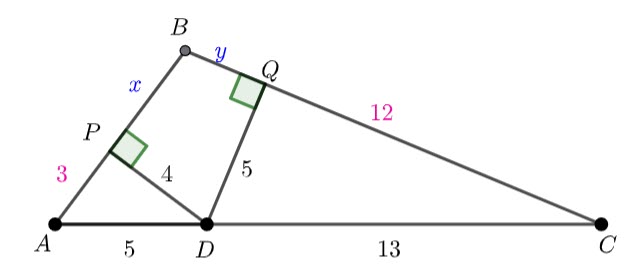
In triangle ABC, AC=18 and D is the point on AC for which AD=5. Perpendiculars drawn from D to AB and CB have lengths of 4 and 5 respectively. What is the area of triangle ABC?

I put together a diagram (in Geogebra)

Add points P and Q

Triangle APD and triangle DQC are right angled. Using pythagoras, AP=3 and QC=12

BQDP is a cyclic quadrilateral and BD is the diameter. I am not sure if this is useful, but it is good to notice.

    \begin{equation*}sin(A+B+C)=sin(180)=0\end{equation}

    \begin{equation*}sin((A+C)+B)=sin(A+C)cosB+sinBcos(A+C)=0\end{equation}

    \begin{equation*}cosB(sinAcosC+sinCcosA)+sinB(cosAcosC-sinAsinC)=0\end{equation}

    \begin{equation*}cosB(\frac{4}{5}\times\frac{12}{13}+\frac{5}{13}\times\frac{3}{5})+sinB(\frac{3}{5}\times\frac{12}{13}-\frac{4}{5}\times\frac{5}{13})=0\end{equation}

    \begin{equation*}cosB(\frac{48}{65}+\frac{15}{65})+sinB(\frac{36}{65}-\frac{20}{65})=0\end{equation}

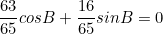
    \begin{equation*}\frac{63}{65}cosB+\frac{16}{65}sinB=0\end{equation}

    \begin{equation*}63cosB+16sinB=0\end{equation}

    \begin{equation*}63+16tanB=0\end{equation}

    \begin{equation*}tanB=\frac{-63}{16}\end{equation}

If tanB=\frac{-63}{16} then sinB=\frac{63}{65}

Now,

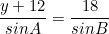
    \begin{equation*}\frac{y+12}{sinA}=\frac{18}{sinB}\end{equation}

    \begin{equation*}y+12=\frac{4}{5}(18)\frac{65}{63}\end{equation}

    \begin{equation*}y+12=\frac{104}{7}\end{equation}

Hence the Area is

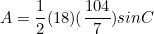
    \begin{equation*}A=\frac{1}{2}(18)(\frac{104}{7})sinC\end{equation}

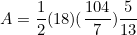
    \begin{equation*}A=\frac{1}{2}(18)(\frac{104}{7})\frac{5}{13}\end{equation}

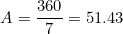
    \begin{equation*}A=\frac{360}{7}=51.43\end{equation}

Leave a Comment

Filed under Area, Finding an area, Geometry, Identities, Non-Right Trigonometry, Pythagoras, Trigonometry

Vector and Scalar Projection

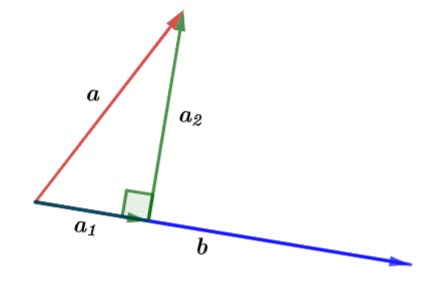
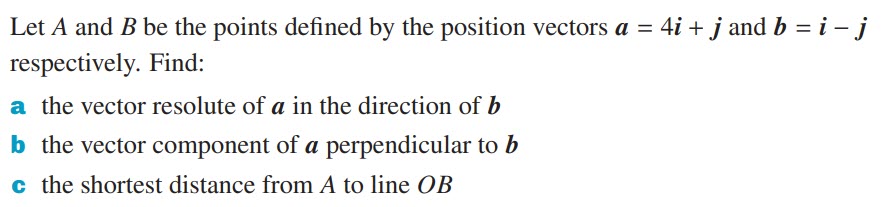
The vector projection (vector resolution or vector component) of \mathbf{a} onto a non-zero vector \mathbf{b} is splitting \mathbf{a} into two vectors, one is parallel to \mathbf{b} (the vector projection) and one perpendicular to \mathbf{b}

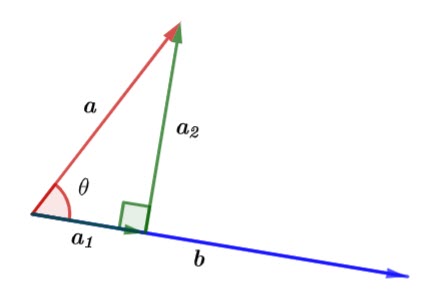
In the above diagram \mathbf{a_1} is the vector projection of \mathbf{a} onto \mathbf{b} and \mathbf{a_2} is perpendicular to \mathbf{b}.

How do we find \mathbf{a_1} and \mathbf{a_2}?

Using right trigonometry,

cos(\theta)=\frac{|\mathbf{a_1}|}{|\mathbf{a}|}

Remember the scalar product (dot product) of vectors is

(1)   \begin{equation*}\mathbf{a}\cdot\mathbf{b}=|\mathbf{a}||\mathbf{b}|cos(\theta)\end{equation*}

Hence cos(\theta)=\frac{\mathbf{a}\cdot\mathbf{b}}{|\mathbf{a}||\mathbf{b}|}

\frac{\mathbf{a}\cdot\mathbf{b}}{|\mathbf{a}||\mathbf{b}|}=\frac{|\mathbf{a_1}|}{|\mathbf{a}|}

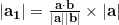
and, |\mathbf{a_1}|=\frac{\mathbf{a}\cdot\mathbf{b}}{|\mathbf{a}||\mathbf{b}|}\times|\mathbf{a}|

|\mathbf{a_1}|=\frac{\mathbf{a}\cdot\mathbf{b}}{|\mathbf{b}|}

This is the scalar projection of \mathbf{a} onto \mathbf{b}

To find the vector projection we need to multiply by \mathbf{\hat{b}}, that is find a vector with the same magnitude as \mathbf{a_1} in the direction of \mathbf{b}.

The vector projection is

\mathbf{a_1}=\frac{\mathbf{a}\cdot\mathbf{b}}{|\mathbf{b}|}\times \mathbf{\hat{b}}

\mathbf{a_1}=\frac{\mathbf{a}\cdot\mathbf{b}}{|\mathbf{b}|}\times \frac{\mathbf{b}}{|\mathbf{b}|}

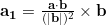
\mathbf{a_1}=\frac{\mathbf{a}\cdot\mathbf{b}}{(|\mathbf{b}|)^2}\times \mathbf{b}

Now for \mathbf{a_2}, we know \mathbf{a}=\mathbf{a_1}+\mathbf{a_2}

Hence, \mathbf{a_2}=\mathbf{a}-\mathbf{a_1}

Example

From Cambridge Year 11 Specialist Mathematics (Chapter 3)

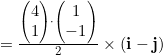
(a) \frac{\mathbf{a}\cdot\mathbf{b}}{|\mathbf{b}|^2}\mathbf{b}

=\frac{\begin{pmatrix}4\\1\end{pmatrix}\cdot\begin{pmatrix}1\\-1\end{pmatrix}}{2}\times(\mathbf{i}-\mathbf{j})

=\frac{3}{2}{(\mathbf{i}-\mathbf{j})

(b)4\mathbf{i}+\mathbf{j}-\frac{3}{2}{(\mathbf{i}-\mathbf{j})=\frac{5}{2}\mathbf{i}+\frac{5}{2}\mathbf{j}

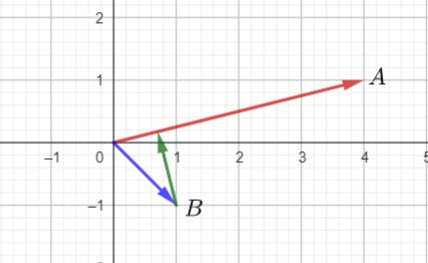
(c)

The shortest distance (green vector) is the vector component of \mathbf{a} perpendicular to \mathbf{b}, i.e. \frac{5}{2}\mathbf{i}+\frac{5}{2}\mathbf{j}

|\frac{5}{2}\mathbf{i}+\frac{5}{2}\mathbf{j}|=\sqrt{\frac{25}{4}+\frac{25}{4}}=\sqrt{\frac{50}{4}}=\frac{5\sqrt{2}}{2}

Leave a Comment

Filed under Right Trigonometry, Trigonometry, Vector Projection, Vectors, Year 11 Specialist Mathematics

Area of Regular Polygons

Finding the area of a regular polygon when you know the side length

Find the area of an n-sided regular polygon if you know the side length, l.

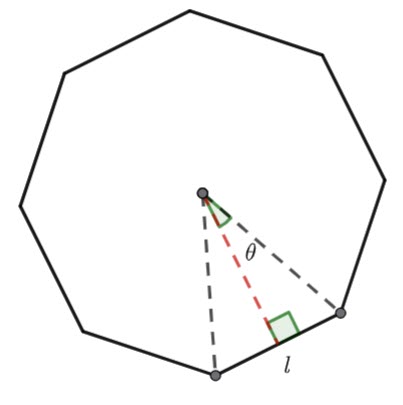
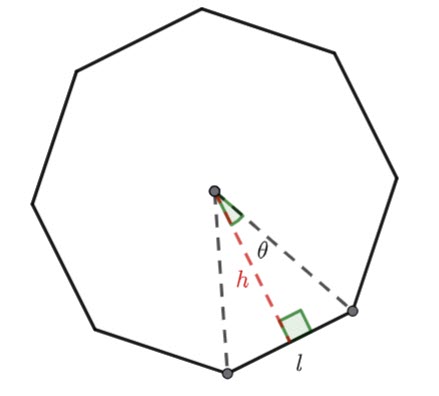
An octagon for a visual reference

Find the h of the triangle in terms of l and theta.

tan(\theta)=\frac{\frac{l}{2}}{h}

h=\frac{l}{2tan(\theta)}

Remember the area of a triangle is A=\frac{1}{2}bh

Hence, A=\frac{1}{2} l \times \frac{l}{2tan(\theta)}=\frac{l^2}{4tan(\theta)}

And \theta=\frac{360}{2n}=\frac{180}{n}

Therefore A=\frac{l^2}{4tan(\frac{180}{n})}

There are n triangles in an n-sided polygon

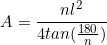
(1)   \begin{equation*}A=\frac{nl^2}{4tan(\frac{180}{n})}\end{equation*}

Find the area of a hexagon with side length 10cm.
A=\frac{6\times10^2}{4tan(\frac{180}{6})}
A=\frac{600}{4(\frac{1}{\sqrt{3}})}
A=150\sqrt{3} cm^2

Finding the area of a polygon if you know the inradius or the apothem

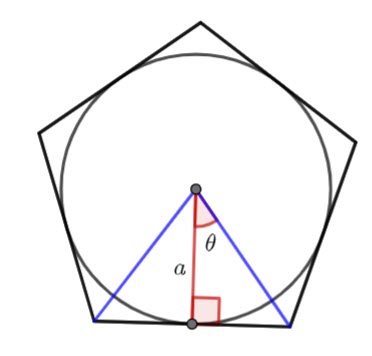
The apothem and the inradius are the same. It is the radius of the incircle.

Find the area of the triangle in terms of a and theta.

tan(\theta)=\frac{\frac{l}{2}}{a}

l=2atan(\theta)

A=\frac{1}{2}bh

A=\frac{1}{2}2atan(\theta)a=a^2tan(\theta)

And \theta=\frac{180}{n}

Hence for an n-sided polygon

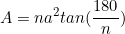
(2)   \begin{equation*}A=na^2tan(\frac{180}{n})\end{equation*}

Find the area of a regular pentagon with apothem 4.5cm
A=5\times 4.5^2tan(\frac{180}{5})
A=73.56cm^2

Finding the area of a regular polygon given the circumradius

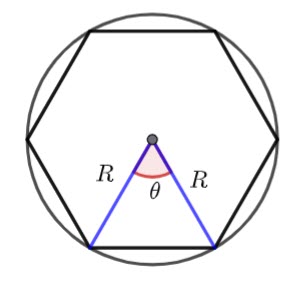
The circumradius is the radius of the circumscribed circle (R in the diagram above)

Remember the area of triangle formula

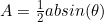
A=\frac{1}{2}absin(\theta)

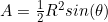
A=\frac{1}{2}R^2sin(\theta)

\theta=\frac{360}{n}

Hence, A=\frac{1}{2}R^2sin(\frac{360}{n})

Hence, for an n-sided polygon

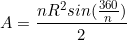
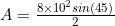
(3)   \begin{equation*}A=\frac{nR^2sin(\frac{360}{n})}{2}\end{equation*}

Find the area of a regular octagon inscribed in a circle of radius 10cm.
A=\frac{8\times 10^2sin(45)}{2}
A=200\sqrt{2}cm^2

Leave a Comment

Filed under Area, Area of Triangles (Sine), Finding an area, Non-Right Trigonometry, Regular Polygons, Right Trigonometry, Year 11 Mathematical Methods

Differentiating the Tangent Function

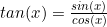
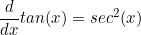
Remember tan(x)=\frac{sin(x)}{cos(x)}.

I use the quotient rule to differentiate f(x)=tan(x).

(1)   \begin{equation*}\frac{d}{dx}(\frac{f(x)}{g(x)})=\frac{f'(x)g(x)-g'(x)f(x)}{[g(x)]^2}\end{equation*}

If h(x)=tan(x)=\frac{sin(x)}{cos(x)} then from equation 1

(2)   \begin{equation*}h'(x)=\frac{cos(x)cos(x)-(-sin(x)sin(x))}{[cos(x)]^2}\end{equation*}

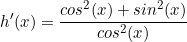
(3)   \begin{equation*}h'(x)=\frac{cos^2(x)+sin^2(x)}{cos^2(x)}\end{equation*}

Remember the Pythagorean identity

(4)   \begin{equation*}sin^2(x)+cos^2(x)=1\end{equation*}

Hence

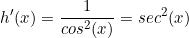
    \begin{equation*}h'(x)=\frac{1}{cos^2(x)}=sec^2(x)\end{equation}

(5)   \begin{equation*}\frac{d}{dx}tan(x)=sec^2(x)\end{equation*}

Leave a Comment

Filed under Calculus, Differentiation, Differentiation, Identities, Quotient Rule, Trigonometry, Year 12 Mathematical Methods

Differentiating Trigonometric Functions

In the last post we looked at two trig limits:

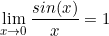
(1)   \begin{equation*}\lim_{x \to 0}\frac{sin(x)}{x}=1\end{equation*}

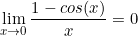
(2)   \begin{equation*}\lim_{x \to 0}\frac{1-cos(x)}{x}=0\end{equation*}

We are going to use these two limits to differentiate sine and cosine functions from first principals.

    \begin{equation*}f(x)=sin(x)\end{equation}

    \begin{equation*}f'(x)=\lim\limits_{h \to 0}\frac{sin(x+h)-sin(x)}{h}\end{equation}

Use the trig identity

    \begin{equation*}sin(A+B)=sinAcosB+sinBcosA\end{equation}

    \begin{equation*}f'(x)=\lim\limits_{h \to 0}\frac{sin(x)cos(h)+sin(h)cos(x)-sin(x)}{h}\end{equation}

    \begin{equation*}f'(x)=\lim\limits_{h \to 0}(\frac{sin(x)(cos(h)-1)}{h}+\frac{sin(h)cos(x)}{h})\end{equation}

    \begin{equation*}f'(x)=sin(x)\lim\limits_{h \to 0}(\frac{(cos(h)-1)}{h}+cos(x)\lim\limits_{h \to 0}\frac{sin(h)}{h}\end{equation}

    \begin{equation*}f'(x)=sin(x)\lim\limits_{h \to 0}(\frac{-(-cos(h)+1)}{h}+cos(x)\lim\limits_{h \to 0}\frac{sin(h)}{h}\end{equation}

Evaluate the limits

    \begin{equation*}f'(x)=sin(x)\times 0+cos(x)\times (1)=cos(x)\end{equation}

Hence, \frac{d}{dx}sin(x)=cos(x).

Now we are going to do the same for f(x)=cos(x).

    \begin{equation*}f'(x)=\lim\limits_{h \to 0}\frac{cos(x+h)-cos(x)}{h}\end{equation}

Use the trigonometric identity

    \begin{equation*}cos(A+B)=cosAcosB-sinAsinB\end{equation}

    \begin{equation*}f'(x)=\lim\limits_{h \to 0}\frac{cos(x)cos(h)-sin(x)sin(h)-cos(x)}{h}\end{equation}

    \begin{equation*}f'(x)=\lim\limits_{h \to 0}\frac{cos(x)(cos(h)-1)-sin(x)sin(h)}{h}\end{equation}

    \begin{equation*}f'(x)=cos(x)\lim\limits_{h \to 0}\frac{-(1-cos(h))}{h}-sin(x)\lim\limits_{h \to 0}\frac{sin(h)}{h}\end{equation}

Evaluate the limits

    \begin{equation*}f'(x)=cos(x)\times(0)-sin(x)\times (1)=-sin(x)\end{equation}

Hence \frac{d}{dx} cos(x)=-sin(x)

1 Comment

Filed under Calculus, Differentiation, Identities, Trigonometry, Year 12 Mathematical Methods

Trigonometric Limits

\lim\limits_{x \to 0}\frac{sin(x)}{x}=?

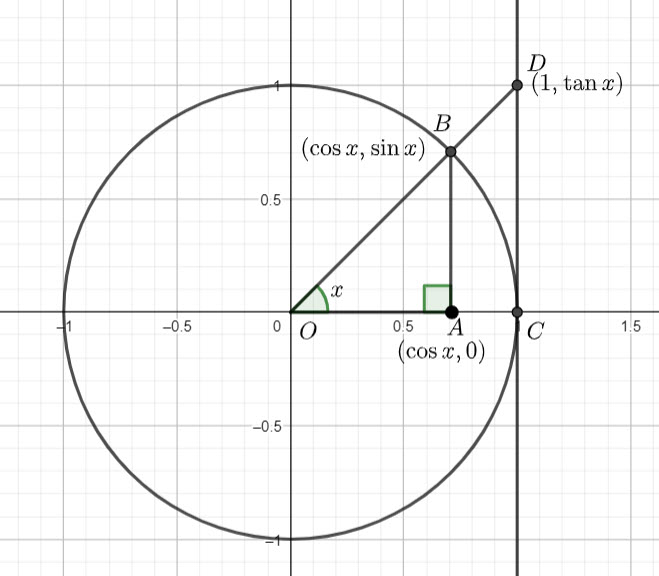
Unit Circle

Remember cos(x)=\frac{OA}{OB}=\frac{OA}{1}, hence OA=cos(x) and the co-ordinate of A is (cos(x), 0).

sin(x)=\frac{AB}{OB}=\frac{AB}{1}, hence AB=sin(x) and the co-ordinate of B is (cos(x), sin(x))

And from the definition of tan(x) we know D is the point (1, tan(x))

Consider the areas of triangle OAB, sector OBC, and triangle OCD.

We know from inspection of the above diagram that

Area OAB< Area OCB<Area OCD

Which means,

\frac{1}{2}b_1 h_1<\frac{1}{2}r^2x<\frac{1}{2}b_2 h_2

We can ignore all of the halves.

cos(x)sin(x)<x<(1)tan(x)

Remember tan(x)=\frac{sin(x)}{cos(x)}

cos(x)sin(x)<x<\frac{sin(x)}{cos(x)}

Divide everything by sin(x) (as we are in the first quadrant we know sin(x)>0, so we don’t need to worry about the inequality)


cos(x)<\frac{x}{sin(x)}<\frac{1}{cos(x)}

Invert everything and change the direction of the inequalities)

\frac{1}{cos(x)}>\frac{sin(x)}{x}>cos(x)

I am going to rewrite it as follows

cos(x)<\frac{sin(x)}{x}<\frac{1}{cos(x)}

because I like to use less thans rather than greater thans.

Now what happens as x tends to 0?

cos(0)=1

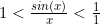
1<\frac{sin(x)}{x}<\frac{1}{1}

Hence by the squeeze theorem \lim\limits_{x \to 0}\frac{sin(x)}{x}=1

Now we know this limit, we are going to use it to find \lim\limits_{x \to 0}\frac{1-cos(x)}{x}

Multiply by \frac{1+cos(x)}{1+cos(x)}

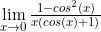
\lim\limits_{x \to 0}\frac{1-cos(x)}{x}\times \frac{1+cos(x)}{1+cos(x)}

\lim\limits_{x \to 0}\frac{1-cos^2(x)}{x(cos(x)+1)}

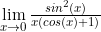
\lim\limits_{x \to 0}\frac{sin^2(x)}{x(cos(x)+1)}

\lim\limits_{x \to 0}\frac{sin(x)}{x}\times sin(x)(cos(x)+1)}

\lim\limits_{x \to 0}\frac{sin(x)}{x}\times \lim\limits_{x \to 0}sin(x)(cos(x)+1)

If we evaluate the limits,

(1)(sin(0)(cos(0)+1)=1\times 0 \times 2=0

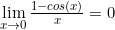
Hence, \lim\limits_{x \to 0}\frac{1-cos(x)}{x}=0

In the next post we are going to use these limits to differentiate sine and cosine functions.

1 Comment

Filed under Area, Area of Triangles (Sine), Calculus, Identities, Trigonometry, Year 12 Mathematical Methods

Interesting Sum

S=\sum_{n=1}^\infty (tan^{-1}(\frac{2}{n^2})), find S.

I came across this sum in An Imaginary Tale by Nahin and I was fascinated.

Let tan(\alpha)=n+1 and tan(\beta)=n-1.

Remember
tan(\alpha-\beta)=\frac{tan(\alpha)-tan(\beta)}{1+tan(\alpha)tan(\beta)}
Hence,
tan(\alpha-\beta)=\frac{(n+1)-(n-1)}{1+(n+1)(n-1)}
tan(\alpha-\beta)=\frac{2}{1+n^2-1}
tan(\alpha-\beta)=\frac{2}{n^2}
Therefore,
\alpha-\beta=tan^{-1}(\frac{2}{n^2})
and
\alpha=tan^{-1}(n+1) and \beta=tan^{-1}(n-1)

tan^{-1}(n+1)-tan^{-1}(n-1)=tan^{-1}(\frac{2}{n^2})

Which means,

    \begin{equation*}S=\sum_{n=1}^\infty(tan^{-1}(n+1)-tan^{-1}(n-1))\end{equation}

Let’s try a few partial sums

S_4=tan^{-1}(2)-tan^{-1}(0)+tan^{-1}(3)-tan^{-1}(1)+tan^{-1}(4)-tan^{-1}(2)+tan^{-1}(5)-tan^{-1}(3)

S_4=-tan^{-1}(0)+-tan^{-1}(1)+tan^{-1}(4)+tan^{-1}(5)

S_6=tan^{-1}(2)-tan^{-1}(0)+tan^{-1}(3)-tan^{-1}(1)+tan^{-1}(4)-tan^{-1}(2)+tan^{-1}(5)-tan^{-1}(3)+tan^{-1}(6)-tan^{-1}(4)+tan^{-1}(7)-tan^{-1}(5)

S_6=-tan^{-1}(0)+-tan^{-1}(1)+tan^{-1}(6)+tan^{-1}(7)

Hence, S_N=-tan^{-1}(0)+-tan^{-1}(1)+tan^{-1}(N)+tan^{-1}(N+1)

S_N=-\frac{\pi}{4}-0+tan^{-1}(N)+tan^{-1}(N+1)

What happens as N\rightarrow \infty ?

\lim\limits_{N\to \infty}\ S_N=-\frac{\pi}{4}+\frac{\pi}{2}+\frac{\pi}{2}=\frac{3\pi}{4}

Because we know tan(\frac{\pi}{2}) is undefined.

1 Comment

Filed under Identities, Interesting Mathematics, Puzzles, Sequences, Trigonometry

Infinite Product Expansion of cos (x)

Remember

(1)   \begin{equation*}cos(x)=1-\frac{1}{2!}x^2+\frac{1}{4!}x^4-\frac{1}{6!}x^6+...\end{equation*}

We know that cos(x)=0 for odd integer multiples of \frac{\pi}{2}, i.e. \frac{\pi}{2}, \frac{3\pi}{2}, ..., which is \frac{(2n-1)\pi}{2} for n\neq 0

Hence,

    \begin{equation*}0=1-\frac{1}{2!}x^2+\frac{1}{4!}x^4-\frac{1}{6!}x^6+...\end{equation}

for x=\frac{(2n-1)\pi}{2}, n>0

We can factorise our cos(x) expansion

    \begin{equation*}(1-\frac{x^2}{r_1})(1-\frac{x^2}{r_2})...\end{equation}

We know r_1=\frac{\pi}{2}, r_2=\frac{3\pi}{2}, ...

    \begin{equation*}cos(x)=(1-\frac{x^2}{(\frac{\pi}{2})^2})(1-\frac{x^2}{(\frac{3\pi}{2})^2})...(1-\frac{x^2}{(\frac{(2n-1)\pi}{2})^2})\end{equation}

    \begin{equation*}cos(x)=\Pi_{n=1}^{\infty}(1-\frac{x^2}{(\frac{(2n-1)\pi}{2})^2})\end{equation}

    \begin{equation*}cos(x)=\Pi_{n=1}^{\infty}(1-\frac{4x^2}{(2n-1)^2\pi^2})\end{equation}

1 Comment

Filed under Factorising, Identities, Infinite Product Expansion, Interesting Mathematics, Polynomials, Trigonometry