Category Archives: Area of Triangles (Sine)

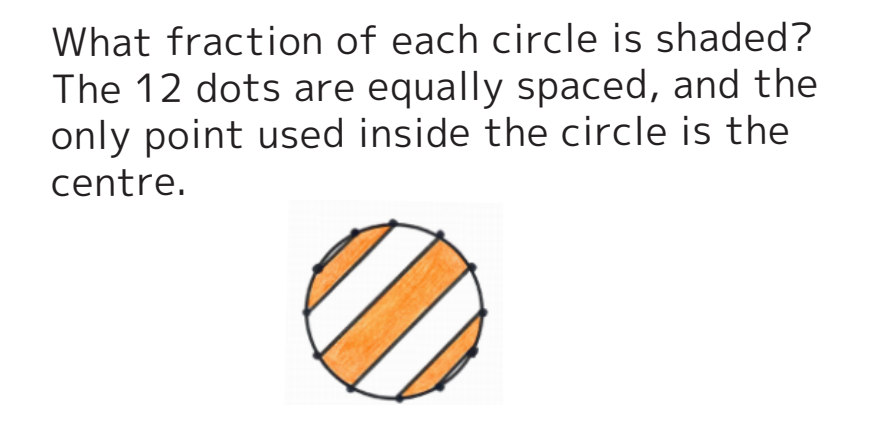
Geometry Puzzle (finding a fraction of an area)

Geometry Puzzles in Felt Tip: A Compilation of puzzles from 2018 – Catriona Shearer

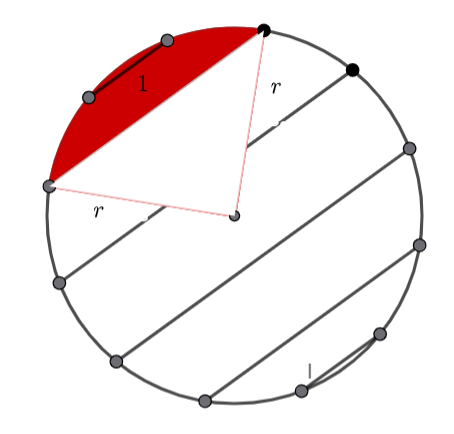
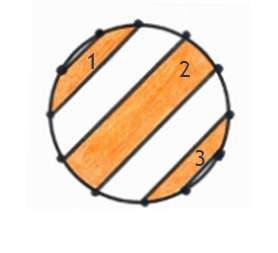
Band 1 and 3 have the same area.

We want to find the area of the shaded segment.

As the dots are equally spaced, the sector’s angle is \frac{\pi}{2} = (\frac{2\pi}{12}\times 3)

Remember the area of a segment is A=\frac{1}{2}r^2(\theta-sin(\theta)) where the angle measurement is in radians.

(1)   \begin{equation*}A=\frac{1}{2}r^2(\frac{\pi}{2}-sin(\frac{\pi}{2}))=\frac{1}{2}r^2(\frac{\pi}{2}-1))=\frac{\pi r^2}{4}-\frac{r^2}{2}\end{equation*}

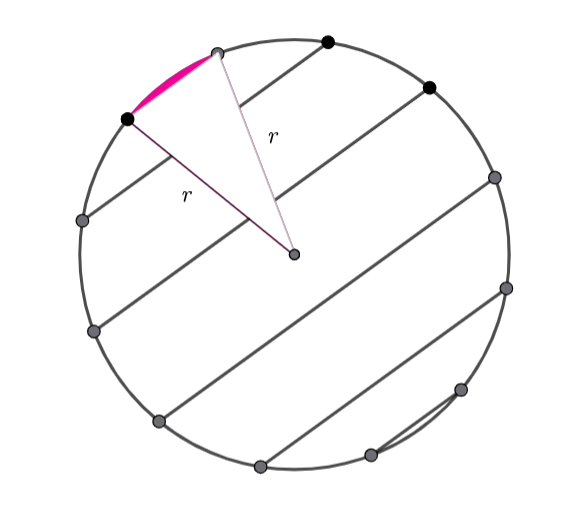
We want to find the area of the shaded segment.

As the dots are equally spaced, the sector’s angle is \frac{2\pi}{12} = (\frac{\pi}{6})

(2)   \begin{equation*}A=\frac{1}{2}r^2(\frac{\pi}{6}-sin(\frac{\pi}{6}))=\frac{\pi r^2}{12}-\frac{r^2}{4}\end{equation*}

The area of band 1 is equation 1 -equation 2.

(3)   \begin{equation*}\frac{\pi r^2}{4}-\frac{r^2}{2}-(\frac{\pi r^2}{12}-\frac{r^2}{4})=\frac{\pi r^2}{6}-\frac{r^2}{4}\end{equation*}

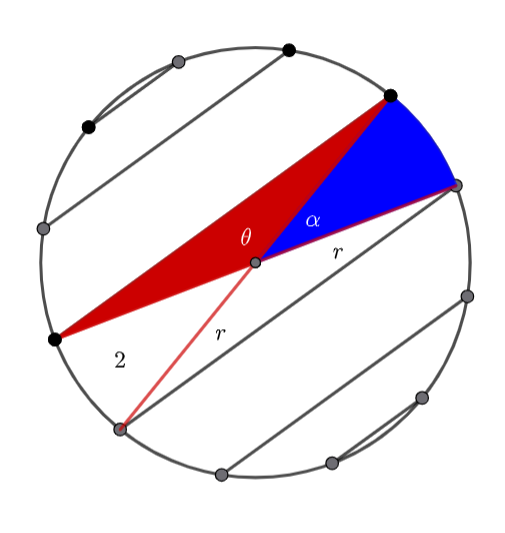
Band 2 consists of two congruent triangles and two congruent sectors.

    \begin{equation*}\theta=\frac{2\pi}{12}\times 5=\frac{5\pi}{6}, \alpha=\frac{\pi}{6}\end{equation}

(4)   \begin{equation*}A=2(\frac{1}{2}r^2sin(\frac{5\pi}{6}))+2(\frac{1}{2}r^2\frac{\pi}{6})=\frac{r^2}{2}+\frac{r^2 \pi}{6}\end{equation*}

Hence the shaded area is 2(\frac{\pi r^2}{6}-\frac{r^2}{4})+\frac{r^2}{2}+\frac{r^2 \pi}{6}=\frac{\pi r^2}{2}

The area of the circle is \pi r^2

Hence the fraction of the shaded area is =\frac{\frac{\pi r^2}{2}}{\pi r^2}=\frac{1}{2}

Leave a Comment

Filed under Area, Area of Triangles (Sine), Finding an area, Geometry, Puzzles, Simplifying fractions

Geometry Problem

Geometry Snacks by Ed Southall and Vincent Pantaloni

I started by trisecting another side of the triangle

This makes it clearer that the two lines are parallel

Which means the two angles labelled above are corresponding and therefore congruent.

Let the side length be x.

The area of the equilateral triangle is

(1)   \begin{equation*}A=\frac{1}{2}x^2 sin(60)=\frac{\sqrt{3}x^2}{4}\end{equation*}

    \begin{equation*}cos(60)=\frac{y}{\frac{2x}{3}}\end{equation}

    \begin{equation*}y=\frac{x}{3}\end{equation}

Area of right triangle

(2)   \begin{equation*}A=(\frac{1}{2})(\frac{2x}{3})(\frac{x}{3})sin(60)=\frac{\sqrt{3}x^2}{18}\end{equation*}

The fraction of the area is

    \begin{equation*}=\frac{\frac{\sqrt{3}x^2}{18}}{\frac{\sqrt{3}x^2}{4}}=\frac{2}{9}\end{equation}

Leave a Comment

Filed under Algebra, Area, Area of Triangles (Sine), Finding an area, Geometry, Puzzles, Right Trigonometry, Simplifying fractions, Trigonometry

Area of Regular Polygons

Finding the area of a regular polygon when you know the side length

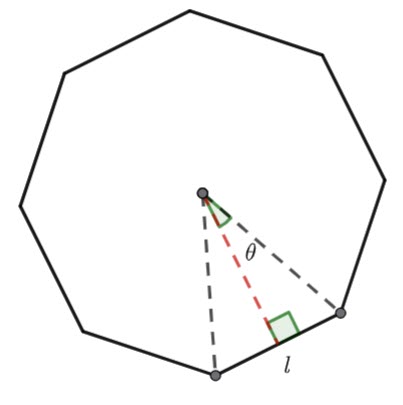
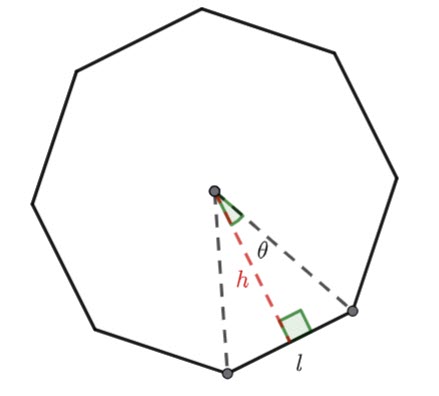
Find the area of an n-sided regular polygon if you know the side length, l.

An octagon for a visual reference

Find the h of the triangle in terms of l and theta.

tan(\theta)=\frac{\frac{l}{2}}{h}

h=\frac{l}{2tan(\theta)}

Remember the area of a triangle is A=\frac{1}{2}bh

Hence, A=\frac{1}{2} l \times \frac{l}{2tan(\theta)}=\frac{l^2}{4tan(\theta)}

And \theta=\frac{360}{2n}=\frac{180}{n}

Therefore A=\frac{l^2}{4tan(\frac{180}{n})}

There are n triangles in an n-sided polygon

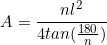
(1)   \begin{equation*}A=\frac{nl^2}{4tan(\frac{180}{n})}\end{equation*}

Find the area of a hexagon with side length 10cm.
A=\frac{6\times10^2}{4tan(\frac{180}{6})}
A=\frac{600}{4(\frac{1}{\sqrt{3}})}
A=150\sqrt{3} cm^2

Finding the area of a polygon if you know the inradius or the apothem

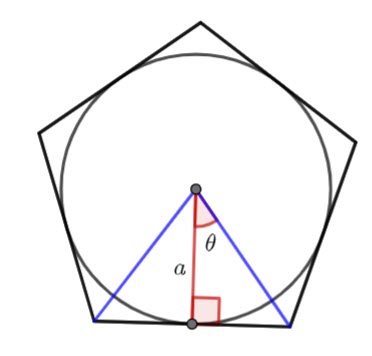
The apothem and the inradius are the same. It is the radius of the incircle.

Find the area of the triangle in terms of a and theta.

tan(\theta)=\frac{\frac{l}{2}}{a}

l=2atan(\theta)

A=\frac{1}{2}bh

A=\frac{1}{2}2atan(\theta)a=a^2tan(\theta)

And \theta=\frac{180}{n}

Hence for an n-sided polygon

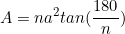
(2)   \begin{equation*}A=na^2tan(\frac{180}{n})\end{equation*}

Find the area of a regular pentagon with apothem 4.5cm
A=5\times 4.5^2tan(\frac{180}{5})
A=73.56cm^2

Finding the area of a regular polygon given the circumradius

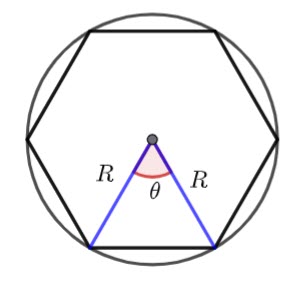
The circumradius is the radius of the circumscribed circle (R in the diagram above)

Remember the area of triangle formula

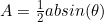
A=\frac{1}{2}absin(\theta)

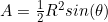
A=\frac{1}{2}R^2sin(\theta)

\theta=\frac{360}{n}

Hence, A=\frac{1}{2}R^2sin(\frac{360}{n})

Hence, for an n-sided polygon

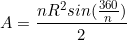
(3)   \begin{equation*}A=\frac{nR^2sin(\frac{360}{n})}{2}\end{equation*}

Find the area of a regular octagon inscribed in a circle of radius 10cm.
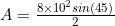
A=\frac{8\times 10^2sin(45)}{2}
A=200\sqrt{2}cm^2

Leave a Comment

Filed under Area, Area of Triangles (Sine), Finding an area, Non-Right Trigonometry, Regular Polygons, Right Trigonometry, Year 11 Mathematical Methods

Trigonometric Limits

\lim\limits_{x \to 0}\frac{sin(x)}{x}=?

Unit Circle

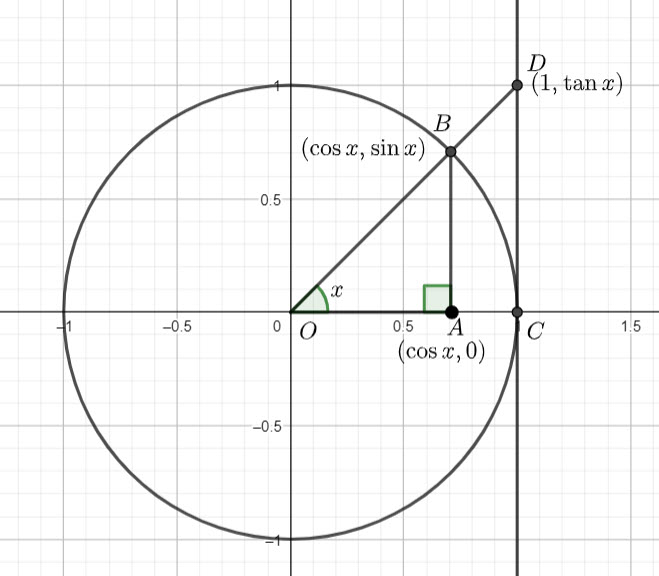
Remember cos(x)=\frac{OA}{OB}=\frac{OA}{1}, hence OA=cos(x) and the co-ordinate of A is (cos(x), 0).

sin(x)=\frac{AB}{OB}=\frac{AB}{1}, hence AB=sin(x) and the co-ordinate of B is (cos(x), sin(x))

And from the definition of tan(x) we know D is the point (1, tan(x))

Consider the areas of triangle OAB, sector OBC, and triangle OCD.

We know from inspection of the above diagram that

Area OAB< Area OCB<Area OCD

Which means,

\frac{1}{2}b_1 h_1<\frac{1}{2}r^2x<\frac{1}{2}b_2 h_2

We can ignore all of the halves.

cos(x)sin(x)<x<(1)tan(x)

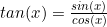
Remember tan(x)=\frac{sin(x)}{cos(x)}

cos(x)sin(x)<x<\frac{sin(x)}{cos(x)}

Divide everything by sin(x) (as we are in the first quadrant we know sin(x)>0, so we don’t need to worry about the inequality)


cos(x)<\frac{x}{sin(x)}<\frac{1}{cos(x)}

Invert everything and change the direction of the inequalities)

\frac{1}{cos(x)}>\frac{sin(x)}{x}>cos(x)

I am going to rewrite it as follows

cos(x)<\frac{sin(x)}{x}<\frac{1}{cos(x)}

because I like to use less thans rather than greater thans.

Now what happens as x tends to 0?

cos(0)=1

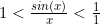
1<\frac{sin(x)}{x}<\frac{1}{1}

Hence by the squeeze theorem \lim\limits_{x \to 0}\frac{sin(x)}{x}=1

Now we know this limit, we are going to use it to find \lim\limits_{x \to 0}\frac{1-cos(x)}{x}

Multiply by \frac{1+cos(x)}{1+cos(x)}

\lim\limits_{x \to 0}\frac{1-cos(x)}{x}\times \frac{1+cos(x)}{1+cos(x)}

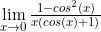
\lim\limits_{x \to 0}\frac{1-cos^2(x)}{x(cos(x)+1)}

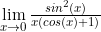
\lim\limits_{x \to 0}\frac{sin^2(x)}{x(cos(x)+1)}

\lim\limits_{x \to 0}\frac{sin(x)}{x}\times sin(x)(cos(x)+1)}

\lim\limits_{x \to 0}\frac{sin(x)}{x}\times \lim\limits_{x \to 0}sin(x)(cos(x)+1)

If we evaluate the limits,

(1)(sin(0)(cos(0)+1)=1\times 0 \times 2=0

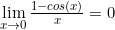
Hence, \lim\limits_{x \to 0}\frac{1-cos(x)}{x}=0

In the next post we are going to use these limits to differentiate sine and cosine functions.

1 Comment

Filed under Area, Area of Triangles (Sine), Calculus, Identities, Trigonometry, Year 12 Mathematical Methods

Three Circles – Area Problem

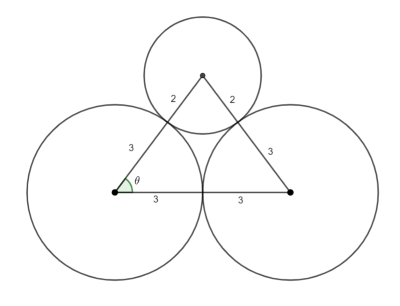
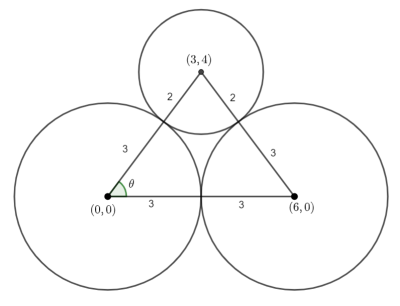
This is question 5 from the UK Maths Trust Senior Challenge October 2023.

I have tackled this in three ways; using non-right trig to find the area, Heron’s Law, and the Shoelace Formula.

Method 1

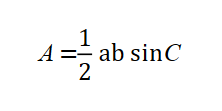
Use the area of a triangle formula

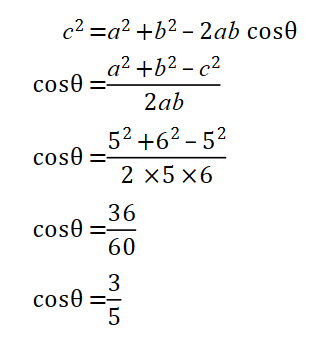
Use the cosine rule to find cosθ.

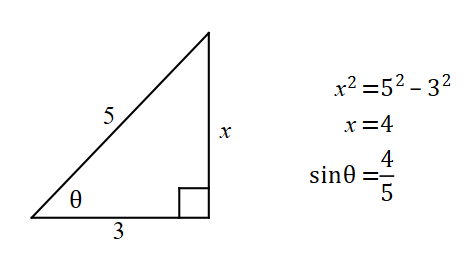
Once we have cosθ, we can find sinθ.

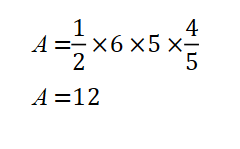
Hence the area is,

Method 2

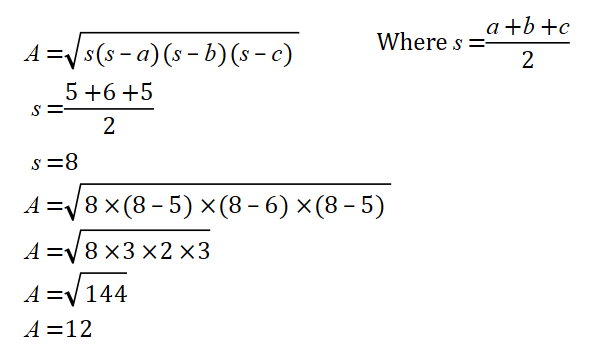
Use Heron’s law.

Heron’s law is a way of calculating area of a triangle from the lengths of the three sides of the triangle.

This is my preferred method – simple and direct.

Method 3

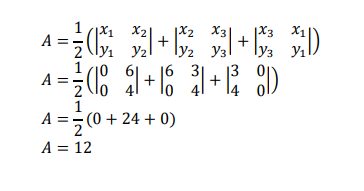
Shoelace formula (Gauss’s Area formula)

We need to allocate each of the vertices a co-ordinate.

The co-ordinates are listed in an anti-clockwise direction.

This is probably a bit over the top, but once you get the hang of it, it’s very easy.

Leave a Comment

Filed under Area, Area of Triangles (Sine), Heron's Law, Non-Right Trigonometry, Shoelace Forumla, Trigonometry